Modern life often demands a level of composure that far exceeds the support we give our nervous systems. Natural remedies, when chosen with discernment and used with intention, can offer a quiet but powerful counterbalance—a way of tending to the mind with the same care we devote to our careers, relationships, and surroundings. This is not about quick fixes or hazy folklore. It is about cultivating a refined, evidence-informed relationship with botanicals, nutrients, and sensory rituals that elevate calm from a concept to a lived, daily experience.
Below are five exclusive insights—less about trends, more about nuanced, sustainable practice—for those who approach mental wellness as both an art and a standard of living.
Insight 1: Treat Herbal Remedies Like Fine Tailoring, Not One-Size-Fits-All
Most discussions of calming herbs stop at a familiar list: chamomile, lavender, maybe valerian. A more sophisticated approach considers constitution—your unique combination of temperament, lifestyle, and physiological tendencies.
For example, a high-performing, mentally restless person who runs “hot” (easily overstimulated, prone to tension headaches and irritability) may respond differently to herbs than someone who feels persistently drained, cold, and foggy. Adaptogens—plants that help the body adapt to stress—illustrate this well:
- Ashwagandha (Withania somnifera) tends to soothe a wired, anxious system and support sleep, but can feel heavy for someone already sluggish.
- Rhodiola rosea is more uplifting and stimulating, useful for fatigue and low mood, yet not always ideal for people already “keyed up.”
- Tulsi / Holy basil (Ocimum tenuiflorum) offers gentle clarity and calm focus, often well-tolerated even in those who find stimulants too harsh.
A refined practice begins with a brief self-audit: Are you wired or tired? Scattered or numb? Anxious or simply overloaded? Then, herbal choices become more deliberate—targeted extracts in capsule or tincture form, or carefully layered teas timed to your day (for example, tulsi in the morning, ashwagandha in the evening). Always consider medication interactions and underlying health conditions; the elegance of this approach lies in personalization, not in indiscriminate use.
Insight 2: The “Micro-Dose” Mindset—Small Sensory Interventions, Big Emotional Dividends
Not all natural remedies require commitment to a full protocol. Subtle, well-chosen “micro-doses” of sensory experience—especially through scent and temperature—can shift the nervous system in under a minute.
High-quality essential oils, used sparingly and safely, act almost like emotional punctuation throughout the day:
- Bergamot: Enhances a sense of lightness and reduces perceived tension; a single inhalation before a demanding call can change its emotional tone.
- Lavender: Well-studied for its calming effects, particularly when inhaled or applied in a diluted roll-on before bed or during late-evening screen work.
- Neroli or rose: Less discussed but exquisitely effective for softening emotional overload, grief, or pressure that feels lodged in the chest.
A sophisticated practice is to create a personal olfactory signature for calm: one scent reserved specifically for decompression (never used during work), so your brain begins to associate it exclusively with safety and down-regulation. Over time, a single inhalation becomes a shorthand for “we are off-duty now.”
This principle extends to temperature rituals: a cool compress across the eyes in the late afternoon, a warm foot soak with magnesium salts in the evening, or alternating warm–cool water over the wrists for 30 seconds before a meeting. These are micro-interventions—minimal time, maximal nervous system impact—woven seamlessly into an already full life.
Insight 3: Mineral Quietude—Magnesium and the Architecture of Calm
Herbs often receive the spotlight, yet a significant amount of mental agitation is quietly amplified by suboptimal mineral status, particularly magnesium. This mineral helps regulate neurotransmitters, modulates stress hormones, and participates in hundreds of enzymatic reactions. When intake is insufficient, the nervous system can feel more brittle—more reactive to everyday stressors.
A refined approach to magnesium is not simply “take a supplement” but choosing form and timing with intention:
- Magnesium glycinate: Gentle, often preferred for those with anxiety or muscle tension; typically well-tolerated for evening use.
- Magnesium threonate: Has emerging evidence for crossing the blood-brain barrier more effectively; considered by some practitioners for cognitive support and mental clarity.
- Topical magnesium (magnesium chloride or sulfate baths): Ideal for those with sensitive digestion or who favor a more spa-like ritual—an evening bath becomes both sensory luxury and mineral therapy.
Pair magnesium with a slowing of the evening environment: reduced overhead lighting, a single scented candle, perhaps soft instrumental music. The synergy of mineral support plus environmental cues deepens the experience from “supplement routine” to a nightly ritual of decompression that conditions the nervous system to anticipate rest.
As always, doses should be chosen conservatively at first, in consultation with a healthcare professional if you have kidney issues, heart conditions, or are on medications.
Insight 4: The Quiet Luxury of Tea Ceremonies for Mental Clarity
Tea can be more than hydration or habit; it can be a structured, daily ceremony that trains the mind to move from urgency to clarity. Elegance, in this context, lies in deliberateness: the choice of tea, the vessel, the setting, and the intention behind each cup.
For mental wellness, consider a “two-tea architecture” to your day:
Morning or late-morning: Clarity without aggression
- Green tea (sencha, gyokuro, or high-quality loose leaf) provides a refined balance of caffeine and L-theanine, an amino acid linked to calm, focused alertness. - The ritual: use a dedicated cup, pour slowly, inhale deeply before sipping. This is not background coffee; it is a brief, three-minute investment in directed focus.
Evening: Descent into restoration
- Lemon balm, passionflower, or a rose–chamomile blend can soften cognitive overdrive without forcing sedation. - The ritual: a consistent time window (for example, 9:30–9:45 PM), screens out of sight, one single warm light source, perhaps a notebook beside you to capture lingering thoughts before bed.
The sophistication of this approach is not only in the botanicals but in the repetition: by associating specific tea profiles with distinct mental states (clarity vs. release), you create predictable anchors in your day. Over time, the simple act of bringing cup to lips becomes an embodied suggestion to the mind: “Now, we focus.” “Now, we let go.”
Insight 5: Designing an “Emotional Apothecary Shelf” at Home
One of the most powerful, underappreciated natural remedies is visibility. What you can see, you are more likely to use—and in moments of distress, the mind reaches more easily for what is physically present and aesthetically inviting.
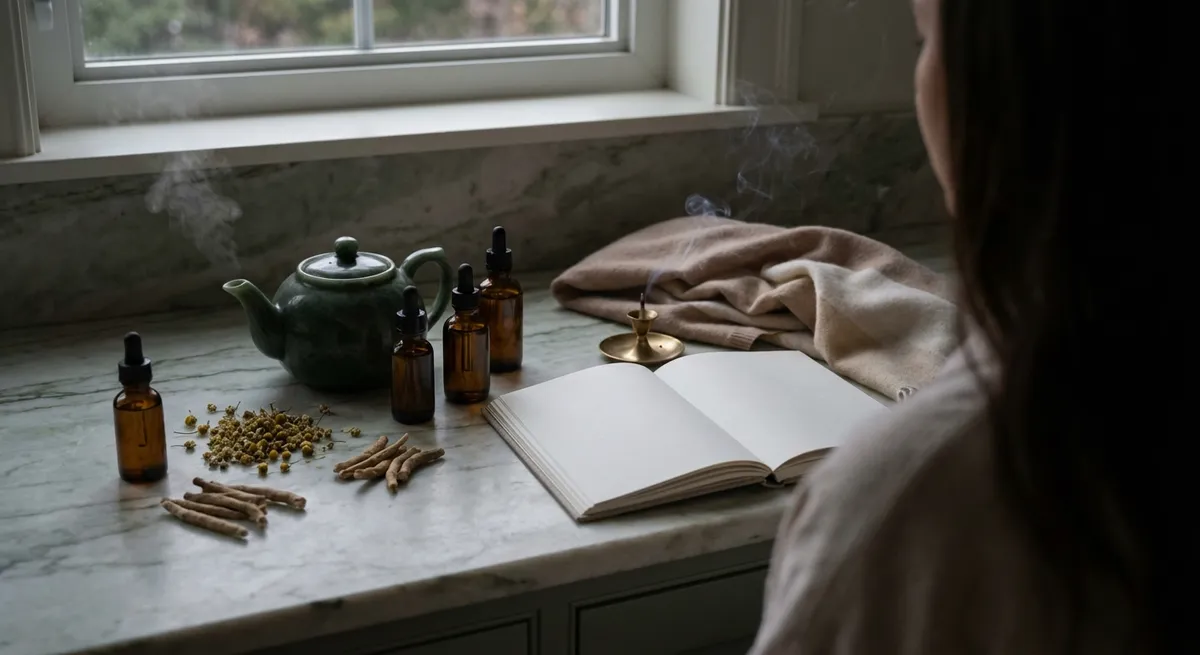
Instead of scattering remedies in drawers, consider curating an emotional apothecary shelf—a dedicated, visually harmonious space where your calm-supportive tools live together:
- A small selection of tinctures (such as lemon balm, tulsi, or a nervous-system blend) in amber glass, with labels you actually enjoy reading.
- One or two essential oils, with a ceramic dish or inhaler, rather than loose bottles rolling in a bag.
- Beautifully packaged herbal teas in canisters or glass jars, clearly visible to the eye.
- A notebook and pen for cognitive decluttering, and perhaps a slim volume of poetry or essays that reliably re-orient your mood.
- A small timer or hourglass to mark five or ten minutes of intentional restoration—tea, breath, or stillness.
The insight here is psychological as much as botanical: we are far more likely to engage with supportive practices when they feel aesthetically congruent with the life we are building. Natural remedies cease to be “extras” and become part of the visual and emotional architecture of the home—an ongoing, quiet invitation to recalibrate.
Curating this shelf is an act of self-definition: you are declaring, in physical form, that your calm is not negotiable but designed for, planned for, and visibly prioritized.
Conclusion
Natural remedies, at their most refined, are not about escaping reality; they are about inhabiting it with greater poise. When you treat botanicals and minerals as tailored tools rather than generic fixes, when you orchestrate micro-sensory rituals, when you elevate tea to ceremony and your shelves to sanctuary, you move from coping to curating.
The calm mind is not a stroke of luck. It is the result of layered, intentional choices—each small, each quiet, but together forming a deeply resilient inner landscape. Let your approach to natural remedies reflect the standard you hold for the rest of your life: thoughtful, discerning, and quietly exquisite.
Sources
- [National Center for Complementary and Integrative Health (NCCIH) – Herbs at a Glance](https://www.nccih.nih.gov/health/herbs-at-a-glance) - Evidence-based overviews of commonly used herbs such as ashwagandha, lemon balm, and others referenced here
- [Mayo Clinic – Magnesium: Why You Need It](https://www.mayoclinic.org/healthy-lifestyle/nutrition-and-healthy-eating/expert-answers/magnesium-supplements/faq-20058105) - Discusses magnesium’s roles in the body, forms of supplementation, and safety considerations
- [Harvard Health Publishing – Stress, Anxiety, and L-theanine in Tea](https://www.health.harvard.edu/mind-and-mood/can-green-tea-and-l-theanine-help-you-relax) - Explores how green tea and L-theanine support relaxation and focused alertness
- [Cleveland Clinic – Essential Oils and Aromatherapy](https://health.clevelandclinic.org/essential-oils-101-do-they-work-how-do-you-use-them) - Reviews benefits and safe use of essential oils like lavender and bergamot
- [National Institutes of Health (NIH) – Rhodiola rosea Monograph (PubMed)](https://www.ncbi.nlm.nih.gov/pmc/articles/PMC3991026/) - Summarizes research on rhodiola’s effects on stress, fatigue, and mental performance
Key Takeaway
The most important thing to remember from this article is that this information can change how you think about Natural Remedies.