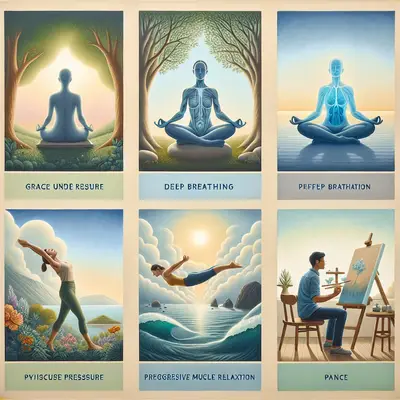
Stress is no longer a passing inconvenience; for many, it has become the ambient soundtrack of modern life. Yet there is a quiet art to meeting pressure without becoming consumed by it—a way of moving through demands with grace rather than strain. This is not about escaping reality, but about refining the way we experience it. In a world that rewards constant output, cultivating “stress elegance” becomes a discreet form of luxury: an internal standard that refuses to let urgency dictate one’s inner climate.
Below are five exclusive, nuanced insights for those who treat mental wellness not as an afterthought, but as a deliberate, ongoing refinement.
1. Reframing Stress as a Fine-Tuned Signal, Not an Enemy
Most people experience stress as an adversary: something to battle, suppress, or numb. A more sophisticated approach is to treat it as precise feedback from an intelligent system—your own.
Physiologically, stress is a coordinated response: your heart rate shifts, cortisol rises, attention narrows. Instead of immediately resisting these sensations, observe them with the same curiosity you might bring to tasting a complex wine or appreciating a layered fragrance. Where is the tension located? What, exactly, triggered it? What very specific need is your system attempting to communicate?
This reframing transforms stress from a vague, looming cloud into a finely detailed message. Perhaps your boundaries have been overstepped, your workload has drifted past sustainable limits, or your nervous system is asking for replenishment (sleep, nourishment, movement, or meaningful human contact). When stress is treated as an exquisitely tuned sensor rather than a defect, your response becomes more discerning: you adjust conditions, not just your mood.
Over time, this cultivated attention creates a form of inner sophistication: you no longer wait for overwhelm to crash in. You notice the early, subtle notes of strain and intervene with precision.
2. Curating Micro-Transitions to Protect Your Mental Atmosphere
Most stress is not only about what we do, but how abruptly we move between roles, environments, and demands. The executive who leaves a high-stakes call and immediately opens email, the parent who ends a draining day and instantly scrolls social media—each transition, unexamined, compounds tension.
Refined stress relief lies in carefully curating your “micro-transitions”: the brief, intentional pockets of recalibration between activities. Think of them as the soft lighting between scenes in a beautifully produced performance.
These transitions need not be long to be effective:
- One minute of deliberate, slower breathing before entering a meeting
- A short walk down the hallway after a difficult conversation, with your attention placed deliberately on physical sensations—footsteps, air temperature, posture
- A ritual object at your desk—a pen, a piece of stone, a textile—that you touch or reposition as a cue to reset your nervous system
- A practice of closing your eyes for three breaths before shifting from work mode to personal life
By inserting these slender bridges between demands, you protect your mental atmosphere from becoming a single, uninterrupted stream of urgency. The day no longer feels like a blur; it becomes a sequence of distinct chapters, each introduced with intention. This is stress relief not as escape, but as design.
3. Designing a Personal “Sensory Baseline” for Rapid Recovery
Many people try generic stress-management techniques and feel underwhelmed. The reason is simple: their nervous system has a unique sensory language, and they are applying methods that don’t speak it fluently.
A “sensory baseline” is your deeply individual set of inputs—sounds, temperatures, textures, movements, scents—that reliably bring your system back toward equilibrium. Discovering it is a subtle, experimental process.
Consider observing your responses across several dimensions:
- Sound: Do you unwind faster with near-silence, low-frequency ambient music, white noise, or nature sounds like rain or ocean?
- Light: Are you soothed by warm, dim lighting, or do you need natural daylight to feel truly at ease?
- Temperature and weight: Does your nervous system respond better to a cooler room with a heavy blanket, or a warmer environment with light fabrics?
- Movement: Do you decompress with stillness, or does your body settle only after walking, stretching, or slow, deliberate exercise?
- Scent and texture: Are there particular aromas or tactile experiences that instantly make you feel more grounded?
Once identified, this baseline becomes a precision tool. Instead of vaguely “trying to relax,” you assemble your personal sensory signature: a certain playlist, a specific corner of your home, a textile you keep within reach, a simple movement sequence that resets your body. Over time, your nervous system begins to associate this constellation of cues with safety and recovery, allowing you to decompress more quickly—even in relatively short windows of time.
4. Practicing “Selective Engagement” as a High-Level Stress Filter
Modern life floods us with invitations—notifications, messages, conversations, causes, news alerts. Much of our stress comes not only from what we must do, but from everything we agree to mentally carry.
Selective engagement is the disciplined choice to invest your attention only where it has meaningful leverage, and to graciously release what is merely agitating without being actionable. It is not indifference; it is intentional conservation of cognitive and emotional resources.
This can be applied with quiet rigor:
- Limiting your exposure to news to a specific time window and a small number of trusted sources
- Declining to participate in conversations that are purely speculative, outrage-driven, or chronically repetitive
- Establishing policies for yourself—such as no email refresh after a certain evening hour, or no immediate response obligation to non-urgent messages
- Recognizing when you are mentally “holding” a situation you cannot influence, and deliberately setting it down, sometimes with a simple phrase: “Not mine to carry right now.”
In refined practice, selective engagement is not harsh; it is elegantly boundaried. You become more available to what truly matters because you are no longer hostage to everything that merely arrives. Stress diminishes not because the world is calmer, but because your participation is curated.
5. Elevating Recovery to the Same Status as Performance
Stress often becomes chronic not because of the intensity of our efforts, but because of the neglect of our recovery. High performers frequently treat rest as a reward for productivity rather than as a non-negotiable partner to it.
A more sophisticated standard places recovery on equal footing with output: they are two halves of the same equation. Sleep, nourishing food, quality hydration, mental downtime, and genuine leisure are recast as strategic infrastructure—essential to clarity, creativity, and emotional balance.
To elevate recovery in tangible ways:
- Schedule restoration the way you schedule important meetings, and protect it with similar resolve
- View high-quality sleep as a premium investment: a carefully constructed ritual, not a leftover hour
- Notice the difference between true leisure (activities that restore you) and passive distraction (activities that occupy you but leave you depleted)
- Build in at least one weekly practice that has no agenda beyond enjoyment—reading purely for pleasure, a slow walk without metrics, a conversation with a person who makes you feel more yourself
When recovery is honored, stress loses its chronic edge. Surges of pressure become periods you can move through and rebound from, rather than a permanent way of being. This shift—treating your nervous system as an asset to be maintained, not a tool to be exhausted—is one of the most understated forms of personal luxury.
Conclusion
Stress will not disappear from modern life, nor should it; it is part of what signals meaning, commitment, and care. The refinement lies in how we meet it: as something to be numbed, or as an intricate phenomenon to be understood and skillfully managed.
By treating stress as a precise signal, curating your transitions, discovering your personal sensory baseline, practicing selective engagement, and elevating recovery to the same status as performance, you begin to inhabit a different relationship with pressure. You are no longer simply coping; you are composing. In that quiet composure, stress relief becomes less about escape and more about a sustained, cultivated elegance of mind.
Sources
- American Psychological Association – Stress: The Different Kinds of Stress – Overview of how stress functions in the body and mind, and distinctions between types of stress
- National Institute of Mental Health – 5 Things You Should Know About Stress – Evidence-based information on causes, symptoms, and management of stress
- Harvard Health Publishing – Understanding the Stress Response – Detailed explanation of the biology of stress and its impact on health
- Mayo Clinic – Chronic Stress Puts Your Health at Risk – Discussion of chronic stress and the importance of healthy coping strategies
- Cleveland Clinic – Relaxation Techniques for Health – Practical guidance on evidence-supported techniques to restore the nervous system and manage stress
Key Takeaway
The most important thing to remember from this article is that this information can change how you think about Stress Relief.