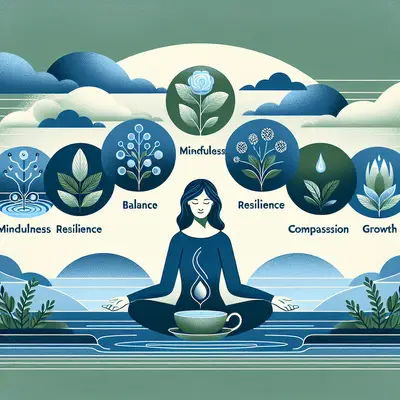
Mental wellness is no longer a side note in an overfull life; it is the quiet architecture beneath everything we care about. For the discerning mind, true calm is not accidental—it is curated, refined, and maintained with the same attention one might bring to an exquisite wardrobe or a thoughtfully designed home. This is not about perfection or relentless productivity. It is about an elevated standard of inner life, where mental clarity, emotional steadiness, and subtle rituals form a private, enduring luxury.
Below are five exclusive, quietly transformative insights—less about quick fixes, more about a considered, long-term relationship with your own mind.
The Refinement of Mental Boundaries
Emotional overwhelm is rarely caused only by “too much to do.” More often, it is the result of blurred boundaries: constantly accessible, perpetually responsive, subtly on display. The refined mind treats boundaries not as walls, but as frames—defining what belongs inside one’s attention and what remains politely outside.
Begin by treating your attention as a premium resource. Before saying yes, ask: Does this deserve my inner space, not just my time? This small distinction prevents your mind from becoming a public thoroughfare for others’ urgency. Digital boundaries are particularly crucial: disabling nonessential notifications, designating specific windows for email or messages, and reserving the first and last 30 minutes of your day as “quiet hours” establishes a protective perimeter for your nervous system.
Equally important is emotional boundary-setting in relationships. You can acknowledge someone’s distress without absorbing it. Phrases like “I hear how difficult this is for you” allow for empathy while keeping your own equilibrium intact. Over time, this refined approach to boundaries cultivates a sense of inner spaciousness—your mind becomes less reactive, more selective, and markedly more serene.
Curated Inputs: Designing a Mentally Luxurious Inner World
Most people curate what they wear or eat with care, yet allow their mental inputs to be entirely accidental. For a mind that feels both calm and sharp, what you consume psychologically matters as much as what you consume nutritionally.
Think in terms of a “mental aesthetic.” What textures, tones, and ideas feel nourishing to you? Long-form essays instead of frantic headlines. Classical or ambient music instead of random background noise. Visually restful spaces instead of cluttered screens. When you begin to treat information and sensory stimuli as a curated collection rather than a constant stream, your nervous system responds with noticeable relief.
This does not mean withdrawing from reality; it means refusing to let low-quality inputs set the tone of your inner life. Create deliberate rituals for high-quality intake: one carefully chosen article with your morning tea, a single podcast episode that genuinely enriches your thinking, an evening spent with a beautiful book instead of an endless scroll. Over time, the cumulative effect is profound—your mind becomes more discerning, less easily agitated, and more capable of sustained, elegant focus.
The Precision of Micro-Recovery
Modern self-care is often framed as a weekend escape, a spa day, or an annual retreat. Refined mental wellness, however, is built on micro-recovery—brief, precise intervals of restoration woven seamlessly into ordinary days.
Micro-recovery respects that the nervous system does not reset in grand gestures but in consistent, small recalibrations. One minute of slow, intentional breathing between meetings. A 90-second pause to feel your feet grounded on the floor before a difficult conversation. A two-minute gaze out a window to rest your eyes and broaden your visual field after an hour of concentrated screen time.
These practices signal safety to the body and quiet to the mind, without requiring dramatic schedule changes. Consider them “breath commas” in the long sentence of your day—small pauses that prevent mental run-on chaos. When practiced consistently, micro-recovery steadily lowers your baseline stress, so that challenges feel more navigable and less invasive. Over weeks and months, this precision of care becomes a powerful, almost invisible form of resilience.
Emotional Literacy as a Quiet Form of Power
In refined spaces, language is rarely accidental. The same should hold true for how we describe our internal states. Emotional literacy—the ability to accurately name and differentiate what you feel—is an understated but formidable asset in mental wellness.
Instead of defaulting to “stressed” or “tired,” experiment with precision: am I overstimulated, disappointed, mentally fatigued, socially drained, or quietly anxious? This nuanced vocabulary is not indulgence; it is data. Each specific word suggests a different response. Mental fatigue may call for a brief cognitive break, while social depletion may be better addressed by solitude rather than sleep.
Keeping a discreet feeling log for a week—simply recording, a few times a day, “I feel [specific emotion] because…”—can reveal patterns in triggers, environments, and relationships. Over time, you begin to anticipate your own emotional weather instead of being surprised by it. This cultivated awareness supports better decisions: which invitations to decline, when to leave an event, how to prepare for known stressors. Emotional literacy becomes a quiet form of power: you are no longer at the mercy of vague discomfort, but in conversation with your inner life.
Ritualizing Transitions: Elevating the In-Between
Most mental strain accumulates not in major life events, but in the friction between them: shifting from work to home, from social mode to solitude, from online to offline. Without intentional transitions, the mind drags the residue of one context into the next, creating a sense of perpetual unfinishedness.
Rituals of transition, when approached with subtlety and care, act as elegant hinges between parts of your day. They need not be elaborate. Closing your laptop with both hands and taking three slow breaths before leaving your workspace. Changing your clothing when you return home to signal a different version of yourself. Playing the same calming track for five minutes at the end of the day to invite your nervous system into a softer state.
These rituals function like a well-composed coda at the end of a musical piece—acknowledging what has just occurred, then gently releasing it. When practiced deliberately, they prevent emotional carryover: work stress doesn’t flood into evening conversations; social overstimulation doesn’t invade your sleep. The result is a life that feels more segmented in the best possible way—each part contained, honored, and then gracefully concluded.
Conclusion
Mental wellness, at its most elevated, is not a performance and not a trend. It is the private craftsmanship of your inner life—how you frame your boundaries, curate your inputs, honor your need for recovery, refine your emotional language, and shape the transitions that hold your days together.
These practices do not demand drama. They ask for discernment. Over time, that discernment becomes a subtle signature: a steadier presence, a clearer mind, and a quieter confidence that you are not merely enduring your life, but composing it—one considered mental choice at a time.
Sources
- National Institute of Mental Health – Caring for Your Mental Health – Overview of evidence-based strategies and concepts related to maintaining mental wellness
- American Psychological Association – Stress Effects on the Body – Explains how chronic stress impacts the nervous system and why recovery practices matter
- Harvard Health Publishing – Why We All Need to Practice Emotional First Aid – Discusses emotional awareness and the importance of timely, intentional emotional care
- Centers for Disease Control and Prevention – Mental Health Basics – Provides foundational information on mental health, stress, and protective habits
- Greater Good Science Center (UC Berkeley) – The Science of Microbreaks – Reviews research on brief breaks and their effect on mental energy and well-being
Key Takeaway
The most important thing to remember from this article is that this information can change how you think about Mental Wellness.