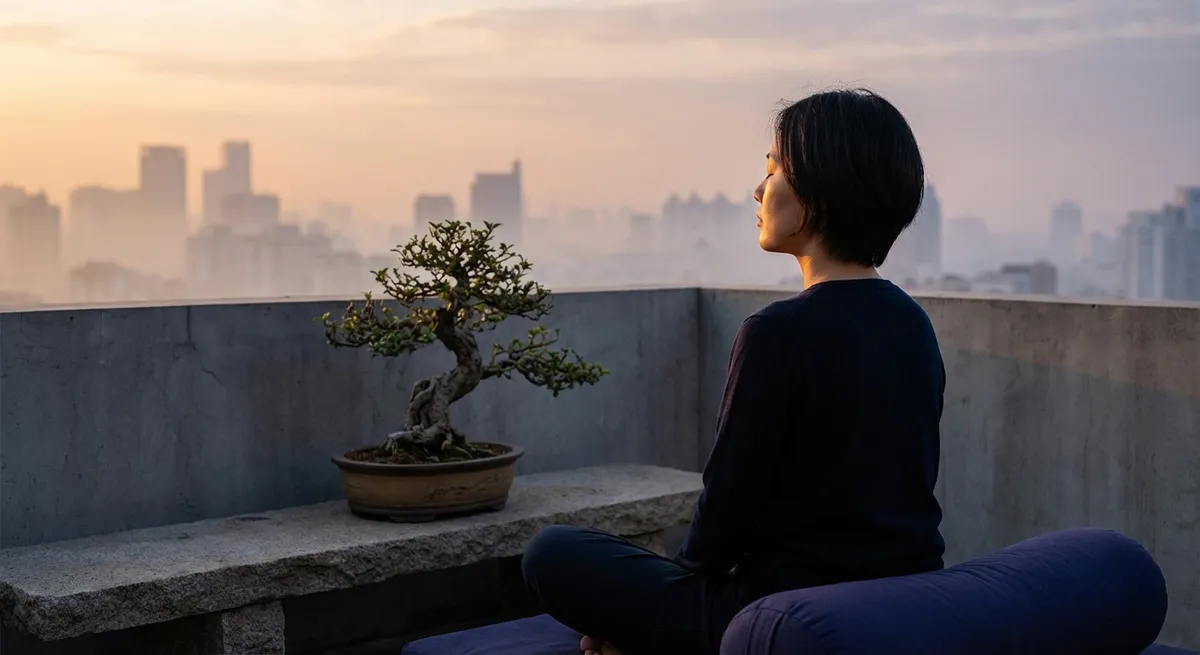
Meditation is often framed as an escape from life. In reality, practiced with discernment, it becomes a way of inhabiting life more fully—more lucidly, more elegantly. For a mind accustomed to high demands and constant input, meditation offers not a retreat, but a recalibration: a daily ritual of quiet power that refines how you think, choose, and respond.
Below are five exclusive, elevated insights into meditation—less about “how to sit” and more about how to weave this discipline into a life that already values quality, intentionality, and subtle excellence.
Meditation as Cognitive Couture, Not Generic Wellness
Most wellness advice treats meditation as a one-size-fits-all prescription: “10 minutes a day” and you’re done. A discerning mind, however, benefits more from a tailored approach than a mass-produced routine.
Meditation can be curated the way you would refine a personal wardrobe. Some days require the clarity of a simple breath practice; others call for a more layered experience, such as body scanning or compassionate awareness. Treat your practice as cognitive couture—selecting textures (techniques), colors (moods), and fits (durations) that align with your current mental landscape and long-term aspirations.
Approach this curation with experimentation but not chaos. For one week, commit to a single style—such as breath-focused meditation—and observe its effects with clinical curiosity. The next week, shift to open-awareness (noticing thoughts and sensations without directing them) and note the contrast. Over time, you’re not just “doing meditation”; you’re designing a personal mental atelier, where different practices are deliberately chosen for specific psychological outcomes: sharper focus, softened reactivity, deeper emotional range.
Rather than chasing novelty, savor refinement. Let your meditation practice evolve like a well-edited collection: fewer pieces, better chosen, deeply understood.
The Subtle Physics of Posture: Architecture for the Inner World
For many, posture is an afterthought—a fleeting instruction at the start of a guided session. For a more meticulous approach, posture becomes the architecture of your inner world, influencing both the depth and quality of your meditation.
An aligned, dignified posture does more than look composed; it subtly signals to your nervous system that you are safe, attentive, and available to the present moment. Research suggests that posture can influence mood, perceived energy, and even cognitive performance. Sitting with a gently lengthened spine, relaxed shoulders, and grounded hips creates a subtle but powerful internal message: “I am steady. I am here. I am capable of meeting what arises.”
Think of three anchor points:
- Base: Hips and legs grounded—on a cushion, chair, or bench. This is your foundation, conveying stability.
- Axis: Spine rising effortlessly, as if lightly suspended from above. This organizes your attention.
- Crown: Chin slightly tucked, jaw relaxed, gaze soft or eyes closed. This refines your mental tone, shifting you from vigilance to awareness.
Treat posture as a ritual of respect—for your mind, your time, and the quality of attention you’re about to cultivate. It doesn’t need to be dramatic; it does need to be deliberate. Over time, your body will learn that this configuration is synonymous with clarity. That association becomes its own quiet luxury.
Temporal Minimalism: Short, Precise, and Intentionally Placed
The modern narrative insists that you must carve out long stretches of time to “properly” meditate. In a sophisticated life where attention is your most precious currency, a more nuanced model is temporal minimalism: shorter, highly intentional sessions placed at psychologically strategic moments.
Consider meditation as a series of precise interventions rather than a single, monolithic event. Three to eight minutes before key transitions can fundamentally reshape the tone of your day:
- Before your first digital interaction in the morning
- As a palate cleanser between demanding tasks or meetings
- As an evening decompression, separating your inner life from the day’s demands
These micro-sessions are not lesser; they are distilled. Their effectiveness often lies in their predictability: your mind learns that these brief intervals are non-negotiable pauses where it can reset. Over time, the consistency of these small commitments can yield more impact than sporadic, longer sessions loaded with expectation and frustration.
Think of it as the difference between occasional grand gestures and a series of impeccably timed, understated refinements. Temporal minimalism values continuity over performance.
Precision Calm: Training the Mind for High-Stakes Clarity
For those navigating high-responsibility environments, meditation is most valuable not as generic relaxation, but as training for precise calm during high-stakes moments. This is less about feeling “zen” and more about exerting elegant control amid complexity.
A refined approach is to deliberately bring a single, mildly stressful thought or scenario into consciousness during meditation—then practice meeting it with composed awareness. You are not ruminating; you are rehearsing your response. Observe the body’s micro-reactions: tightening in the chest, subtle jaw clenching, breath shortening. Then, gently lengthen your exhale, relax muscular tension, and soften your focus while the thought remains present.
This repeated pairing—of challenge with composure—reconditions your stress circuitry. Over time, your default shifts from impulsive reaction to studied response. In negotiation rooms, medical decisions, creative pitches, or intimate conversations, this training translates into a quietly commanding presence: your mind remains lucid even as stakes rise.
Meditation, in this sense, is not an escape from pressure but a laboratory for optimizing how you operate within it. You’re not avoiding complexity; you’re upgrading your internal operating system to move through it with less noise and more grace.
The Afterglow Audit: Cultivating a Collector’s Eye for Subtle Shifts
Many practitioners meditate, stand up, and immediately re-enter their day, barely noticing what has changed. A more elevated practice treats the moments after meditation as part of the ritual, using a “collector’s eye” to notice fine-grained shifts in perception, emotion, and behavior.
After each session, pause for 60–90 seconds and conduct an internal audit:
- How has the texture of your thoughts changed—faster, slower, quieter, more spacious?
- How does your body feel—warmer, lighter, more grounded, or simply more noticeable?
- What has softened? What has sharpened?
You might keep a minimalist log—a single sentence or a few discreet words: “More patient,” “Less reactive,” “Clearer priorities,” “Still restless.” Over weeks, this record reveals patterns: which types of meditation cultivate the states you most value, and which times of day are most potent for your unique nervous system.
This practice mirrors the way a collector comes to understand nuance: small details, repeatedly observed, reveal the true depth of a piece. In the same way, your afterglow audit transforms meditation from a generic habit into a finely tuned instrument for self-knowledge. The real luxury isn’t the session itself; it’s the heightened discernment that develops from watching your mind with refined attention, day after day.
Conclusion
Meditation, approached with sophistication, is less a wellness trend and more an art of mental craftsmanship. It’s the deliberate shaping of how you meet each moment—how you occupy your own mind.
By tailoring your practice as cognitive couture, refining posture as inner architecture, embracing temporal minimalism, training for precision calm, and conducting an afterglow audit, you redefine meditation from “something you should do” into a daily ritual of quiet power. The result is not perfection, but a life in which your inner world feels less accidental and more exquisitely designed.
Sources
- [National Center for Complementary and Integrative Health – Meditation: In Depth](https://www.nccih.nih.gov/health/meditation-in-depth) - Overview of meditation types, benefits, and research-backed effects
- [Harvard Health Publishing – Mindfulness meditation may ease anxiety, mental stress](https://www.health.harvard.edu/mind-and-mood/mindfulness-meditation-may-ease-anxiety-mental-stress) - Explores how meditation influences stress, anxiety, and brain function
- [American Psychological Association – Mindfulness and meditation](https://www.apa.org/topics/mindfulness/meditation) - Summarizes psychological mechanisms and outcomes associated with meditation practices
- [Mayo Clinic – Meditation: A simple, fast way to reduce stress](https://www.mayoclinic.org/tests-procedures/meditation/in-depth/meditation/art-20045858) - Practical description of meditation benefits and how to integrate them into daily life
- [National Institutes of Health – Meditation and the Mind-Body Connection](https://www.ncbi.nlm.nih.gov/pmc/articles/PMC1361002/) - Research-based discussion of physiological and psychological impacts of meditation
Key Takeaway
The most important thing to remember from this article is that this information can change how you think about Meditation.