There is a quiet luxury in realizing that your nervous system can be cared for as deliberately as your wardrobe, your home, or your calendar. Natural remedies, when chosen with discernment, offer not just “relief” but a refined choreography of mood, focus, and inner spaciousness. This is not about filling your shelves with supplements; it is about curating a small, exquisite repertoire of practices and botanicals that make your mind feel luminous rather than merely “less stressed.”
Below, you’ll find five exclusive, research-informed insights—less about hacks, more about cultivation—for those who view mental wellness as a subtle, lifelong craft.
1. The Micro-Dose Afternoon: Calming the “Second Wind” Without Sedation
Many people protect their mornings yet tolerate a chaotic afternoon, when cortisol naturally dips and then rebounds. This “second wind” can feel jangly rather than energizing—racing thoughts, scattered focus, low-grade anxiety. Instead of reaching for sugar or caffeine, you can design a micro-dose ritual that gently steers your nervous system back toward composure.
A well-structured micro-dose afternoon blends three elements: hydration, targeted botanicals, and sensory refinement. Begin with mineralized water (a pinch of sea salt and a squeeze of citrus) to counter the subtle dehydration that mimics anxiety. Add a mild adaptogen—such as low-dose ashwagandha or tulsi (holy basil) tea—rather than a stimulant; both have been studied for their potential to modulate stress hormones and support a steadier emotional baseline. Crucially, keep doses modest; the goal is clarity, not drowsiness.
Layer in sensory cues that gently signal your nervous system to “downshift without collapsing.” A single essential oil—like high-quality bergamot or lavender—diffused for just 10–15 minutes can decrease perceived stress and heart rate variability in some individuals, according to emerging evidence. The elegance is in the brevity and precision: a five-minute stretch, a single cup of warm herbal tea, and three slow exhalations longer than your inhales. By repeating this compact ritual daily at a consistent hour, you train your body to anticipate calm as predictably as the afternoon light.
2. Botanical Pairing as a Mental-Health Sommelier Practice
Most people approach herbs as isolated solutions—one tea for sleep, another for focus. A more refined approach is to think like a sommelier, pairing botanicals with the “emotional climate” of your day, and with each other, to create a nuanced mental effect.
Imagine your inner palette along three axes: arousal (revved vs. sluggish), valence (pleasant vs. unpleasant), and clarity (foggy vs. focused). From there, you can pair botanicals to gently shift the state, rather than overpower it. For example, if you are pleasantly alert but mentally scattered, a combination of rosemary (linked in some research to improved cognitive performance) with green tea (for low-dose caffeine and L-theanine) can sharpen focus while preserving an already good mood. If you are depleted and tense, a blend of milky oat tops (nervine and nourishing over time) with lemon balm (mildly calming, with some evidence for anxiety reduction) can relax without flattening you.
What distinguishes a premium practice is restraint and iteration. Keep a minimal apothecary of five or six herbs you truly understand—perhaps chamomile, lemon balm, tulsi, rosemary, and lavender—and experiment deliberately, changing one variable at a time. Track not only how you sleep or focus, but the subtler qualities: Does this blend make you more patient in conversation? Less reactive to emails? Over weeks, you become your own connoisseur of inner states, using natural remedies as precise instruments rather than blunt tools.
Always remember: botanicals can interact with medications and health conditions. Consulting a clinician or trained herbalist before introducing new herbs is part of an elevated, responsible approach.
3. Circadian Beauty: Treating Light as a Daily Natural Remedy
Among the quietest yet most powerful natural remedies for mental equilibrium is not a plant but a pattern: light. Your brain’s chemistry is exquisitely responsive to light exposure, especially in the morning and evening, influencing mood, alertness, and sleep quality. Instead of treating light as a background condition, elevate it to the status of a daily prescription.
Within the first hour of waking, expose your eyes (without sunglasses, but never staring at the sun) to natural outdoor light for 10–20 minutes when possible. This simple act anchors your circadian rhythm, supporting more predictable cortisol and melatonin cycles—core hormones in the architecture of mood and calm. Clinical guidelines increasingly highlight morning light exposure as a foundational, non-negotiable pillar of anxiety and depression management.
Equally important is the “sunset of the nervous system.” Two hours before bed, dim overhead lights and shift to warmer, lower lighting—lamps, candles, or amber bulbs—to cue your brain that the day is winding down. Minimizing blue-light exposure from screens or using blue-light filters is not a wellness fad but a physiological safeguard; evening blue light can delay melatonin and fragment sleep, subtly eroding resilience and mental clarity. Treat this as you would skin care: a nightly ritual of protecting the delicate architecture of your inner night.
Over time, you may notice that emotional volatility softens not because you are doing more, but because your days and nights are finally moving in harmony with something older and wiser than your to-do list: the rhythm of light itself.
4. The Nervous System Menu: Designing a Personal “Calm Range” Instead of Chasing Bliss
Many people approach mental wellness as a quest for perpetual serenity, which is neither realistic nor biologically desirable. A more sophisticated goal is to define and extend your calm range—the range of arousal in which you can think clearly, feel deeply, and act intentionally, even under stress.
Natural remedies can support this not by erasing stress, but by broadening the window in which your nervous system feels capable. Think of your day as a menu of nervous system inputs: caffeine, sugar, news, social media, noise, movement, breath, botanicals, light, and human contact. Each either tightens or widens your calm range. For example, high-dose caffeine on an empty stomach may shrink it—heart racing, mind buzzing. A modest dose paired with protein and followed by five minutes of slow nasal breathing might leave you alert yet grounded.
Herbs like ashwagandha, rhodiola, or tulsi—when indicated and used thoughtfully—have been studied as adaptogens, potentially helping the body adapt to stress. But their true power emerges when they are integrated into a wider nervous system menu: balanced meals, consistent sleep-wake times, gentle exercise, and even moments of deliberate quiet. Instead of asking, “Does this remedy fix my anxiety?” ask, “Does this remedy, in this context, slightly expand my ability to stay present with my life?”
Over weeks, track small but meaningful shifts: a shorter recovery time after a stressful meeting, a gentler inner dialogue when you make a mistake, a more graceful transition from work to evening. These micro-changes are evidence that your calm range is expanding—an outcome far more sustainable than the brittle pursuit of constant tranquility.
5. Ritual Minimalism: One Signature Practice for Emotional Reset
A premium mental wellness life is often defined not by how much you do, but by the few things you do so consistently they become signature. Instead of scattering your attention across dozens of techniques, consider cultivating one natural ritual so embedded in your day that it becomes your emotional reset button.
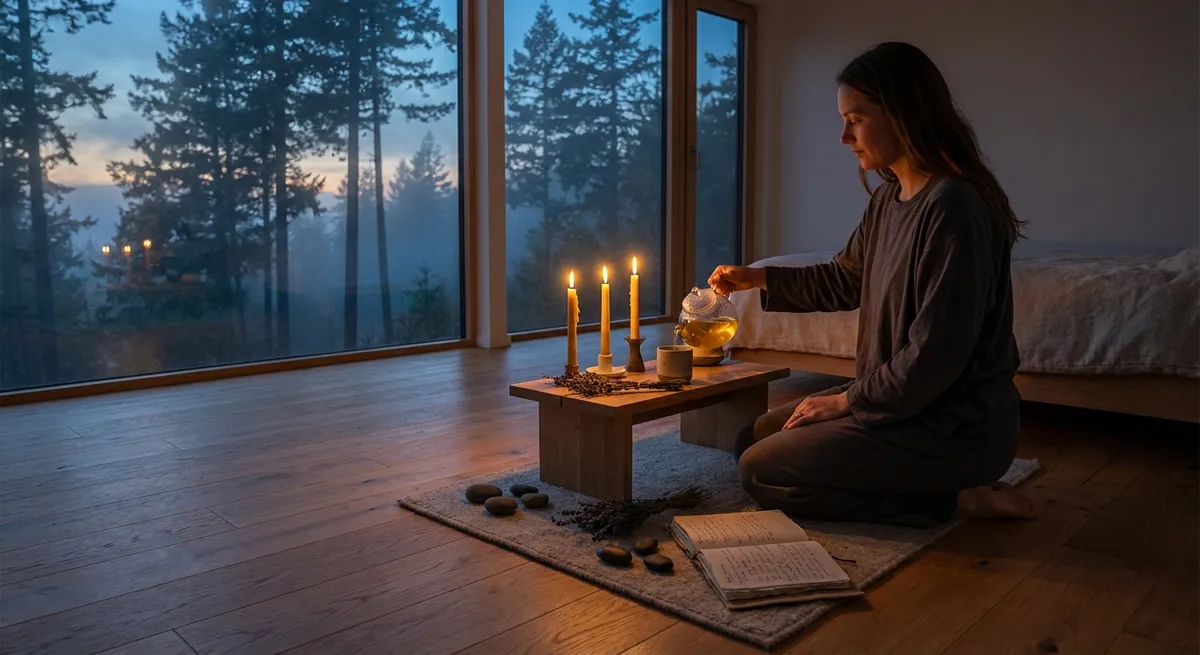
This ritual should be brief (5–15 minutes), sensorily rich, and repeatable anywhere with minimal equipment. Examples include: a single, beautifully prepared cup of loose-leaf herbal tea enjoyed without screens; a short, repeated breath pattern such as 4-second inhale, 6-second exhale, accompanied by a drop of lavender oil on your wrists; or a nightly foot soak with Epsom salts and a favorite calming playlist. The content matters less than the consistency, and the sensory cues that help your brain associate the ritual with safety.
Research on routines and habit formation suggests that pairing a new behavior with an existing anchor (after your last work email, after brushing your teeth, after placing your phone on airplane mode) greatly increases adherence. Over time, your nervous system begins to anticipate calm as soon as you initiate the opening move of your ritual—the click of the kettle, the dimming of the lamp, the first slow exhale. This conditioned association is itself a natural remedy: a portable, self-generated signal to your brain that you are allowed to soften, even for a moment.
In a world obsessed with optimization, there is something quietly radical about choosing just one ritual and refining it until it feels like an heirloom—simple, familiar, and deeply your own.
Conclusion
Elevated mental wellness is less about adding more products and more about curating fewer, finer practices that honor the sophistication of your nervous system. From the micro-dose afternoon and botanical pairing, to circadian elegance, the calm range perspective, and a single signature ritual, each of these insights invites you to treat your inner world with the same discernment you bring to the rest of your life.
Natural remedies, at their best, are not dramatic interventions but gentle companions—subtle influences that, repeated over time, re-teach your body what it feels like to live inside a mind that is clear, steady, and quietly luminous.
Sources
- [National Center for Complementary and Integrative Health (NCCIH): Herbs at a Glance](https://www.nccih.nih.gov/health/herbs-at-a-glance) - Evidence-based overviews of common herbs such as ashwagandha, lemon balm, and chamomile, including safety and interaction information
- [Harvard Health Publishing: Blue light has a dark side](https://www.health.harvard.edu/staying-healthy/blue-light-has-a-dark-side) - Explains how evening light exposure affects melatonin, sleep, and overall health
- [National Institute of Mental Health (NIMH): Caring for Your Mental Health](https://www.nimh.nih.gov/health/topics/caring-for-your-mental-health) - Outlines foundational lifestyle and behavioral strategies for supporting mental well-being
- [Cleveland Clinic: Circadian Rhythm](https://my.clevelandclinic.org/health/articles/22965-circadian-rhythm) - Describes circadian rhythms, the role of light, and how they influence sleep and mood
- [Mayo Clinic: Stress management](https://www.mayoclinic.org/healthy-lifestyle/stress-management/in-depth/stress-symptoms/art-20050987) - Provides an overview of stress, its impact on the body, and practical approaches to managing it
Key Takeaway
The most important thing to remember from this article is that this information can change how you think about Natural Remedies.