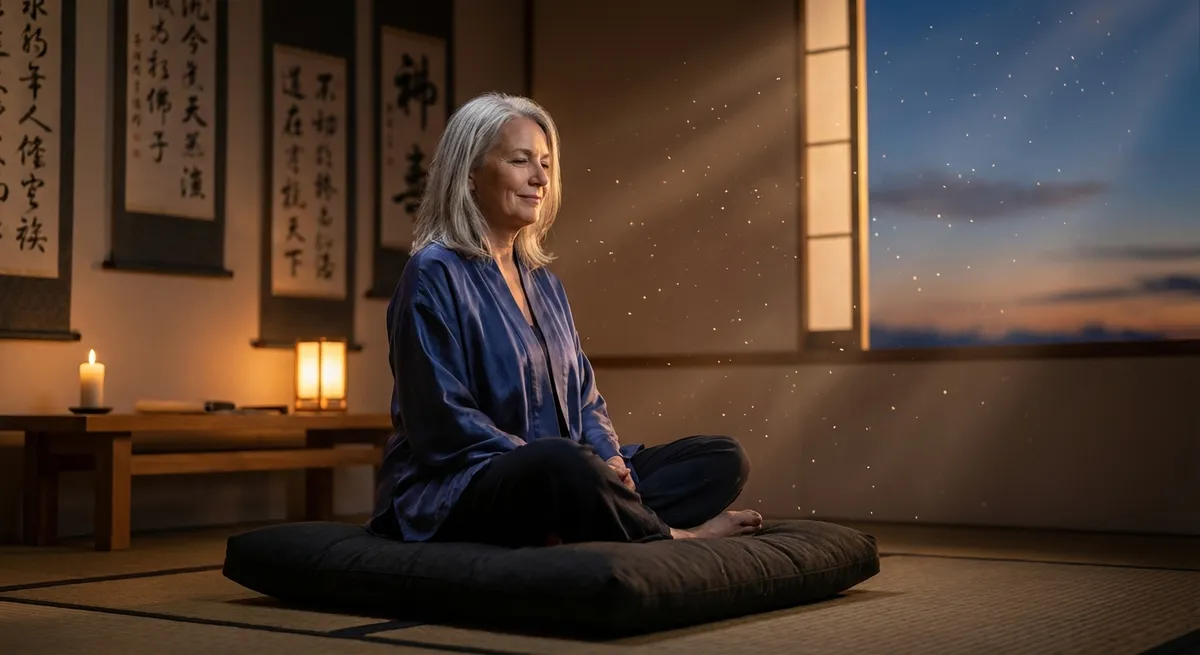
Meditation is often presented as a lifestyle accessory—another item on an already crowded wellness checklist. Yet at its most elegant, meditation is not something we “do” in brief, isolated moments; it becomes a discreet refinement of how we inhabit every moment. For those who seek not just relief from stress, but an elevated, composed way of moving through the world, meditation offers a quiet form of mastery: subtle, precise, and deeply tailored to the inner landscape.
Below are five exclusive, nuanced shifts in attention that transform meditation from a basic practice into a cultivated art of mental poise.
1. From Emptying the Mind to Curating Its Contents
Many people abandon meditation because they imagine its goal is to “empty the mind”—a task that feels both impossible and, frankly, uninteresting. A more sophisticated approach treats the mind not as a problem to erase, but as a private gallery to curate.
Instead of battling thoughts, you begin to observe which thought patterns deserve a place in your inner collection. Are they exquisite, useful, or aligned with the person you are becoming? Or are they habitual, crude, and outdated? In meditation, you are not a guard forcing thoughts out; you are a discerning curator deciding what earns your continued attention.
Practically, this might look like sitting in silence and labeling thoughts with gentle precision: “planning,” “self-critique,” “comparison,” “creativity,” “gratitude.” Over time, this refinement develops a kind of mental connoisseurship. You become less impressed by loud, frantic thoughts and more drawn to those that carry clarity, depth, and integrity. The mind is not emptied; it is edited.
2. Breathing as an Intelligent Instrument, Not a Background Process
Breathwork is often treated as a basic relaxation tool—a way to “take a deep breath” and calm down. For a more refined practice, the breath becomes an instrument of intelligent modulation, much like adjusting lighting or acoustics in a well-appointed room.
Longer exhalations, for instance, can gently activate the parasympathetic nervous system, encouraging the body into a state of rest and restoration. Slower, more deliberate breathing can nudge the heart rate downward and soften muscular tension. Over time, you begin to sense that each inhalation and exhalation is a precise dial on your physiological state, not a blunt tool.
In meditation, treat your breath as a craftsperson would treat their materials. You might experiment with subtle lengthening of the exhale when the mind feels overstimulated, or slightly deeper, rounder inhales when lethargy encroaches. You are not merely “breathing deeply”; you are developing a sophisticated rapport with the body’s most immediate regulator of calm.
3. Upgrading the Inner Voice from Critic to Concierge
Many meditative instructions suggest “noticing the inner voice” and letting it pass. But for those cultivating a truly elevated inner life, there is an opportunity to refine that voice itself: to upgrade it from constant critic to a kind of internal concierge—attentive, informed, and quietly supportive.
During meditation, listen not only to what the inner voice says, but how it says it. Is it blunt, rushed, and dismissive? Or measured, curious, and precise? Instead of trying to silence that voice, you can practice revising its tone. When self-judgment appears—“You’re doing this wrong”—you might internally respond with a more dignified phrasing: “Let’s begin again, more gently.”
Over repeated sessions, this becomes a subtle but powerful transformation. Your mental commentary shifts from surveillance to stewardship. The inner voice becomes less of a harsh supervisor and more of an expert host, quietly coordinating your experience in a way that feels reassuringly competent and aligned with your wellbeing.
4. Using Stillness as a Luxury of Attention, Not a Moral Obligation
Many people approach meditation with a sense of obligation: “I should meditate more; it’s good for me.” This moral framing often leads to guilt and inconsistency. A more elevated approach is to treat stillness as a luxury of attention—something precious you choose, not something you owe.
In a world saturated with noise, the ability to sit in stillness becomes a rare privilege. Consider your meditation time as an intentionally reserved space where nothing is demanded of you, and your attention is freed from transactional use. No one is asking, expecting, or requiring. There is no productivity goal, no moral tally being kept. Only space.
This reframe changes the emotional temperature of the practice. Meditation stops feeling like another self-improvement task and begins to resemble slipping into a tailored garment: a deliberate, chosen refinement of your internal state. The very act of sitting down becomes a quiet declaration that your inner life is worth this level of care and exclusivity.
5. Treating Everyday Moments as Micro-Meditations of Precision
Formal meditation—ten, twenty, or thirty minutes in a dedicated setting—is deeply valuable. But for a mind that seeks a truly composed lifestyle, the real art lies in integrating meditative precision into the day’s smallest gestures.
Consider the pause before replying to a message, the breath you take before entering a difficult conversation, the way you sip your morning tea or coffee. These are ideal sites for micro-meditations: two or three conscious breaths, a brief scan of bodily tension, or a quiet question such as, “What would a calmer version of me choose here?”
Such micro-practices are not mere mindfulness clichés; they are structural reinforcements. Each small moment of deliberate attention strengthens the neural pathways you cultivate during formal practice. Over weeks and months, you are no longer “someone who meditates”; you are someone who moves through life with a noticeably different level of mental elegance and restraint.
These tiny, repeated refinements give your day a kind of invisible architecture—simple, understated, but unmistakably intentional.
Conclusion
Meditation, approached with discernment, becomes something far more profound than a tool for coping. It is the quiet mastery of attention: a curated inner gallery of thoughts, a refined relationship with the breath, an upgraded inner voice, a chosen luxury of stillness, and a network of micro-moments that subtly elevate the entire day.
For those seeking mental wellness at a higher caliber, the invitation is not to meditate harder, but to meditate more intelligently—to bring the same taste, care, and precision you might apply to your external environment into the deepest layers of your inner world. Over time, the true luxury emerges: a mind that feels composed, trustworthy, and exquisitely your own.
Sources
- [National Center for Complementary and Integrative Health (NCCIH) – Meditation: In Depth](https://www.nccih.nih.gov/health/meditation-in-depth) - Overview of meditation practices, potential benefits, and current research
- [Harvard Health Publishing – Mindfulness meditation may ease anxiety, mental stress](https://www.health.harvard.edu/mind-and-mood/mindfulness-meditation-may-ease-anxiety-mental-stress) - Summarizes evidence on mindfulness meditation for stress and anxiety
- [American Psychological Association – Mindfulness meditation: A research-proven way to reduce stress](https://www.apa.org/topics/mindfulness/meditation) - Discusses psychological mechanisms and outcomes of meditation practices
- [Mayo Clinic – Meditation: A simple, fast way to reduce stress](https://www.mayoclinic.org/tests-procedures/meditation/in-depth/meditation/art-20045858) - Practical guidance on meditation types and their health effects
- [National Institutes of Health – Relaxation techniques: Breath focus](https://medlineplus.gov/ency/patientinstructions/000880.htm) - Explains breath-focused techniques and their impact on the nervous system
Key Takeaway
The most important thing to remember from this article is that this information can change how you think about Meditation.