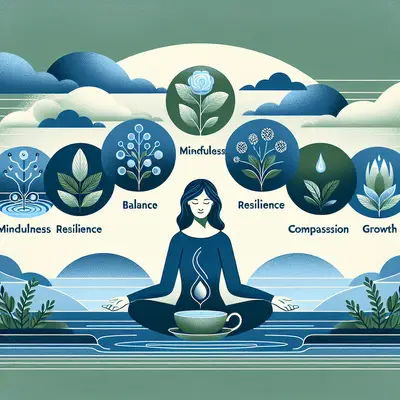
Mental wellness, at its most refined, is less about dramatic breakthroughs and more about subtle, deliberate calibration. In a culture obsessed with intensity and speed, true clarity begins to feel like a quiet luxury—rare, considered, and deeply personal. This piece is an invitation to treat your inner world with the same discernment you reserve for the most important decisions in your outer life.
Rather than revisiting familiar advice, we’ll explore five exclusive, elevated insights—less about “fixing” yourself, more about curating the conditions in which a composed, intelligent mind can naturally emerge.
Reframing Mental Wellness as Cognitive Curation
For a cultivated mind, wellness is no longer a vague aspiration; it becomes curation. Just as a well-edited space reflects the removal of the unnecessary, mental clarity often begins with subtraction, not addition. Every notification, conversation, and commitment represents a cognitive “entry” into your inner collection. Over time, this archive shapes how you think, feel, and decide.
Instead of asking, “How can I calm down?” it is more useful to ask, “What am I allowing into my mental gallery?” This shift is quiet but profound. It reframes wellness as an editorial process: Which voices deserve long-term exhibition? Which images, headlines, and recurring narratives are clutter? Research on cognitive load suggests that excess information degrades attention, working memory, and mood; in discerning minds, this manifests as a gentle insistence on boundaries. You might curate your day with intentional “white space”—intervals without inputs—so the mind is not merely reacting but integrating. Over time, this curation creates a mental environment where clarity is not forced; it is the natural consequence of what you no longer allow in.
The Precision of Emotional Vocabulary
Sophisticated mental wellness rarely announces itself through grand gestures; it shows up in the precision of language. Many people move through their days describing everything as “stressed,” “tired,” or “overwhelmed,” when in reality they might be feeling disappointment, performance anxiety, low-grade resentment, or emotional fatigue. The broader the label, the blunter the response. The more precise the label, the more elegant the intervention.
Psychological research calls this “emotional granularity”—the ability to identify and differentiate nuanced emotional states. Higher emotional granularity is associated with better emotion regulation, fewer depressive symptoms, and more adaptive responses to stress. For the discerning mind, this is not merely a skill; it is a standard. You might pause once or twice a day and ask: “What is the closest word for what I’m feeling—exactly?” Perhaps it is not “anxious,” but “anticipatory,” “self-conscious,” or “uncertain about outcome.” Each word suggests a different kind of response. This simple act of precision is a quiet form of mastery: instead of drowning in a vague mood, you begin to relate to your inner life with the same nuance you would bring to a complex work of art.
Designing Micro-Rituals for Cognitive Recovery
High-functioning individuals often over-invest in performance and under-invest in recovery. True mental wellness, however, depends less on occasional escapes and more on thoughtfully designed micro-rituals that restore the mind in real time. These are not grand spa days or digital detox retreats; they are compact, repeatable, and quietly luxurious moments threaded into the ordinary.
Consider three elements when designing such rituals: brevity, sensory depth, and repeatability. A ninety-second breathing sequence between meetings, a carefully prepared cup of tea sipped away from screens, or a brief transition walk at twilight can serve as cognitive “bookends” that reset attention and arousal levels. Neuroscience suggests that even short pauses can help regulate the nervous system and restore executive functioning, especially when they involve deliberate breathing or gentle movement. What makes these practices elevated is not their novelty but their intentional design: the choice of a specific cup, a certain chair, a recurring playlist, a particular view. These details signal to your nervous system, “We are in a space of restoration now.” In time, these micro-rituals become quiet, portable sanctuaries.
The Strategically Unbusy Mind
In refined living, the absence of noise is not emptiness; it is a statement. The same is true of the intentionally unbusy mind. Many people equate mental wellness with managing more—more hacks, more productivity, more optimization. A more sophisticated approach recognizes that mental health often improves when we relinquish the obsession with constant occupation. Space in the calendar and space in the mind are interdependent luxuries.
Strategic unbusyness is not about doing nothing; it is about refusing to fragment your attention on the trivial. You might experiment with designed “low-stimulation intervals”—times when you deliberately avoid multitasking, background media, or rapid context switching. This type of minimalism is supported by research showing that multitasking impairs performance and increases perceived stress. For the discerning mind, such intervals are not indulgent; they are foundational. During these spaces, thoughts are allowed to wander, recombine, and resolve. Problems that felt intractable in a compressed schedule often yield to insight when the mind is granted a less crowded landscape. In this way, unbusyness becomes a quiet strategy, not a guilty secret.
Gentle Ambition: Pursuing Growth Without Inner Hostility
There is a particular tension experienced by ambitious, self-aware individuals: the desire to grow, paired with a growing intolerance for self-violence masquerading as “motivation.” Gentle ambition is the art of pursuing excellence without allowing your inner dialogue to become adversarial. It does not mean lowering standards; it means refusing to use self-contempt as fuel.
Psychology research on self-compassion indicates that people who treat themselves with kindness in the face of setbacks are more likely to persist, less prone to burnout, and better able to learn from mistakes. This stands in direct contrast to the myth that harsh self-criticism is a prerequisite for achievement. Practically, gentle ambition sounds like: “I expect a lot from myself—but I will not threaten myself to get there.” It allows you to set elevated goals while maintaining a fundamentally respectful relationship with your own mind. Over time, this shift alters the emotional climate in which you live: growth becomes sustainable, and your inner world feels less like a battlefield and more like a well-run studio—disciplined, focused, and quietly humane.
Conclusion
Mental wellness, at its most elegant, is not a spectacle. It is a series of intelligent, almost imperceptible choices: what you allow into your mental space, how precisely you name your inner states, how thoughtfully you recover, how intentionally you create room for unbusyness, and how you relate to your own ambition. These are not quick fixes; they are subtle upgrades in how you inhabit your mind.
When treated as a form of quiet luxury, mental clarity stops being a distant ideal and becomes a standard you uphold daily—through curation, precision, and an unwavering commitment to inner refinement. In that cultivated interior, wellness is not merely felt; it is designed.
Sources
- American Psychological Association – The Secret Life of the Brain: Information Overload - Discusses how excessive information and cognitive load affect mood, attention, and decision-making
- Harvard Health Publishing – Stress, the Brain, and Mental Health - Explores how stress influences the nervous system and why recovery practices matter
- Greater Good Science Center (UC Berkeley) – What Is Emotional Granularity? - Explains emotional granularity and its links to emotional regulation and well-being
- Stanford University – Multitasking and Cognitive Control - Research on how multitasking impairs performance and attention
- Kristin Neff, Ph.D. – Self-Compassion Research - Summarizes empirical findings on how self-compassion supports resilience, motivation, and mental health
Key Takeaway
The most important thing to remember from this article is that this information can change how you think about Mental Wellness.