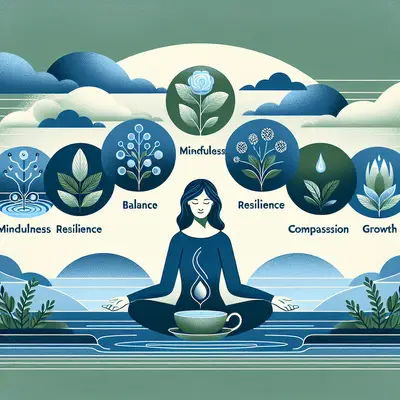
Mental wellness today is less about escaping the pace of life and more about moving through it with poise. For those whose days are structured, demanding, and carefully curated, the question isn’t “How do I slow everything down?” but “How do I remain composed, clear, and discerning while it all continues?” This is the quiet luxury of mental wellness: an inner standard that accompanies you anywhere—boardrooms, airports, late-night emails, early-morning commitments—without feeling fragile or performative.
Below are five exclusive, elevated insights designed for a mind that expects more than clichés: practices that are subtle, sustainable, and worthy of a refined inner life.
The Signature Mindset: Curating a Personal Standard of Calm
Mental wellness becomes genuinely transformative when you treat it not as a rescue plan, but as a personal standard—your “signature mindset.” Instead of asking how to feel better in moments of crisis, you begin asking a more discerning question: “What is the level of clarity and composure I insist on living with, regardless of circumstances?”
This standard is not about perfection or perpetual serenity. It is about consistently returning to a baseline of steadiness that feels non-negotiable. You decide what that looks like: perhaps it’s never answering messages while emotionally charged, never going to sleep with your mind racing if a simple ritual could reset it, or never walking into a high-stakes conversation without centering yourself first.
Establishing this standard transforms wellness from a passive hope into an active identity. You stop waiting to “find time” for your mind, and instead quietly architect your day around it. The result is a subtle but profound shift: the world no longer dictates your internal tempo—you do.
Insight 1: The Micro-Transition Principle
Most people treat their day as a single, continuous stream. High performers who protect their mental wellness, however, design micro-transitions—brief, intentional pauses between roles, tasks, or environments.
A micro-transition can be as brief as 30–90 seconds but carries outsized impact. Before opening your laptop for the day, you might stand, close your eyes, and ask: “How do I intend to think today?” After a demanding meeting, you might take ten slow breaths, letting your shoulders drop, before speaking to someone you care about. Before entering your home after work, you might deliberately slow your pace for the last few steps, symbolically leaving the day outside.
These small intervals allow your nervous system to recalibrate instead of carrying residual tension forward. Over time, micro-transitions prevent the subtle mental “fraying” that accumulates when your day blurs into a single, unexamined rush. You are no longer dragged from moment to moment; you are escorted, with intention, from one mental state to the next.
Insight 2: Cognitive Minimalism as a Luxury Practice
Minimalism is often framed as a visual aesthetic—clean lines, neutral palettes, spare interiors. Yet the most luxurious minimalism is cognitive: a deliberate reduction of what your mind is required to hold at once.
Cognitive minimalism begins with auditing your mental load. How many projects, relationships, unmade decisions, and digital inputs are you expecting your mind to process simultaneously? A refined approach to mental wellness treats attention as a premium resource and refuses to spend it carelessly.
You might practice cognitive minimalism by:
- Consolidating decisions (e.g., standardizing weekday meals or outfits) to preserve mental clarity for higher-level thinking.
- Creating one trusted “inbox” for ideas and tasks, rather than scattering them across emails, notes, and unsent messages to yourself.
- Scheduling strict windows for news and social media instead of allowing constant ambient consumption throughout the day.
The goal is not a smaller life, but a more deliberate one. When your mind is no longer cluttered with minor, unresolved items, your deeper capacities—creativity, insight, emotional nuance—have space to emerge. The experience is not empty; it is exquisitely spacious.
Insight 3: The Nervous System as Your Invisible Wardrobe
Just as you would never arrive at an important event without considering what you wear, there is an equal—if not greater—elegance in choosing the state of your nervous system before you step into key moments.
Most of us wait to notice our nervous system only when it misbehaves: a racing heart before a presentation, tension after an argument, restlessness at night. A more refined practice treats your nervous system as something you dress, deliberately, throughout the day.
You might ask yourself in the morning: “What will my nervous system be asked to hold today?” If it includes crucial decisions, intense negotiation, or emotional care-taking, you can “pre-dress” your system:
- For clarity: start the day with a few minutes of quiet, device-free observation—of light, sound, or breath. This anchors your baseline.
- For resilience: incorporate short, intentional physical movement (stretching, walking, yoga sequences) to signal to your body that it is capable and grounded.
- For recovery: pre-plan a brief, calming ritual after a known stressor: ambient music, dim lighting, or a few pages of slow reading.
This level of intentionality reframes wellness as preparation, not repair. You stop being surprised by your reactions and instead meet your day in a state chosen, not inherited.
Insight 4: Emotional Precision Over Emotional Suppression
For those accustomed to high standards and constant delivery, emotions can feel like interference—unwelcome fluctuations in an otherwise controlled system. The temptation is to flatten them, to become “unbothered.” Yet emotional suppression is not sophistication; emotional precision is.
Emotional precision is the ability to name, differentiate, and understand what you feel without becoming overtaken by it. It is the difference between “I’m stressed” and “I feel mentally overloaded and slightly underappreciated, but not actually in danger.” That nuance alone can dramatically soften your body’s stress response.
You can cultivate emotional precision by:
- Taking a brief pause when you feel “off” and describing your internal state with more specific language: frustrated, restless, uncertain, overstimulated, disappointed, quietly anxious.
- Asking, “What is the real request inside this feeling?” Often it is for rest, acknowledgment, clarity, or boundaries—not for your entire life to change.
- Separating intensity from instruction: a strong feeling does not automatically deserve a strong reaction. It deserves accurate interpretation first.
This approach allows you to remain emotionally attuned without feeling emotionally exposed. You are not armored, but you are exquisitely calibrated.
Insight 5: The Art of Non-Negotiable Recovery
High-functioning individuals often treat rest as optional and productivity as obligatory. In a truly elevated wellness practice, the reverse becomes true: recovery is non-negotiable, because it is the very infrastructure that sustains performance, creativity, and presence.
Non-negotiable recovery is less about occasional indulgence and more about consistent, thoughtfully designed restoration. It can be elegantly simple:
- A firm, technology-free boundary for the last 30–60 minutes of the evening, allowing your mind to shed the “input reflex.”
- A weekly block of time—however small—that is not optimized, monetized, or shared. It is protection for your inner life, not a reward for output.
- Seasonal adjustments: recognizing that your energy, sleep, and emotional bandwidth change with light, temperature, and obligations, and allowing your schedule to reflect that.
By elevating recovery from an afterthought to a core value, you send yourself a powerful message: “My mind is not a disposable resource.” Mental wellness stops being something you squeeze in and becomes the quiet architecture that everything else rests upon.
Conclusion
A composed inner world is not an accident, nor is it a privilege reserved for those with empty calendars and long retreats. It is the product of subtle, decisive choices made repeatedly: curating your cognitive load, dressing your nervous system with intention, transitioning with care, feeling with precision, and honoring recovery as a core responsibility.
In a life that rarely pauses, mental wellness becomes a discreet form of luxury—an invisible refinement that shapes how you think, respond, and create. The external demands may remain, but the internal experience transforms. You are no longer simply keeping up; you are moving through your life with a quiet, unmistakable poise.
Sources
- [National Institute of Mental Health – Caring for Your Mental Health](https://www.nimh.nih.gov/health/topics/caring-for-your-mental-health) – Overview of practical strategies and evidence-based perspectives on maintaining mental wellness.
- [American Psychological Association – Stress Effects on the Body](https://www.apa.org/topics/stress/body) – Explains how the nervous system and body respond to stress, supporting the importance of intentional regulation.
- [Harvard Health Publishing – The Importance of Sleep for Mental Health](https://www.health.harvard.edu/newsletter_article/sleep-and-mental-health) – Details the connection between recovery, sleep, and emotional regulation.
- [Mayo Clinic – Mindfulness Exercises](https://www.mayoclinic.org/healthy-lifestyle/consumer-health/in-depth/mindfulness-exercises/art-20046356) – Describes accessible practices that support micro-transitions and present-moment awareness.
- [Yale Center for Emotional Intelligence](https://www.ycei.org/) – Offers research and resources on emotional awareness, labeling, and regulation, reinforcing the concept of emotional precision.
Key Takeaway
The most important thing to remember from this article is that this information can change how you think about Mental Wellness.