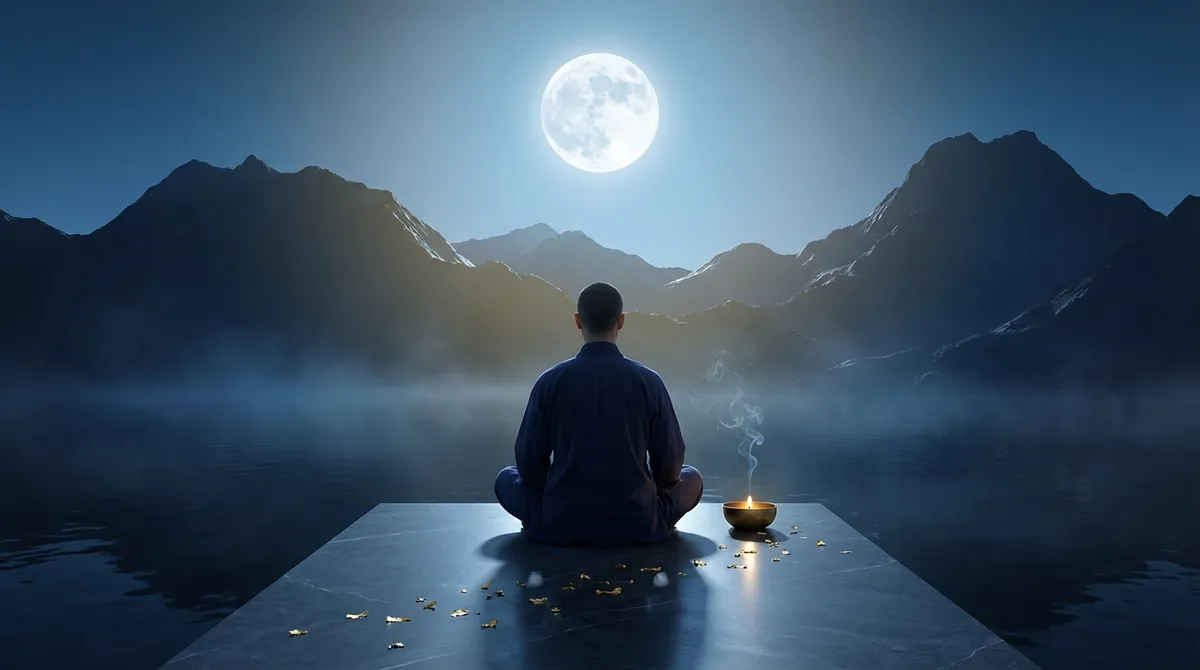
In a world that rewards speed and constant commentary, meditation offers something distinctly rare: a refined, unhurried intimacy with one’s own mind. It is less a wellness trend and more an understated art of inner curation—a way of choosing what deserves your attention and what can be gently released. For those who value discernment in every other aspect of life, meditation becomes not merely a coping mechanism, but a deliberate elevation of everyday consciousness.
Below are five exclusive insights into meditation that move beyond beginner advice. Each is intended for the person who is no longer satisfied with basic relaxation tips, and instead seeks a more nuanced, cultivated relationship with their own mental landscape.
Meditation as Cognitive Tailoring, Not Escape
Meditation is often framed as a way to “get away” from stress, but a more sophisticated understanding views it as deliberate cognitive tailoring: the precise shaping of attention, perception, and emotional tone.
Rather than trying to turn off thoughts, you begin to notice the mind’s patterns with the same discerning eye you would bring to an art collection or a carefully edited wardrobe. Some thoughts are useful, some are beautifully creative, some are simply noise. Meditation refines your ability to distinguish among them without drama.
Neuroscientific research suggests that regular meditation can alter activity and connectivity in brain regions associated with attention, emotional regulation, and self-referential thinking. Over time, this does not sterilize your emotional life; it restores its clarity. Stressors remain, but your interpretive lens becomes less reactive and more composed. You begin to respond, not reflexively react.
Approach your practice as a daily appointment with mental craftsmanship. You are not escaping your life; you are tailoring your inner response so that the outer world feels less like a series of emergencies and more like a sequence of choices.
The Luxury of Single-Task Presence
In a culture addicted to multitasking, undivided attention has become a luxury experience. Meditation trains precisely this: the capacity to inhabit a single moment, a single breath, a single sensation without fracturing your focus.
You may notice, over time, that your standards for mental clutter change. Scrolling while half-watching a show, half-checking email begins to feel abrasive. You start to crave the elegance of one thing at a time—whether that is a conversation, a meal, or simply looking out a window without immediately reaching for your phone.
This is not about productivity hacks; it is about reclaiming cognitive dignity. A mind stretched across too many stimuli loses its subtlety. Meditation, even for ten or fifteen minutes a day, quietly reconditions your nervous system to recognize that steadiness is safe, that it is permissible to do less at once and feel more within each action.
The result is not boredom, but a higher resolution of experience. Taste becomes sharper, music richer, intimacy deeper. You are no longer grazing the surface of your own life; you are inhabiting it with deliberate presence.
Emotional Nuance: From Mood Swings to Subtle Gradients
For many people, emotions appear as blunt instruments: stressed or calm, overwhelmed or fine, anxious or okay. Meditation opens a more nuanced emotional palette, allowing you to perceive subtle gradients instead of crude categories.
When you sit quietly with your experience—without forcing it to change—you begin to notice delicate distinctions: the difference between physical fatigue and emotional depletion, between anticipatory anxiety and genuine intuition, between sadness that needs soothing and sadness that is actually a quiet form of letting go.
This heightened emotional granularity is powerful. Research in affective science suggests that people who can label their emotions with greater specificity are often better at regulating them. Meditation cultivates this inner vocabulary not by adding more analysis, but by refining your direct, moment-to-moment awareness.
In practice, this means you can intervene earlier and more intelligently. You sense the early tremor of overwhelm, rather than the full collapse. You detect a mild social fatigue before it solidifies into resentment. Emotional nuance becomes an internal early-warning system, enabling graceful, preventative adjustments—a short walk, a pause, a boundary—long before crisis mode.
Ritual Architecture: Designing a Practice That Feels Bespoke
A meditation practice acquires depth when it stops feeling like an obligation and begins to feel like a subtle ritual—architected around your particular preferences, rhythms, and aesthetic sensibilities.
Instead of forcing yourself into an austere routine, consider how to make the experience quietly exquisite. A small, uncluttered corner with a single object that holds significance. A specific chair or cushion chosen for comfort and stability. A familiar scent—a candle, essential oil, or fresh air from an opened window—that signals “this is the time we turn inward.”
Timing can be curated as well. Some minds respond better to early-morning clarity; others find their sharpest introspection just after dusk. You might pair meditation with a brief, handwritten reflection, or a glass of herbal tea sipped slowly afterward. The objective is not to accumulate props, but to design conditions that your nervous system associates with safety and ease.
By honoring these details, meditation shifts from something you “have to do” into something you are subtly drawn toward. The ritual itself becomes a signal: this time is set apart, protected from interruption and excessive urgency. Over weeks and months, this consistent architecture supports deepening—not through force, but through familiarity and quiet anticipation.
Integrative Mindfulness: Letting the Practice Follow You
The most refined expression of meditation is not found on the cushion; it is revealed in how you conduct the micro-moments of daily life. An advanced perspective sees formal meditation as training, and the rest of the day as the real performance.
You can experiment with integrative mindfulness in unobtrusive ways. Use transitional moments—waiting for the kettle to boil, sitting in the back of a car, standing in a corridor before a meeting—as brief opportunities to return to your breath and soften your shoulders. These are not full sessions; they are small recalibrations.
During conversations, you might practice the discipline of full listening: noticing when the mind prepares its rebuttal and gently returning to the other person’s words, tone, and facial expressions. In decision-making, you may pause for three conscious breaths before responding to an email that provokes urgency or irritation.
Over time, this integration creates an internal continuity. You are no longer tranquil only in controlled conditions and scattered in the real world. The qualities cultivated in meditation—spaciousness, discernment, steadiness—begin to follow you into complex environments, difficult personalities, and high-stakes decisions. The practice becomes less about carving out sacred time, and more about infusing everyday life with a quiet, deliberate poise.
Conclusion
Meditation, approached with refinement, is not merely a technique for calming down. It is an ongoing conversation with your own mind—a way of tailoring attention, elevating emotional insight, and reclaiming the luxury of single-task presence. Through thoughtful ritual, cognitive clarity, and daily integration, the practice evolves from a wellness checkbox into a subtle signature of how you live.
In the end, the most compelling benefit is not dramatic transformation, but a steady, almost understated shift: less reactivity, more choice; less noise, more nuance. A composed mind is not an accident—it is something you quietly, patiently, and beautifully cultivate.
Sources
- [National Center for Complementary and Integrative Health: Meditation and Mindfulness](https://www.nccih.nih.gov/health/meditation-and-mindfulness) - Overview of meditation, types of practices, and evidence-based benefits
- [American Psychological Association: Mindfulness Meditation—A Research-Proven Way to Reduce Stress](https://www.apa.org/topics/mindfulness/meditation) - Summarizes research on how meditation affects stress, emotion regulation, and overall mental health
- [Harvard Health Publishing: Mindfulness Meditation May Ease Anxiety, Mental Stress](https://www.health.harvard.edu/mind-and-mood/mindfulness-meditation-may-ease-anxiety-mental-stress) - Discusses clinical findings on mindfulness and its impact on anxiety and stress responses
- [Mayo Clinic: Meditation—A Simple, Fast Way to Reduce Stress](https://www.mayoclinic.org/tests-procedures/meditation/in-depth/meditation/art-20045858) - Provides practical guidance on starting a meditation practice and outlines health benefits
- [NIH News in Health: Mindfulness for Your Health](https://newsinhealth.nih.gov/2012/01/mindfulness-your-health) - Explores how mindfulness practices influence physical and mental well-being
Key Takeaway
The most important thing to remember from this article is that this information can change how you think about Meditation.