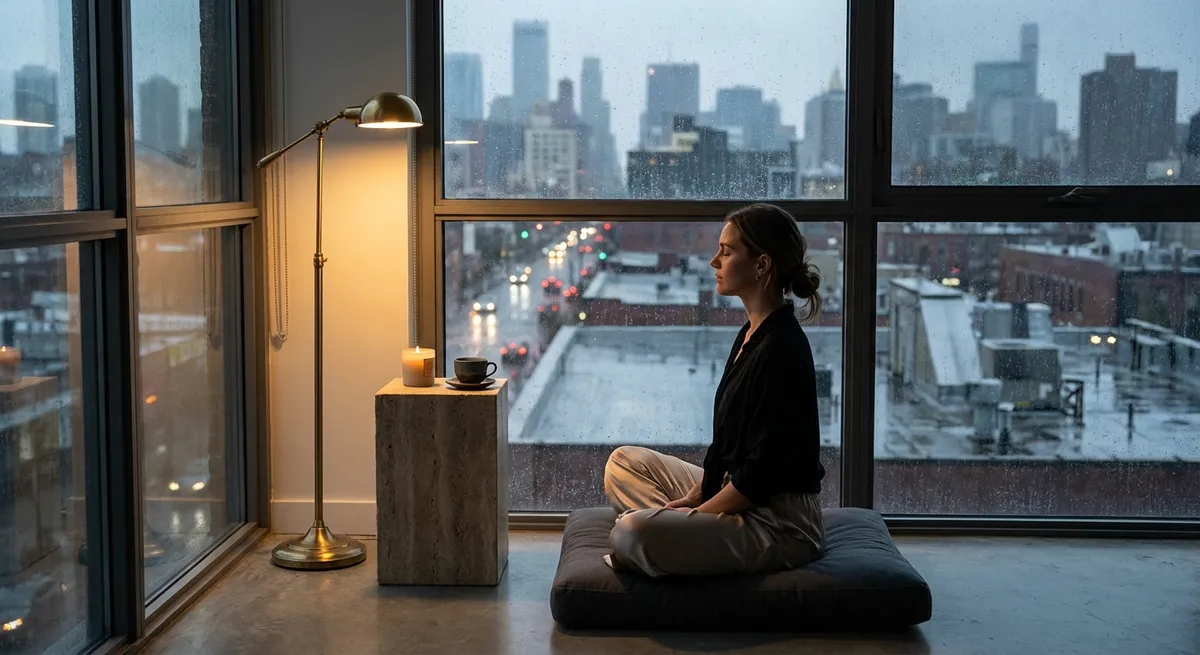
In an age of relentless notifications and curated distractions, sustained attention has become a rarefied asset. Meditation, when approached with discernment, is less a wellness trend and more a quiet luxury: an intentional refinement of how we inhabit our own minds. Beyond stress relief or productivity hacks, it offers a subtle reorientation—away from compulsion and toward choice, away from noise and toward a composed, lucid presence. For those seeking mental wellness with a touch of elegance, the practice becomes not just a tool, but a cultivated way of being.
Meditation as the Curation of Mental Input
Most people think of meditation as something done after the day has already happened—an evening ritual to “decompress.” A more elevated understanding treats it as curation rather than cleanup: a deliberate choice about which thoughts and impressions are allowed to take up residence in the mind.
When you sit to meditate, you are not simply observing thoughts; you are quietly teaching your nervous system to distinguish between signal and static. Over time, this curation changes how you move through your day. Emails still arrive, people still demand your time, the world remains imperfectly loud—but your attention no longer rushes to meet every stimulus with equal urgency. Instead, you begin to experience mental life as a gallery, not a warehouse. Only a fraction of what arises is granted your full engagement, and this selectivity is deeply protective for mental wellness.
Consistent practice is where this refinement becomes apparent. Research on mindfulness and attention has shown improvements in selective attention, working memory, and emotional regulation, suggesting that meditation is training the brain’s capacity to prioritize what truly matters. The result is not detachment from life but a more intentional participation in it.
The Subtle Recalibration of Pace
A premium wellness practice is rarely about adding more; it is often about subtracting excess. Meditation performs a quiet recalibration of internal pace, softening the compulsion to outrun one’s own life. Even short, well-structured sessions can begin to anchor you in a tempo that feels sustainable, not performative.
This recalibration is physiologic as much as philosophical. Slow, steady breathing and nonjudgmental awareness influence the autonomic nervous system, gently shifting it away from a chronic fight-or-flight state. Over time, this can reduce baseline anxiety, improve sleep quality, and support more measured responses to stress. But beyond the measurable, there is an experiential elegance: life feels less like a race and more like a conversation you are no longer too distracted to hear.
Instead of “fitting in” meditation as another item on an overburdened checklist, consider it the metronome for the rest of your day. Five minutes of poised stillness before your first screen, three attentive breaths before a meeting, a brief body-scan before bed—each of these micro-practices quietly reclaims your pace from the demands of others.
The Aesthetic of Inner Order
For those drawn to refined environments—beautifully lit rooms, intentional design, curated spaces—it is worth recognizing that meditation can become the interior counterpart to this aesthetic. A composed mind has its own architecture: uncluttered, coherent, and quietly ordered.
Meditation invites you to notice the arrangement of your inner life. Are your thoughts stacked in precarious piles of what-ifs and should-haves? Are your emotions crammed into corners, unattended yet constantly leaking into the present? With continued practice, you begin to “tidy” from within—not by suppressing complexity but by giving each experience a rightful place. Regret is acknowledged but not allowed to dictate the future. Anticipation is felt but not permitted to steal the present.
This inner order does not require dramatic spiritual experiences or elaborate rituals. It emerges from consistent, understated effort: sitting, noticing, returning. Over time, many practitioners report reduced rumination and greater clarity, echoes of psychological research showing that meditation can decrease repetitive negative thinking. The mind feels less like a storage unit and more like an elegantly arranged room where it is a pleasure to dwell.
Emotional Nuance as a Sign of Progress
A sophisticated approach to meditation does not equate progress with perpetual calm. In fact, one of the more exclusive insights—often missed in mainstream wellness—is that increased emotional nuance can be a marker of genuine advancement.
As attention grows more precise, you begin to notice subtle gradations in feeling: the difference between irritation and genuine anger, between fatigue and quiet sadness, between restlessness and unspoken desire. Rather than flattening your emotional life into “good vs. bad,” meditation invites you to experience a fuller spectrum with less reactivity and more curiosity.
This nuanced awareness is psychologically protective. You recognize early signals of burnout before they escalate. You notice when you are saying “yes” out of obligation rather than alignment. You catch the fine line between productive ambition and corrosive self-critique. Research on mindfulness-based interventions supports this experiential observation, showing improved emotional regulation and reduced symptoms of anxiety and depression in many individuals.
Far from making you indifferent, this cultivated nuance allows you to respond to your inner world with discernment instead of reflex. Emotional life becomes less of a storm and more of a weather pattern you understand and can elegantly prepare for.
Turning Solitude into a Deliberate Ritual
In a culture that often mistakes constant connection for belonging, meditation reclaims solitude as a deliberate, nourishing ritual rather than a gap to be filled. For those pursuing mental wellness at a higher standard, learning to be accompanied by your own mind—without immediate distraction—becomes a quietly radical act.
This does not require dramatic retreats or hours of silence. A refined approach favors understated consistency over spectacle. You might designate a specific chair, a particular corner, a certain time of day as your “quiet appointment” with yourself. Over weeks, the mind learns that this space is not for performance, but for honest presence.
In time, solitude shifts from feeling empty to feeling spacious. You may notice a gentler internal voice, more generous self-talk, or a clearer sense of what actually restores you versus what merely distracts you. Studies on meditation frequently highlight increases in self-compassion and decreases in perceived loneliness, not because life becomes easier, but because your relationship with your own mind becomes less adversarial and more collaborative.
When solitude is given this level of attentiveness, it stops being an absence of others and becomes a presence with yourself—deliberate, restorative, and quietly luxurious.
Conclusion
Meditation, approached with care and sophistication, is far more than a stress-management technique. It is an ongoing refinement of how you allocate attention, set your pace, design your inner landscape, perceive your emotions, and inhabit your own solitude. These are not loud transformations; they are subtle shifts that accumulate, gradually replacing mental chaos with a composed, discerning presence.
For the discerning seeker of mental wellness, the true luxury is not in owning more time, but in inhabiting each moment with clarity and intention. Meditation is the understated craft of doing precisely that—poised, attentive, and quietly powerful.
Sources
- National Center for Complementary and Integrative Health – Meditation: In Depth - Overview of meditation types and research on benefits for health and well-being
- American Psychological Association – Mindfulness Meditation: A Research-Proven Way to Reduce Stress - Summarizes psychological research on mindfulness, attention, and emotional regulation
- Harvard Health Publishing – Mindfulness Meditation May Ease Anxiety, Mental Stress - Discusses how meditation affects stress, anxiety, and brain function
- Mayo Clinic – Meditation: A Simple, Fast Way to Reduce Stress - Practical explanation of meditation’s impact on stress and overall well-being
- National Institutes of Health – The Effects of Mindfulness Meditation on Mental Health - Research article reviewing evidence on mindfulness meditation and psychological outcomes
Key Takeaway
The most important thing to remember from this article is that this information can change how you think about Meditation.