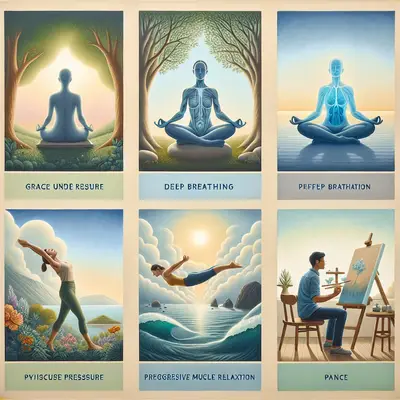
Stress is no longer a rare interruption; it has become the ambient soundtrack of modern life. Yet for those who value discernment, the question is not simply how to “cope,” but how to cultivate a mind that remains poised, lucid, and quietly powerful even when the world accelerates. This is not about escaping pressure, but about refining your inner apparatus so that pressure becomes a catalyst for clarity rather than collapse.
What follows is a considered exploration of stress relief as a cultivated art—rooted in science, elevated by intention. Interwoven throughout are five exclusive insights for a more composed, intelligent relationship with stress, designed for those who expect more from their wellness practices than generic advice and passing trends.
Redefining Stress: From Enemy to Intelligent Signal
Stress is often framed as a villain, something to eliminate at all costs. Biologically, however, stress is closer to a finely tuned alarm system—overactive for many of us, but still fundamentally protective. The sympathetic nervous system elevates your heart rate, sharpens attention, and mobilizes energy. It is meant to be a sprint, not a permanent address.
The issue is not stress itself, but chronic, unmodulated stress that never allows the body to return to its baseline. When every email, notification, or slight delay triggers the same physiological response once reserved for survival threats, the system begins to fray. Sleep becomes shallow, attention fragmented, and emotional nuance replaced by a dull sense of being “on edge” all the time.
A more refined approach begins with acknowledging stress as feedback: a message from your nervous system that something in your rhythm, priorities, or environment is misaligned. Instead of asking, “How do I make this stop?” a better question is, “What is this tension asking me to recalibrate?” This subtle reframing creates space for curiosity over self-criticism—and restores your role as conductor of your inner orchestra, rather than its overwhelmed audience.
Exclusive Insight #1: The “Stress Signature”
Each person has a unique stress signature—a particular combination of physical sensations, thought patterns, and behaviors that emerge under strain. For some, it’s jaw tension and impatience. For others, it’s indecision and mental fog. Spend a week quietly observing your personal signature: where tension arrives first in your body, what stories your mind tends to tell (“I’m behind,” “I’m failing,” “I must fix this now”), and which habits you default to (scrolling, snacking, overworking).
By knowing your stress signature, you can respond earlier and more precisely, rather than waiting for a full collapse before intervening. It transforms stress relief from damage control into refined, early-stage course correction.
The Nervous System as a Luxury Instrument
Consider your nervous system as a finely crafted instrument—capable of immense range, from deep stillness to fierce focus. Just as a Stradivarius demands careful handling, your system responds exquisitely to how you live, breathe, and even arrange your environment.
Physiologically, stress relief is less about willpower and more about giving your parasympathetic nervous system—the “rest and restore” mode—regular, intentional invitations. These invitations are subtle: the length of your exhale, the softness of your gaze, the way your shoulders drop when you allow yourself to sit back, even for thirty seconds.
Small, repeating gestures of relaxation are what build resilience, not occasional grand retreats. This is where ritual becomes powerful. A well-designed ritual creates a familiar pathway for the body to recognize: “Here, we soften. Here, we are safe enough to release tension.”
Exclusive Insight #2: The 90-Second Reset
Neuroscience suggests that the physiological component of an emotional stress response can crest and begin to subside in roughly 90 seconds—if we do not continually feed it with new thoughts and narratives. Design a 90-second reset you can perform discreetly anywhere:
- Inhale through the nose for a count of four, exhale for a count of six or eight.
- Loosen your jaw and let your tongue rest gently on the floor of your mouth.
- Lower your shoulders and feel the weight of your body supported by the chair or ground.
- Choose one neutral visual anchor (a plant, a texture, a window frame) and keep your gaze soft.
Executed elegantly, this becomes a quiet, portable luxury: a small but powerful act of nervous system stewardship that needs no app, no equipment, and no announcement.
Curated Environments: Designing for Calm, Not Clutter
Most stress advice focuses on what happens inside your head. Yet your surroundings are constantly shaping the baseline of your nervous system, often more than you realize. Environmental noise, harsh lighting, cluttered surfaces, and perpetual digital interruptions place your brain on low-grade alert before any “real” stressor appears.
Think of your environment as a co-therapist: either it is supporting your calm, or it is undermining it. A refined approach to stress relief involves curating your spaces the way a gallerist curates an exhibition—with intention, restraint, and attention to subtle detail.
Begin with the visual field you encounter most often: your desk, nightstand, or main living area. Remove anything that consistently triggers a micro-stress response: stacks of unprocessed papers, multiple open devices, items that belong elsewhere. Replace them with a few tactile, grounding elements that quietly signal ease: a single well-chosen candle, a carafe and glass, a small bowl or tray that prevents items from visually scattering.
Exclusive Insight #3: The “Threshold Principle”
Instead of trying to redesign your entire home or office, focus on thresholds: the places where you transition between modes—doorways, entry tables, the edge of your desk, the area beside your bed. These are the micro-moments where your nervous system either ramps up or down.
- At your front door, place a single object associated with arrival and release: a small dish where you intentionally leave keys, or a hook where you hang the day’s tension along with your coat—an anchored mental association repeated daily.
- At your desk, define a clear starting ritual (perhaps aligning your notebook and pen, or opening one single tab) and an ending ritual (closing your laptop fully, placing it out of sight, turning your chair slightly away).
By elevating these thresholds into intentional transitions, you teach your nervous system that it is safe to step out of “performance mode” and into restoration, even without changing your obligations.
Cognitive Refinement: Editing Mental Noise
Much of modern stress is not caused by events themselves, but by unedited mental noise: the constant internal commentary, prediction, and replay that occupies an extraordinary amount of cognitive real estate. The cultivated mind is not necessarily free of difficult thoughts; it is simply more selective, less easily hijacked.
Stress relief, at this level, becomes an act of cognitive curation. Instead of trying to “think positive,” you practice thinking precisely. You distinguish between what is fact and what is forecast, between what requires action and what is mere mental habit.
A simple yet sophisticated tool is the separation of load into three categories: actual, assumed, and absorbed.
- Actual load: Responsibilities and tasks that are genuinely yours and require action.
- Assumed load: Extra pressure you take on through perfectionism, over-functioning, or imagined expectations.
- Absorbed load: Stress taken in from others—news, social media, colleagues, family—that feels urgent but is not directly actionable for you.
Exclusive Insight #4: The Evening Mental Edit
Once a day—preferably in the evening—perform a brief “mental edit” in a notebook or digital document:
- List what is currently weighing on you, unfiltered.
- Mark each item as A (actual), AS (assumed), or AB (absorbed).
- For each actual item, write the single next action (not the whole plan).
For each assumed item, question: “What would this look like if it were ‘good enough’ instead of perfect?”
For each absorbed item, ask: “Is there one discreet action I can take (donation, message, boundary), and if not, can I consciously set this down for now?”
This practice respects both your intellect and your sensitivity while teaching your mind that not every concern deserves equal access to your energy.
Quiet Power: Stress Relief Through Deliberate Under-Scheduling
In ambitious circles, the default posture toward time is maximization—fitting in “just one more thing,” crowding the calendar, treating rest as a reward for being sufficiently productive. Yet the nervous system is not impressed by busyness; it responds to rhythm.
Under-scheduling is not laziness; it is a sophisticated form of self-governance. By deliberately leaving small pockets of unclaimed time in your day, you create room for stress to dissipate rather than accumulate. These intervals are not for random scrolling or passive distraction; they are for unstructured presence: walking slowly, sitting with a cup of tea, looking out a window without agenda.
Exclusive Insight #5: The Protected Interval
Select one 20–30 minute block in your day and treat it as non-negotiable—equal in importance to your most significant meeting. During this interval:
- No screens, unless used for a guided breath or sound practice.
- No multitasking.
- Choose one calming activity: a brief walk, stretching, journaling, or simply sitting quietly with a beverage.
Protect this interval with the same seriousness you would a critical appointment with someone you deeply respect. Over time, your nervous system begins to anticipate this daily sanctuary, lowering baseline tension because it trusts that a reprieve is reliably coming.
Conclusion
Refined stress relief is not a single technique, but a constellation of intelligent choices: how you interpret stress signals, how you care for your nervous system, how you design your environments, how you edit your thoughts, and how you guard pockets of time with quiet ferocity.
When approached with sophistication and consistency, these practices do more than soothe frayed edges. They cultivate a way of being in which you can remain poised under pressure—clear, steady, and composed—no matter how insistently the world accelerates around you. Stress will visit; that is non-negotiable. But with a more elegant architecture of mind and habit, it no longer decides the quality of your inner life.
Sources
- [American Psychological Association – Stress: The Different Kinds of Stress](https://www.apa.org/topics/stress) – Overview of stress types, health impacts, and evidence-based approaches to management.
- [Harvard Health Publishing – Understanding the Stress Response](https://www.health.harvard.edu/staying-healthy/understanding-the-stress-response) – Explains the biology of the stress response and the role of the sympathetic and parasympathetic nervous systems.
- [Mayo Clinic – Chronic Stress Puts Your Health at Risk](https://www.mayoclinic.org/healthy-lifestyle/stress-management/in-depth/stress/art-20046037) – Discusses the health consequences of chronic stress and outlines practical strategies to mitigate them.
- [Cleveland Clinic – Mindfulness: What It Is and How to Practice](https://my.clevelandclinic.org/health/articles/22690-mindfulness) – Describes how mindful awareness can modulate stress and improve emotional regulation.
- [National Institute of Mental Health – 5 Things You Should Know About Stress](https://www.nimh.nih.gov/health/publications/stress) – Provides research-based insights on stress, its effects, and when to seek additional support.
Key Takeaway
The most important thing to remember from this article is that this information can change how you think about Stress Relief.