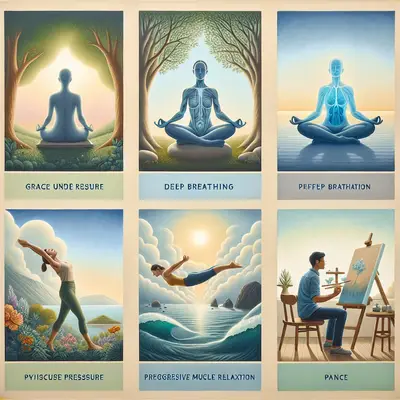
Stress rarely announces itself with drama. It seeps in through unfinished emails, late-night scrolling, and the subtle tightening of your jaw as you move through the day. For the discerning mind, relief is not about escape, but about cultivating a poised, precise response to pressure—one that feels elegantly sustainable rather than hastily improvised.
This is stress relief as quiet strength: not a luxury, but a refined discipline. Below, you’ll find five exclusive, deeply considered insights designed for those who view mental wellness as both an art and a standard of living.
Redefining Stress: From Enemy to Intelligent Messenger
Most people treat stress as a villain to be eliminated. A more elevated approach is to treat it as data—information about the gap between your current life and your deeper needs.
Physiologically, stress is your body’s adaptive alarm system, not inherently harmful but potentially corrosive when left in a chronic, unexamined state. The premium mindset is not “how do I stop feeling stressed?” but “what exactly is this tension trying to tell me?” This reframing turns rumination into inquiry.
You might notice that your stress spikes only in meetings where your values feel compromised, or on evenings after you’ve overridden your need for rest. Instead of numbing this discomfort, you become fluent in its language. Over time, this attitude subtly shifts your nervous system from antagonism to collaboration, easing intensity because the signal is finally being heard.
True relief emerges when stress is not suppressed, but intelligently negotiated.
Insight 1: The Micro-Transition Ritual – Closing Loops Between Moments
One of the most underestimated sources of tension is the way we slide from one demand to the next without any psychological closure. Your mind drags unresolved fragments—conversations, deadlines, irritations—from one context into another, creating a low-grade hum of unease.
A micro-transition ritual is a brief, intentional practice you insert between segments of your day—such as between work and home, meeting and email, laptop and pillow. It’s not a full break; it’s an elegant reset.
For example:
- After finishing a task, place your hands flat on the desk, exhale slowly for six seconds, and mentally say: “This is complete for now.”
- Before entering your home, pause at the door, feel your feet on the ground, and decide who you want to be in the next hour: partner, parent, friend, or simply a human at ease.
- After closing your laptop, gently rest your gaze on a distant point for 30 seconds, letting your eyes and mind widen before engaging with anything else.
These rituals signal to your nervous system that one chapter has closed and another is beginning. Over time, they reduce the cognitive “carryover” that makes your days feel like a single, uninterrupted, relentless stream. The result is a quieter mind—not because you did less, but because you ended what you started, moment by moment.
Insight 2: Nervous System Editing – Curating What Your Body Actually Has to Hold
Stress relief is often approached as a mental exercise, yet your nervous system quietly holds the imprint of nearly everything you experience—noise, notifications, expressions, posture, light. A refined strategy is to edit what your body is asked to process.
Instead of trying to “think your way” out of stress while marinating in overstimulation, you reduce the baseline load. You can do this subtly, without drastic lifestyle theatrics:
- Auditory curation: Replace background news or talk shows with soft instrumental soundscapes for certain hours. Your amygdala does not distinguish sharply between witnessed conflict and implied threat; reducing exposure to agitating audio lowers baseline arousal.
- Visual decluttering: Clear a single surface in your primary workspace or home—a desk, bedside table, or countertop. A visually quiet field becomes a small sanctuary for an overwhelmed nervous system.
- Postural refinement: Stress often lives in microscopic habits: shoulders slightly raised, jaw gently clenched, breath shallow. Several times a day, perform a 10-second check: drop the shoulders, unclench the teeth, soften the tongue, and invite one fuller inhale. This is nervous system editing at the level of micro-gesture.
By thoughtfully curating inputs, you are not being delicate; you are being precise. Your body is no longer forced to metabolize a constant flood of minor threats, which means your capacity for real pressure increases with surprising elegance.
Insight 3: The Luxury of Cognitive Boundaries – Designing a Mind with Doors
In a world that rewards constant mental availability, a boundary is no longer merely a psychological recommendation; it is a high-end performance tool. One of the most sophisticated forms of stress relief is the deliberate creation of cognitive boundaries—deciding which thoughts are allowed in, and when.
Instead of aiming for “work-life balance,” consider “cognitive zoning”:
- Time-bound concerns: Allocate specific windows to think about particular domains (finances, long-term goals, complex relationships). Outside those windows, when a related worry appears, you acknowledge it and gently bookmark it: “Not for now. For Wednesday at 5 p.m.”
- Device doors: Decide where, in your physical environment, certain thoughts are allowed. For instance, emails are read and answered only at your desk—not in bed, not at the dinner table, not in transit. The body learns: “Here, we rest. There, we respond.”
- Thought-tiering: Not every concern merits the same psychological budget. Mentally categorize: Is this a 5-minute worry, a 30-minute problem, or a multi-week project? By right-sizing your response, you prevent every irritation from receiving the energy of a crisis.
This approach doesn’t deny reality; it sequences it. The result is that your mind becomes a home with well-defined rooms, rather than a single, chaotic, multipurpose space. Stress reduces not because life becomes easier, but because your mental architecture becomes more deliberate.
Insight 4: Emotional Refinement – Upgrading from Vague Distress to Precise Language
One reason stress feels so smothering is that it’s often labeled with blunt terms: “I’m overwhelmed,” “I’m anxious,” “I’m stressed.” These phrases are emotionally honest but operationally vague. Emotional refinement is the practice of naming your inner state with greater precision—and it has a calming effect.
When you move from “I’m stressed” to “I am frustrated that my efforts feel unnoticed,” or “I am unsettled because the outcome is uncertain,” the nervous system receives clarity. It recognizes that the threat is relational, situational, or existential—not universal.
You can refine in three steps:
Locate: Where is the stress most noticeable—chest, throat, stomach, jaw?
2. Label: Choose more specific words—irritated, disappointed, worried, ashamed, rushed, scattered, pressured, depleted. 3. Link: Complete the sentence: “I feel [specific emotion] because [specific trigger].”
This triad—locate, label, link—turns a fog into a map. From there, appropriate action becomes more obvious: a boundary, a conversation, a pause, or, at times, intentional acceptance. The elegance lies not in removing unpleasant emotion, but in relating to it with discernment instead of vague dread.
Insight 5: Recovery as a Crafted Experience, Not an Afterthought
For many high-functioning individuals, recovery is what happens accidentally—half-watching a show, half-scrolling, half-resting. Yet refined stress relief is built on intentional recovery, where rest is treated as something to be designed, not stumbled into.
Consider crafting a “signature recovery experience” that you can reliably return to—a personal ritual that feels both grounding and beautiful:
- Sensory consistency: Choose one scent (a particular tea, essential oil, or candle), one texture (a blanket, robe, or chair), and one sound (playlist, ambient noise, or silence). Repeatedly pairing these with rest teaches your body to associate them with complete exhale.
- Structured brevity: Instead of waiting for a free weekend, curate a 12–20 minute nightly or afternoon sequence—a cup of herbal tea, five minutes of gentle stretching or breathwork, followed by a few pages of slow, analog reading. The brevity makes it repeatable; the structure makes it potent.
- Elegant boundaries: Protect this experience with the same seriousness you would a meeting with someone you respect. This transforms stress relief from a last resort to a non-negotiable signature of how you live.
When recovery is crafted with intention, your days no longer alternate between exertion and collapse. Instead, they unfold with a rhythm that feels both productive and humane—ambitious, but not self-erasing.
Conclusion
Stress in the modern world is inevitable; being frayed by it is not. Quiet strength emerges when you respond to pressure with design rather than default—curating transitions, inputs, boundaries, language, and recovery with the care usually reserved for the most important aspects of your life.
These five insights are not quick hacks, but enduring refinements. Implemented gently, they begin to alter not only how you manage stress, but how you inhabit your own mind: with precision, spaciousness, and an unmistakable sense of inner poise.
Sources
- National Institute of Mental Health – 5 Things You Should Know About Stress - Overview of what stress is, its effects on the body and mind, and basic coping strategies
- American Psychological Association – Stress Effects on the Body - Detailed explanation of the physiological and psychological impact of stress
- Harvard Health Publishing – Understanding the Stress Response - Insight into how the stress response works and why chronic stress is harmful
- Mayo Clinic – Chronic Stress: Can It Cause High Blood Pressure? - Discussion of chronic stress and its link to cardiovascular health
- Yale Medicine – Stress and Your Health - Clinical perspective on stress-related health issues and evidence-based management approaches
Key Takeaway
The most important thing to remember from this article is that this information can change how you think about Stress Relief.