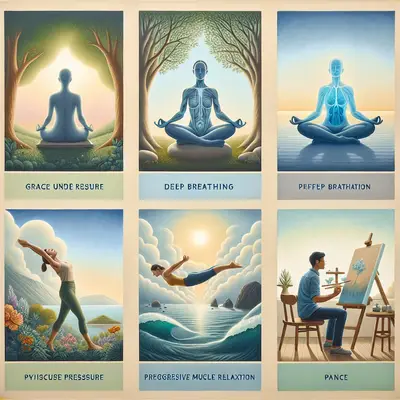
In a culture that glorifies urgency, genuine calm has become a quiet form of luxury. The most effective stress relief is rarely dramatic or performative; it is discreet, deliberate, and woven into the smallest details of a day. This is not about escaping life, but about inhabiting it with greater precision, elegance, and ease. What follows is an exploration of stress relief as a subtle daily art—five exclusive, refined insights for those who see mental wellness not as a trend, but as a lifelong craft.
Stress Relief as Energetic Curation, Not Emotional Control
Many people approach stress relief as a form of damage control—something to reach for once everything feels frayed. A more sophisticated approach sees it as energetic curation: the intentional design of what you allow to shape your inner climate.
Rather than attempting to control every emotion, you begin by editing inputs. This might mean being selective about which conversations you engage with after 8 p.m., which news notifications reach your phone, or which projects truly warrant your immediate attention. The goal is not withdrawal from life, but discernment about what earns your bandwidth.
This perspective reframes stress from being purely “out there” to something that is partially shaped “in here,” by how you allocate attention. Over time, this curation builds a sense of agency: you are not merely the recipient of stressors, but the architect of your inner thresholds. The result is a nervous system that is less frequently pushed to its limits, and far more capable of responding with clarity when it truly matters.
Precision Pausing: The Understated Power of 90-Second Intervals
Stress often escalates not because of a single event, but because we never interrupt its momentum. A refined practice is the art of precision pausing: brief, intentional interruptions that gently disrupt your stress trajectory before it becomes a cascade.
Neurophysiological research suggests that intense emotional waves can move through the body in roughly 90-second cycles when we do not continuously feed them with additional narrative. A 90-second pause—taken at the right moment—can prevent a difficult email, a tense meeting, or a moment of self-criticism from spiraling into an entire afternoon of agitation.
A precision pause is not merely “taking a break.” It is a structured micro-practice: closing your eyes if possible, softening your jaw, lowering your shoulders, and placing your attention on a single anchor (such as the sensation of your exhale or the feeling of your feet on the floor) for just 90 seconds. No analysis, no self-lecture, just a deliberate slowing of input.
These pauses are deceptively simple. Yet practiced consistently between transitions—before answering a message, entering a meeting, or responding to a request—they create a sense of refined composure. Your day begins to feel less like a series of collisions and more like a sequence of intentional entries.
Sensory Editing: Turning Everyday Moments into Nervous System Signals
Stress is not only psychological; it is profoundly sensory. The nervous system “reads” sound, light, temperature, scent, and touch long before the intellect forms an opinion. A premium approach to stress relief recognizes this and treats the senses as a direct pathway to nervous system safety.
Sensory editing is the deliberate adjustment of your environment so that it communicates calm at a subtle, continuous level. This might mean reducing harsh overhead lighting in the evening and using warmer, lower light sources, or introducing a single consistent scent—such as lavender, neroli, or sandalwood—that your body begins to associate with unwinding. It could be the quiet ritual of a particular tea in a specific cup, chosen not only for its ingredients but for its weight in your hand and its visual minimalism.
Sound is particularly powerful: a consistent, non-intrusive soundscape (soft instrumental music, nature sounds, or simple quiet) tells the nervous system that there is no immediate threat. Over time, these sensory cues become internal signals—your system begins to relax more quickly because it recognizes the environment as reliably safe.
This level of detail may seem subtle, but sophistication often resides in nuances. Sensory editing is not about creating a perfect aesthetic; it is about sending repeated, coherent messages to the body that it can exhale.
Cognitive Refinement: Upgrading Your Inner Dialogue from Reactive to Curated
Stress is amplified not only by events but by the internal commentary that follows them. Human minds are inclined toward negativity and overprediction of threat—an adaptive trait that, left unmanaged, can feel like mental static. Cognitive refinement is the art of becoming a discerning editor of your internal language.
Rather than forcing “positive thinking,” this approach focuses on precision. For instance, shifting from “Everything is falling apart” to “This is one difficult moment inside a larger, still-intact life” does not deny reality; it situates it. Replacing “I can’t handle this” with “This is a lot, and I am handling it piece by piece” recognizes both challenge and capacity.
You might designate one daily moment—during your commute, at your desk before you open your inbox, or in the few minutes after brushing your teeth—to scan for one dominant thought pattern that has colored your day. Then you refine it: not into wishful thinking, but into a more accurate, measured statement that leaves room for choice and competence.
Over time, these micro-adjustments compound. Your inner dialogue ceases to be an unfiltered broadcast and becomes more like a curated channel—clearer, quieter, and far less prone to catastrophizing. The nervous system responds in kind, softening its hypervigilance when it is no longer constantly fed with exaggerated internal alarms.
Rest as Strategy: Treating Recovery Like a High-Value Appointment
Stress relief is often undermined by a single belief: that rest is optional, a luxury to be earned after productivity. A more elevated view treats rest as an integral part of performance and presence—a non-negotiable strategy, not a reward.
This begins with a simple but powerful reframe: scheduling recovery with the same seriousness as important meetings. Rather than vaguely intending to “rest more,” you define specific, protected windows—perhaps a technology-light hour before bed, a non-negotiable midday stepping-away-from-screens interval, or a weekly block reserved for something genuinely restorative (not simply numbing).
Sleep, in particular, becomes a central pillar. Even modest improvements in sleep duration and quality can drastically alter how stress is processed the following day. Supporting this might include a consistent sleep-wake schedule, a wind-down ritual that is quiet and repeatable, and a deliberate boundary around late-evening mental stimulation.
Seen through this lens, rest is not evidence of weakness or self-indulgence. It is silent infrastructure—an elegant system of support that underwrites clear thinking, emotional steadiness, and the capacity to meet stress without being consumed by it. Those who treat rest as strategy rather than afterthought often discover that life feels less like a test of endurance and more like a series of deliberate engagements.
Conclusion
Refined stress relief is rarely dramatic. It is quiet, precise, and cumulative—an art practiced in choices so small they are often invisible to others. You curate your inputs rather than attempting to control every emotion. You interrupt stress in 90-second intervals instead of allowing it to gather force. You edit your sensory world, refine your inner language, and treat recovery as a central part of your design, not a leftover.
This approach does not promise a life without pressure. Instead, it offers something deeper: the ability to meet pressure without abandoning your inner elegance. Over time, that becomes its own form of calm wealth—an internal reserve that cannot be easily disrupted by the noise of the external world.
Sources
- American Psychological Association – Stress and Health - Overview of how stress affects the body and mind, with evidence-based strategies for coping
- Harvard Health Publishing – Understanding the Stress Response - Explains the physiology of the stress response and its impact on health
- National Institutes of Health – Stress Fact Sheet - NIMH resource detailing types of stress, symptoms, and treatment approaches
- Cleveland Clinic – Emotional Regulation and the 90-Second Rule - Discusses emotional waves, their duration, and practical tools for working with them
- Centers for Disease Control and Prevention – Sleep and Health - Describes the relationship between sleep, stress, and overall wellbeing
Key Takeaway
The most important thing to remember from this article is that this information can change how you think about Stress Relief.