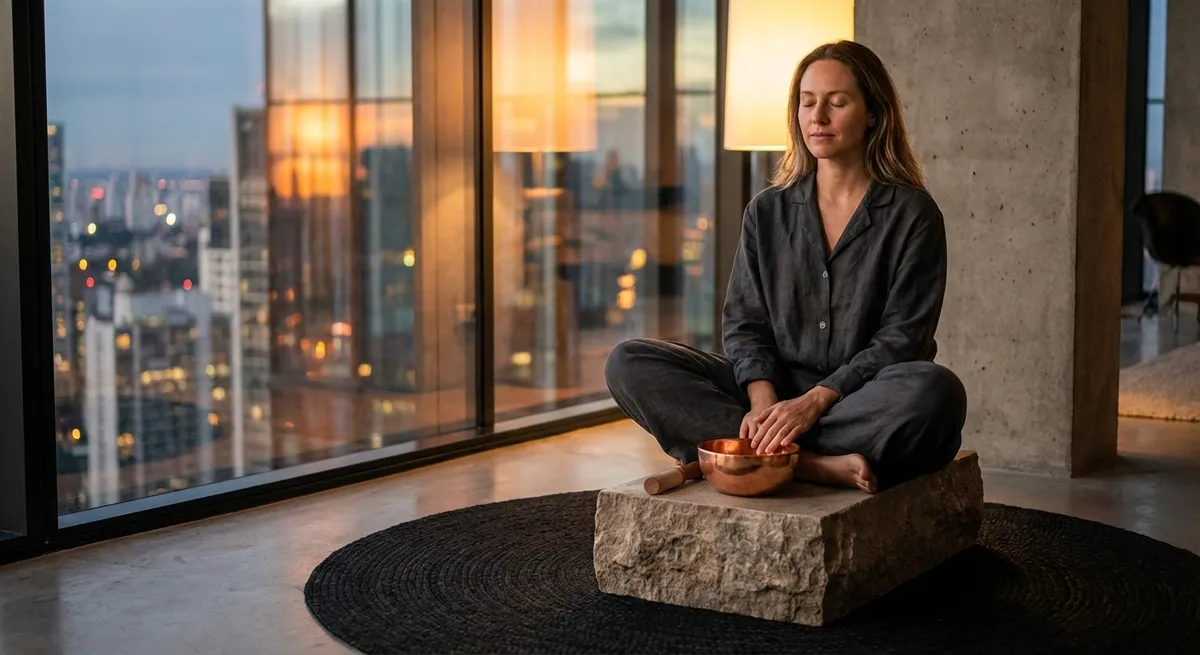
The most discerning forms of self-care are rarely loud. They are quiet, exacting, and meticulously chosen. Meditation, when practiced with intention and refinement, becomes less a vague “relaxation technique” and more a precision instrument for directing attention, emotional tone, and mental clarity. This is not about retreating from life; it is about entering it with composure that feels deliberate—almost architectural. Below, you’ll find five exclusive, elevated insights designed for those who see mental wellness not as an afterthought, but as a crafted standard.
Meditation as Cognitive Curation, Not Escape
Many approach meditation as a way to flee their thoughts, hoping for a blank mind. A more sophisticated understanding views meditation as cognitive curation: the art of selecting which thoughts receive your energy and which are allowed to dissipate without engagement.
Instead of “stopping thoughts,” imagine you are curating an art gallery. Every thought that arises is a piece offered for display. During meditation, you are not obligated to hang every piece on the wall of your attention. You simply acknowledge each, decide whether it serves the gallery you’re creating, and let it pass if it does not. Over time, this trains the mind to elevate nuanced, helpful thinking while allowing repetitive noise to remain background.
This curated approach subtly refines your inner dialogue outside of meditation. Meetings feel less crowded by mental clutter. Conversations gain more space for nuance. Choices feel less reactive, more deliberate. Meditation thus becomes not a sanctuary from life, but a training ground for more elegant thinking within it.
The “Micro-Precision” Session: Five Minutes of Deliberate Depth
Length is often mistaken for depth. A 40-minute meditation done distractedly can be less effective than a five-minute session executed with surgical precision. The “micro-precision” session is an elevated structure for those who prefer quality over duration.
In just five minutes, you can move through three deliberate phases:
- Anchor (60–90 seconds): Sit with a poised posture—shoulders relaxed, spine tall, jaw softened. Choose a single anchor: breath at the nostrils, the sensation of the chest rising, or the feeling of your hands resting. Your only task: notice, feel, name (“in, out” or “rise, fall”).
- Refinement (2–3 minutes): Each time the mind drifts, you do not criticize; you simply label the type of distraction with one refined word: “planning,” “remembering,” “judging,” or “anticipating.” Then, gently return to the anchor. This quiet taxonomy develops a precise awareness of your mental habits.
- Integration (60–90 seconds): Before you open your eyes, ask a single, focused question: “How do I want to show up for the next hour?” Choose one quality—composed, attentive, generous—and briefly visualize yourself embodying it in your immediate future.
This structured micro-practice is tailored for those with demanding schedules who still insist on depth. It transforms five spare minutes into a high-yield, mentally clarifying ritual that can be repeated between calls, before negotiations, or as a reset after emotionally dense interactions.
The Sensory Minimalist: Elevating Your Meditation Environment
Refined meditation is not about elaborate accessories, but about intentional sensory subtraction. The goal is not asceticism; it is the creation of a clean, understated environment that telegraphs to the nervous system: “This is where I exhale.”
Consider three pillars of sensory minimalism:
- Visual restraint: Choose a setting with minimal visual noise—a clear table, a single candle, a neutral-toned cushion. Visual clutter forces the mind to process and categorize; simplicity preconditions the brain for stillness.
- Textural elegance: Let your body register subtle comfort without indulgence. A soft but structured seat, breathable natural fibers, and stable grounding under the feet or seat communicate safety and stability at a somatic level.
- Scent as a quiet signal: A consistent, subtle scent—such as a single essential oil or a lightly fragranced candle—used only during meditation can become an anchor in itself. Over time, this pairing trains your nervous system to anticipate calm the moment the scent appears, creating an elegant, Pavlovian exhale.
This sensory minimalism means your space does some of the mental work for you. Rather than forcing stillness, you step into a room that gently suggests it.
Emotional Alchemy: Using Meditation to Refine, Not Suppress, Feeling
The sophisticated meditator does not strive to become emotionally neutral; instead, they develop the capacity to refine emotions into usable information rather than uncontained reactivity. Meditation becomes the crucible where raw feeling is heated, observed, and transformed.
When a strong emotion arises—irritation, anxiety, envy—your practice is to:
- Locate it physically: Identify where it lives in the body: tight chest, clenched jaw, raised shoulders, churning stomach. This shifts you from narrative to sensation.
- Name it precisely: Avoid vague labels like “bad.” Instead, choose nuanced words: “uneasy,” “overstimulated,” “slighted,” “uncertain.” Precision in language supports precision in regulation.
- Stay, but don’t spiral: Remain with the sensation for a few breaths, without adding story: no replaying of conversations, no imagined arguments. You are observing, not editorializing.
- Inquire gently: When the emotion feels slightly less raw, ask: “What is this feeling trying to protect or request?” Often, anxiety hides a need for clarity, irritation a boundary, envy a latent desire.
In time, meditation trains you to experience emotions as data to be decoded, not storms to be feared. You remain fully human—touched, moved, affected—yet less easily hijacked. This is not numbness; it is emotional elegance.
The Subtle Performance Edge: Meditation as Discreet Mental Engineering
At higher levels of responsibility—whether in leadership, creative work, or caregiving—mental performance is less about working harder and more about eliminating friction. Meditation, practiced consistently, becomes a discreet form of mental engineering that sharpens your edge without fanfare.
Three quiet shifts emerge with regular practice:
- Reduced cognitive noise: You recover faster from distractions, returning to tasks more efficiently. This is not just “focus”; it is reduced switching cost—the mental tax of bouncing between tasks, thoughts, and stimuli.
- Enhanced meta-awareness: You begin to notice your state before it derails you. You catch the early signs of impatience in a meeting, the subtle tightening before a difficult conversation, and can adjust in real time.
- Composed presence: Others may not know you meditate, but they will feel the difference. You listen without visibly rushing, pause before responding, and hold silence with ease. This kind of presence is quietly persuasive; it signals both steadiness and self-command.
When approached as a precision tool rather than a vague wellness trend, meditation becomes a quiet competitive advantage—one that optimizes how you think, decide, and relate, often in ways only you fully understand.
Conclusion
Meditation, practiced with discernment, belongs less in the realm of “self-improvement fads” and more alongside well-tailored clothing, considered interiors, and intentional routines: a subtle marker of how seriously you take your inner life. It is not about dramatic retreats or ornate rituals, but about repeated moments of precise attention—five refined minutes at a time—that accumulate into a different quality of mind.
In a world that rewards speed and noise, choosing stillness with accuracy and grace is a statement in itself. You are not merely surviving your days; you are engineering the mental conditions under which you perform, connect, and create at your quiet best.
Sources
- National Institutes of Health – Meditation: In Depth – Overview of meditation types, potential benefits, and current research from a U.S. government health agency
- American Psychological Association – Mindfulness Meditation: A Research-Proven Way to Reduce Stress – Summarizes psychological research on how meditation affects stress, emotion regulation, and cognition
- Harvard Health Publishing – Mindfulness Meditation May Ease Anxiety, Mental Stress – Discusses clinical findings on meditation’s effects on anxiety and stress from a leading medical institution
- Mayo Clinic – Meditation: A Simple, Fast Way to Reduce Stress – Practical overview of meditation benefits and techniques from a major healthcare organization
- JAMA Network – Effect of Mindfulness-Based Stress Reduction vs. Escitalopram on Anxiety Disorders – Peer-reviewed clinical trial comparing a structured meditation program with medication for anxiety disorders
Key Takeaway
The most important thing to remember from this article is that this information can change how you think about Meditation.