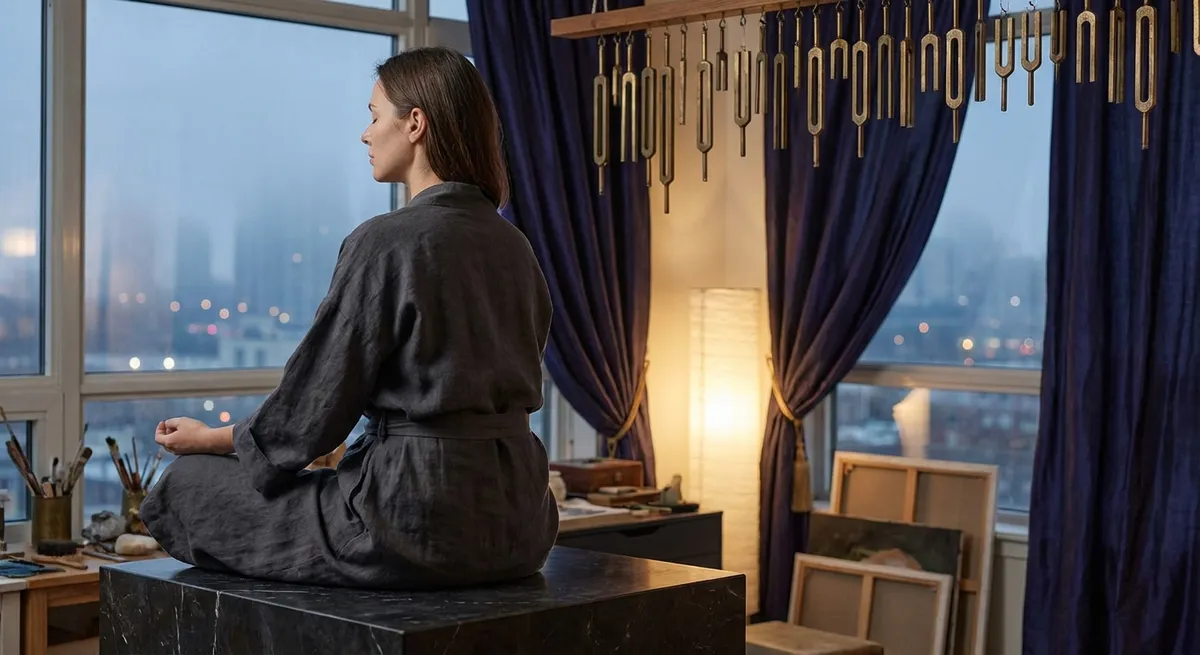
Meditation is often described in broad strokes—relaxation, focus, presence. Yet for a discerning mind, those abstractions can feel imprecise. What if meditation were approached instead as a process of fine-tuning, an art of subtle calibration rather than a blunt attempt to “switch off” the mind? For those who value refinement—of environment, of routine, of inner dialogue—meditation can become less of a wellness task and more of a cultivated mental craft. This piece explores meditation not as a generic practice, but as an elegant discipline of quiet precision, with nuanced insights chosen for those who appreciate detail, subtlety, and depth.
Meditation as Cognitive Curatorship, Not Escape
Many approach meditation hoping for temporary escape—relief from deadlines, notifications, and mental noise. Yet the more sophisticated use of meditation is not to flee the mind, but to curate it.
Instead of trying to empty your thoughts, imagine yourself as a curator in an impeccably designed gallery. Thoughts still appear, but you decide what is displayed at the center and what is quietly returned to storage. Rather than resisting unwanted mental content, you refine which patterns receive your sustained attention. Over time, this shifts meditation from a battle against distraction to an editorial process of the mind.
This shift is powerful because it aligns with how high-functioning individuals already operate in other areas: selecting priorities, choosing conversations, editing their calendars. In meditation, the same principle applies to internal content. You learn to notice which thoughts deserve a place in your mental “front room” and which are simply passing background noise.
This cognitive curatorship has a measurable basis. Research on attention and mindfulness suggests that non-reactive awareness of thoughts—labeling them rather than fusing with them—reduces rumination and emotional reactivity. In practice, that means the mind stays alert, but less entangled. Meditation becomes not about turning the lights off, but adjusting the spotlight.
The Architecture of Attention: Designing Your Inner Space
We often obsess over the external setting for meditation—lighting, scent, sound—yet neglect the inner architecture that matters more: how attention is structured. For a refined practice, think in terms of designing an interior space of the mind.
Begin with a “central object” of attention—typically the breath, but it can also be a precise sensation (the coolness of the inhale at the nostrils, the rise of the sternum, the weight of the body on the chair). This is not chosen at random; it is your anchor, the minimal, understated centerpiece of your inner room.
Around this central object, you allow secondary sensations to exist—ambient sounds, distant thoughts—without promoting them to the center. The discipline lies not in suppressing them, but in maintaining the architectural hierarchy: the breath remains the focal sculpture; everything else is context.
This architectural framing refines three qualities:
- Stability – You repeatedly return to the central object, training the mind to “come home” without drama.
- Clarity – You develop sensitivity to fine-grained sensations, noticing micro-shifts in breath and posture that most people miss.
- Spaciousness – By letting peripheral experiences remain peripheral, you discover that busyness and calm can coexist within a larger, stable awareness.
Over time, meditation ceases to be a fragile state that breaks at the first distraction. It becomes more like an elegantly designed room: people may walk through, sounds may come and go, but the form and feeling of the space remain intact.
The Luxury of Micro-Moments: Precision Practice in Daily Life
A sophisticated meditation practice does not rely solely on long, isolated sessions. Instead, it extends into the day in subtle micro-moments—brief, deliberate recalibrations that are almost invisible from the outside, yet transformative within.
Think of these as “precision intervals” of 20–60 seconds:
- Pausing before opening your inbox to feel three full breaths.
- Standing in a quiet hallway and noticing how your weight is distributed across your feet.
- Waiting for a video call to connect and gently relaxing the muscles around the eyes and jaw.
- Sitting in a car or rideshare and following the movement of the breath for ten cycles rather than defaulting to your phone.
These micro-moments are not a lesser version of “real” meditation; they are the sophisticated continuation of it. They prevent the practice from becoming quarantined to a cushion and instead weave it through the architecture of your day.
Research on mindfulness in everyday life shows that brief, frequent moments of mindful awareness can improve mood, reduce perceived stress, and enhance cognitive flexibility. For someone with a demanding schedule, this approach is both realistic and quietly luxurious: calm is no longer confined to an appointment with yourself—it’s integrated as a design principle of your day.
Emotional Tasting Notes: A Refined Palette for Inner States
Just as a refined palate can distinguish subtle flavor notes, a refined mind can distinguish emotional nuances. Meditation, practiced with care, heightens this discernment.
Most people file their emotional experience under blunt labels: “stressed,” “fine,” “overwhelmed,” “okay.” In meditation, you begin to notice that what you usually call “stress” may actually be a precise blend: mental speed, tightness in the chest, warmth in the face, a specific narrative about time or expectations.
Instead of collapsing everything into one label, you quietly study:
- Where is this felt in the body?
- Is it heavy, tight, buzzing, hollow, warm, cold?
- Does it arrive in waves, spikes, or a steady background hum?
- What thought patterns seem to amplify it; which ones soften it?
This is not indulgent self-analysis; it is emotional literacy. Research on affect labeling—simply putting words to internal states—shows that it can reduce emotional intensity and reactivity. In practice, that means that naming and precisely sensing your inner climate makes it more workable, less overwhelming.
For the mentally ambitious, this is a crucial insight: meditation is not about becoming unfeeling or endlessly serene. It is about gaining a more elegant vocabulary and sensitivity for your internal world, so that complex emotions can be navigated with the same finesse you might apply to a complex project or negotiation.
The Quiet Audit: Aligning Values, Habits, and Mental Atmosphere
Beyond relaxation, meditation offers something much rarer: a quiet audit of your inner life. In stillness, patterns surface—what you repeatedly think about, defend, avoid, or long for. If approached consciously, this becomes a refined review, not a flood of self-criticism.
After a session, instead of rushing to the next task, take two to three minutes for a mental audit with three discreet questions:
What themes kept resurfacing? Work, relationships, identity, security, status, health?
What did my body consistently communicate? Fatigue, tension, restlessness, or actually, surprising ease?
3. What felt misaligned? Perhaps the way you’re spending time does not reflect what you quietly value most.
This is where meditation transcends technique and becomes strategic. You begin to see which obligations are genuinely necessary and which are habit. You notice where your calendar and your values do not match. You detect subtle forms of self-sabotage: overcommitting, under-resting, or chasing distractions that dilute your attention.
The audit is not about perfection; it is about refinement. It allows you to make micro-adjustments—slightly different boundaries, a more protective sleep routine, a clearer “no” to unnecessary engagements—that cumulatively transform your mental atmosphere. Over months, the mind you sit down to meditate with becomes less chaotic not because life is easier, but because its design has become more intentional.
Conclusion
Meditation, approached with precision and elegance, is far more than a technique for calming down. It is an art of mental fine-tuning: curating thoughts instead of escaping them, designing an inner architecture for attention, incorporating micro-moments of presence into the day, cultivating a refined emotional palette, and conducting quiet audits that realign life with deeper values.
For those who seek more than generic wellness advice, this approach offers something enduring—a way to treat the mind as a finely crafted instrument worthy of care, calibration, and respect. Calm is no longer a rare event; it becomes an atmosphere you can deliberately cultivate, one subtle, attentive moment at a time.
Sources
- [Harvard Health Publishing – Mindfulness meditation may ease anxiety, mental stress](https://www.health.harvard.edu/mind-and-mood/mindfulness-meditation-may-ease-anxiety-mental-stress) – Overview of research on mindfulness and its effects on stress and emotional regulation.
- [American Psychological Association – Mindfulness meditation: A research-proven way to reduce stress](https://www.apa.org/topics/mindfulness/meditation) – Summarizes psychological findings on how meditation influences attention, mood, and cognitive processes.
- [National Center for Complementary and Integrative Health (NCCIH) – Meditation and Mindfulness: What You Need To Know](https://www.nccih.nih.gov/health/meditation-and-mindfulness-what-you-need-to-know) – Evidence-based review of meditation’s benefits, mechanisms, and appropriate use.
- [Greater Good Science Center, UC Berkeley – How the brain changes when you meditate](https://greatergood.berkeley.edu/article/item/how_the_brain_changes_when_you_meditate) – Discusses neuroscientific research on attention, emotion, and brain structure in meditators.
- [UCLA Mindful Awareness Research Center – What is Mindfulness?](https://www.uclahealth.org/programs/marc/mindfulness) – Educational resource explaining mindfulness practices and how to integrate them into daily life.
Key Takeaway
The most important thing to remember from this article is that this information can change how you think about Meditation.