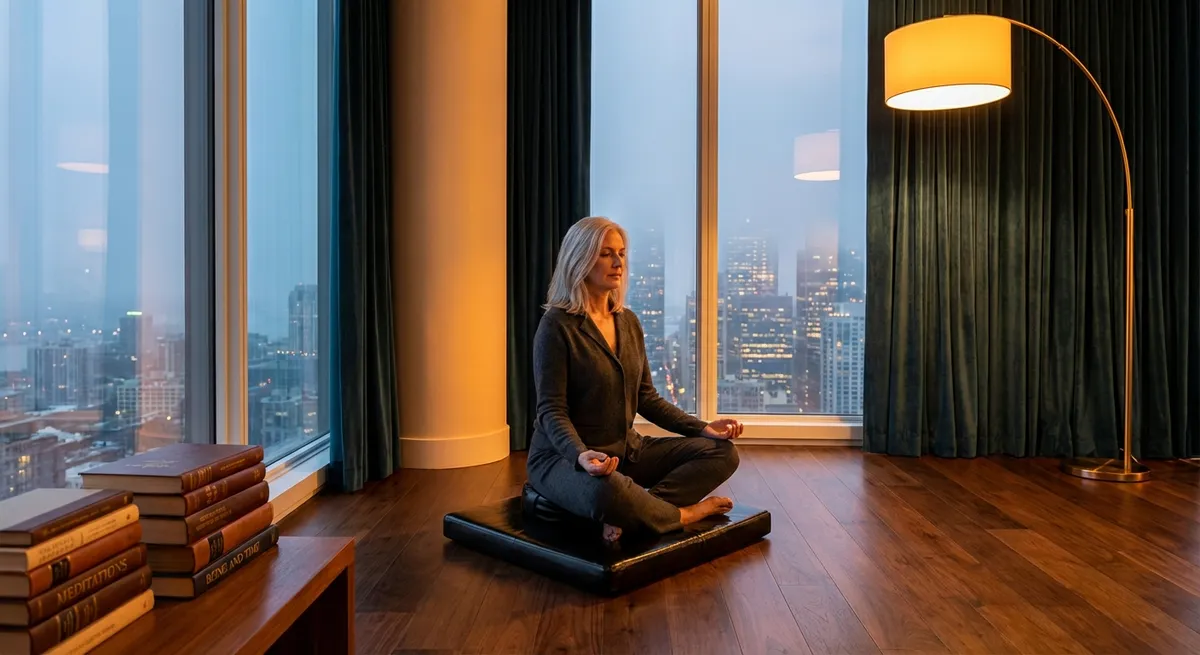
In a culture that prizes speed, the rarest luxury is not another possession—it is an unhurried mind. Meditation, when approached with discernment and intention, becomes less a wellness “habit” and more a private signature of how you move through the world. This is not about escaping life, but about inhabiting it with a quieter, more exquisite presence. What follows is a refined exploration of meditation, designed for those who value subtlety, precision, and rituals that age well.
Meditation as Mental Tailoring, Not a One-Size Practice
Meditation is often presented as a universal prescription: sit, breathe, clear the mind. But a sophisticated practice recognizes that your inner life deserves something more bespoke than a standard template.
Rather than forcing yourself into a generic technique, consider meditation as mental tailoring—an ongoing refinement of methods that match your temperament, daily demands, and aesthetic of living. A highly visual mind might benefit from elegant visualization practices; a restless analytical mind may respond better to structured breathing sequences or mantra repetition that gives thought patterns a subtle, dignified rhythm.
Think of your meditation style the way you think of your wardrobe or your interior spaces: curated, evolving, and aligned with who you are when you are at your most honest and unperformed. This approach transforms meditation from a task you “should” complete into a ritual that feels as personally relevant and non-negotiable as your chosen fragrance or your preferred morning light.
Over time, this tailored approach creates something rare: a practice that feels like it was designed for you, not something you must contort yourself to fit.
The Quiet Architecture of Your Environment
Most advice about meditation focuses on what happens in your mind, but the physical setting is a silent collaborator. A refined practice acknowledges that the environment is not background—it is part of the technique.
Instead of a generic “meditation corner,” consider creating what might be called a stillness vignette: a small, intentional composition of elements that quietly signal to your nervous system that it is safe to soften. This does not require elaborate décor, but it does call for discernment. One carefully chosen chair or cushion, a single tactile throw, a low, indirect light source, and perhaps one natural element—a stone, a branch, a small bowl of water—can be enough.
The aim is not to impress others but to create a setting that feels like an internal exhale the moment you enter it. Neutral or softened tones, an absence of visual clutter, and the removal of distracting digital devices help reduce cognitive load before you even close your eyes. The space becomes a kind of mental foyer, where the noise of the day is left at the door.
This attention to environmental detail is not superficial; studies suggest that lighting, sound, and visual complexity all subtly affect stress levels and cognitive performance. A thoughtfully composed meditation setting becomes a daily reminder that you are allowed to interact with your own mind in a slower, more deliberate way.
Five Exclusive Insights for a More Refined Practice
For those who have moved beyond basic “how-to” guides, these nuanced insights can deepen meditation into an elegant, enduring part of your life.
1. Treat Meditation as Refinement, Not Repair
Many people come to meditation only when they feel frayed or overwhelmed, using it reactively as a tool for crisis management. A more refined approach is to treat meditation as ongoing mental craftsmanship—a way to tune perception, strengthen emotional nuance, and refine how you respond to the world long before you reach a breaking point.
Instead of asking, “How can this fix my stress?” consider, “How can this elevate the way I experience ordinary moments?” This subtle shift—from repair to refinement—eases the pressure to achieve instant calm and invites curiosity about the finer details of your mental life: the micro-pauses between thoughts, the texture of your attention, the way your mood shifts with your breathing.
The result is not dramatic transformation overnight, but a gentle recalibration of your baseline—a quieter default setting that makes high-pressure moments less destabilizing when they arise.
2. Let Your Breath Become Your Signature Rhythm
Breathwork is often presented as a technique to master, but you can approach it as something more personal: your own almost-invisible signature. The tempo, depth, and texture of your breathing are as individual as your gait or your handwriting.
Rather than rigidly forcing a prescribed count, begin by observing your natural breath with forensic curiosity: where it initiates in your body, how it changes with different emotions, how long it takes to return to baseline after a demanding conversation or a long meeting. Then, introduce subtle refinements—slightly lengthening the exhale, softening the shoulders on each out-breath, allowing the abdomen to receive the inhale instead of the upper chest.
One particularly elegant pattern for mental clarity is a gentle 4–6 rhythm: inhaling for four counts, exhaling for six. The longer exhale invites the parasympathetic nervous system—your body’s “rest and restore” mode—to participate. With regular practice, this breathing rhythm can become a quiet companion you return to in elevators, boardrooms, and late-night restlessness, without anyone else noticing.
3. Curate Your Internal Language with Care
Thoughts are not just noise; they are language patterns that either agitate or soothe. In meditation, your internal commentary deserves the same editorial rigor you would apply to any refined communication.
Instead of chastising yourself for distraction (“Why can’t I focus?”), adopt language that suggests direction without judgment: “Returning,” “Softening,” “Observing.” These single words can serve as understated anchors. They guide without scolding, allowing you to maintain dignity in your inner dialogue even when your mind is unsettled.
Over time, this curatorial approach to self-talk begins to shape how you speak to yourself outside of meditation as well. In high-pressure situations, you may find that your mind no longer defaults to critique, but to quiet labels: “Noticing stress,” “Choosing pause,” “Allowing space.” The internal tone becomes less punitive and more composed—an invisible luxury that eventually colours every decision you make.
4. Integrate Micro-Meditations into Transitional Moments
A sophisticated practice recognizes that the modern day is rarely spacious. Rather than mourning the absence of long, uninterrupted sessions, you can transform transitional slivers of time into micro-meditations with surprising impact.
Moments such as waiting for a kettle to boil, sitting in a parked car, standing in an elevator, or pausing between virtual meetings can become 30–90 second rituals of reset. A single slow breath cycle, a brief body scan from jaw to shoulders, or a silent phrase like “arriving here” can quietly reset your nervous system.
These small, nearly invisible practices create a mosaic of calm that accumulates throughout the day. Instead of one isolated session with long stretches of reactivity, you cultivate a lightly meditative tone to your entire schedule. The elegance lies in the subtlety; no one else needs to know that while you appear to be simply waiting, you are actually rebalancing your internal landscape.
5. Use Sensory Minimalism to Deepen Presence
For many, the modern sensory environment is saturated: constant notifications, layered sounds, multiple screens, multiple conversations. Meditation offers something rare when approached with intentional sensory minimalism—an environment where nothing competes for your attention.
One refined technique is to gently subtract stimuli before you meditate: silence unnecessary devices, lower the lighting, remove strongly scented products, and if possible, allow only one soft, steady sound (like distant rain, a low fan, or a quiet instrumental piece). The aim is not complete deprivation but a careful paring back, so the senses can finally exhale.
In this restrained environment, subtle experiences—like the movement of breath at the tip of your nose, or the warmth of your hands resting on your lap—begin to feel more vivid. The mind, no longer pulled in multiple directions, can explore the fine grain of the present moment. Sensory minimalism is not about austerity; it is about creating a stage on which presence can perform without interruption.
Crafting an Enduring, Elegant Ritual
A truly elevated meditation practice is not measured in perfect sessions or dramatic breakthroughs. Its sophistication lies in its consistency, its discretion, and its quiet integration into the architecture of your day.
Instead of aspiring to the ideal of a forever-calm mind, aim for something more grounded and luxurious: a life in which you regularly return to yourself with care. Where your thoughts are met not with impatience, but with a composed curiosity. Where the quality of your attention feels as meticulously chosen as the objects and experiences you allow into your home.
In this way, meditation becomes less an escape from your life and more the invisible framework that holds it together—a private, enduring ritual that, over time, shapes you into someone who moves through the world with a kind of unhurried clarity that is increasingly rare, and therefore, profoundly valuable.
Sources
- [National Center for Complementary and Integrative Health – Meditation: In Depth](https://www.nccih.nih.gov/health/meditation-in-depth) - Overview of different meditation types, potential benefits, and scientific evidence
- [American Psychological Association – Mindfulness Meditation: A Research-Proven Way to Reduce Stress](https://www.apa.org/topics/mindfulness/meditation) - Summarizes research on how meditation and mindfulness affect stress, mood, and cognition
- [Harvard Health Publishing – Mindfulness Meditation May Ease Anxiety, Mental Stress](https://www.health.harvard.edu/mind-and-mood/mindfulness-meditation-may-ease-anxiety-mental-stress) - Discusses clinical findings on meditation’s impact on anxiety and stress
- [Mayo Clinic – Meditation: A Simple, Fast Way to Reduce Stress](https://www.mayoclinic.org/tests-procedures/meditation/in-depth/meditation/art-20045858) - Practical overview of meditation, techniques, and health benefits
- [Greater Good Science Center, UC Berkeley – How Meditation Changes the Brain and Body](https://greatergood.berkeley.edu/article/item/how_meditation_changes_the_brain_and_body) - Explores research on neurological and physiological changes associated with meditation
Key Takeaway
The most important thing to remember from this article is that this information can change how you think about Meditation.