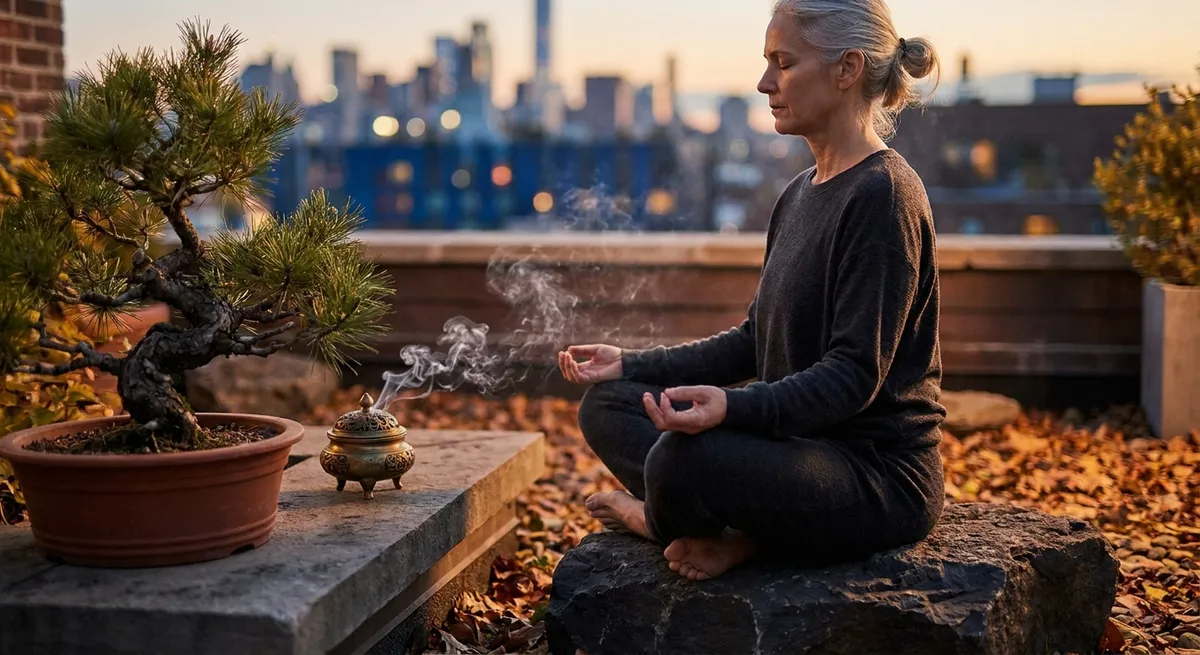
The most elegant luxuries are often the least visible. Among them, meditation stands apart—not as an escape from life, but as a refinement of how we move through it. For those who value discernment, subtlety, and quiet excellence, meditation is less a spiritual fad and more a lifelong craft: a way of training attention with the same care one might devote to curating a wardrobe or designing a room. This is not about perfection or performance; it is about cultivating an interior world that feels spacious, composed, and exquisitely your own.
Below are five exclusive, elevated insights into meditation that speak to a more refined approach to mental wellness—beyond apps, trends, and quick fixes.
Meditation as Mental Architecture, Not Just Relaxation
Meditation is often marketed as a way to “calm down,” but that drastically understates its sophistication. For a discerning mind, a more accurate framing is mental architecture: you are not merely soothing your thoughts; you are restructuring how your inner world is arranged.
Instead of seeing meditation as a break from your day, imagine it as the quiet drafting room where you sketch how you wish to think, feel, and respond. Breath awareness strengthens your capacity to stay with complexity without collapsing into anxiety. Open monitoring practices train you to notice patterns—self-criticism, catastrophizing, perfectionism—as they arise, and to choose a more elegant response. Over time, you are not just “less stressed”; you are differently organized inside: more coherent, less reactive, more deliberate. This architectural shift is why regular meditators often report that challenges feel navigable rather than overwhelming, even when external circumstances remain the same.
The Luxury of Unfragmented Attention
In a culture that splinters our focus into notifications, feeds, and perpetual urgency, sustained attention has become a quiet luxury. Meditation, at its core, is the cultivation of unfragmented attention—a resource as precious as time and as transformative as rest.
Consider the experience of truly listening to someone without checking your phone or preparing your reply. That single act of undivided presence can change the tone of a conversation, soften conflict, and deepen connection. Meditation trains this level of presence repeatedly: with your breathing, your bodily sensations, your thoughts, your surroundings. It is a daily rehearsal for being fully here, instead of chronically elsewhere in worry or distraction. Over time, your work becomes more focused, your relationships more textured, your leisure more satisfying. The mind, no longer pulled in a dozen directions, begins to feel both quieter and more potent—like a well-tuned instrument rather than background noise.
Curating Your Inner Sensory Palette
A refined life is rarely accidental; it is curated—textures, scents, lighting, and sound all chosen with intention. The same principle can be applied to meditation by treating your inner life as a sensory palette to be curated rather than endured.
During practice, instead of merely “trying to focus,” you can become connoisseurial about the nuances of your own experience. Notice the subtle temperature shifts in your breath, the micro-relaxations in your jaw as you exhale, the faint vibration of your pulse in your fingertips. This level of subtle observation trains a delicacy of perception that carries into daily life: the ability to detect rising stress earlier, to discern the difference between genuine fatigue and mere overstimulation, to sense when you need silence versus social contact. You become less at the mercy of blunt, late-stage signals like overwhelm or burnout and more attuned to the refined, early cues that invite gentler adjustments.
Transforming Overthinking into Disciplined Reflection
Many high-functioning, intellectually driven people quietly worry that meditation will dull their edge. In reality, when practiced skillfully, it does the opposite: it refines cognition, transforming overthinking into disciplined reflection.
Instead of trying to “stop thinking,” you can use meditation to separate useful thought from mental noise. When you sit, you notice the mind’s tendency to spiral: replaying conversations, rehearsing imagined scenarios, constructing intricate what-ifs. The practice is to label these patterns lightly—planning, remembering, worrying—without indulging or suppressing them. Over time, you begin to recognize when you are solving and when you are simply looping. This is the crucial distinction. Meditation doesn’t strip you of complexity; it edits it. Your mind becomes more like a well-edited manuscript: rich, but not cluttered; layered, but not chaotic. This shift allows for deep thinking without the exhaustion of perpetual rumination.
Designing a Signature Meditation Ritual
For the discerning practitioner, meditation is not a generic routine; it becomes a signature ritual—crafted, personal, and quietly luxurious. The goal is not aesthetic for its own sake, but to create an environment that signals to your nervous system: this is where we soften, sharpen, and reset.
Perhaps your ritual involves a single chair that you use only for meditation, a particular low light, and a single, well-chosen scent. Maybe it is a precise time of day—before the household wakes, or in the interval between work and evening—that becomes non-negotiable. You might pair your practice with a small, intentional act: a cup of unsweetened tea afterward, a brief note in a minimalist journal capturing one sentence about your state of mind. These details are not frivolous; they anchor the habit in sensory memory and make it something you look forward to rather than tolerate. Over time, this ritual becomes a private sanctuary of reliability—a place where, no matter how complex your outer life, your inner world knows exactly how to return to itself.
Conclusion
Meditation, approached with discernment, is less about chasing serenity and more about cultivating an inner standard: how you wish to think, feel, perceive, and respond in a world that constantly invites you to scatter yourself. It offers mental architecture instead of mere relief, unfragmented attention instead of endless distraction, curated perception instead of numbed autopilot, disciplined reflection instead of runaway thought, and a signature ritual instead of generic routine.
In the end, the most refined luxury is not what you own or where you go, but the quality of awareness you bring to each moment. Meditation is the craft of that awareness—quiet, exacting, and exquisitely transformative.
Sources
- National Institutes of Health – Meditation: In Depth - Overview of meditation types, benefits, and current research from the U.S. government’s integrative health institute
- American Psychological Association – Mindfulness Meditation: A Research-Validated Practice - Explores how mindfulness and meditation affect cognition, stress, and emotional regulation
- Harvard Health Publishing – Mindfulness Meditation May Ease Anxiety, Mental Stress - Summarizes clinical findings on meditation’s impact on stress and anxiety from Harvard Medical School
- Mayo Clinic – Meditation: A Simple, Fast Way to Reduce Stress - Practical overview of meditation techniques and documented health benefits
- National Center for Biotechnology Information – Neural Mechanisms of Mindfulness and Meditation - Research article examining how meditation alters brain structure and function
Key Takeaway
The most important thing to remember from this article is that this information can change how you think about Meditation.