In a culture of constant alerts and subtle exhaustion, genuine stillness has become a luxury—yet it is also a learnable skill. Meditation, approached with precision and elegance rather than obligation or trend, can become the quiet axis around which the rest of your life rotates. This is not about retreating from ambition or beauty; it is about cultivating a mind composed enough to fully inhabit both. What follows is an exploration of meditation as a refined daily practice, with five exclusive insights tailored for those who expect their mental wellness rituals to be as considered as the rest of their lives.
Meditation as Mental Architecture, Not Escape
For many, meditation is marketed as a quick antidote to stress—a way to step out of life for a few minutes. A more elevated approach is to treat meditation less as escape and more as architecture: you are not stepping away from your mind, you are redesigning its internal layout.
When you sit, you are effectively reconfiguring how attention is allocated, how emotional responses are triggered, and how thoughts are allowed to flow. Instead of chasing “calm” as a mood, you are constructing a mental environment that makes calm more probable. This reframing is crucial. It shifts meditation from a passive relaxation technique to a deliberate act of mental craftsmanship. Over time, this “architect mindset” encourages consistency: you meditate not because you feel distressed, but because you are invested in the ongoing design of your inner world. The result is a nervous system that responds less reflexively and a mind that feels both spacious and precise.
Curated Sensory Minimalism: The Understated Setup
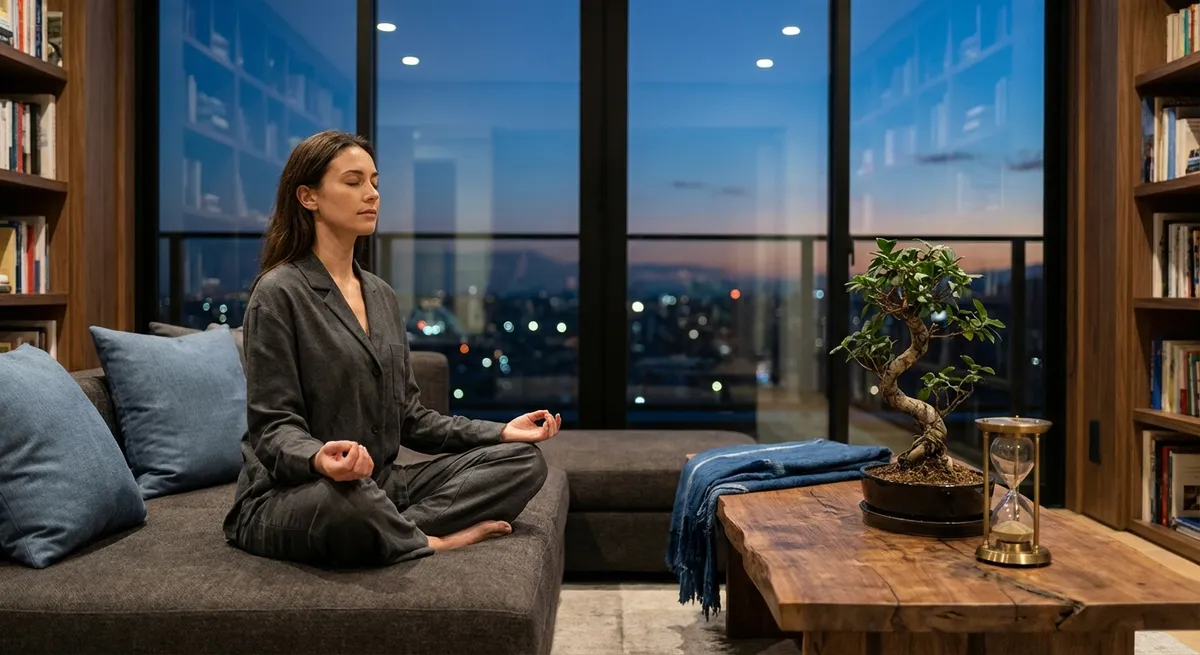
The way you stage your meditation space matters—not because it must be elaborate, but because it should be intentional. Think in terms of curated sensory minimalism: remove anything visually or physically noisy, and then add one or two elements that feel quietly luxurious rather than distracting.
A supportive chair or cushion that allows an upright spine without strain becomes an investment in longevity of practice, not just comfort. Lighting that is soft but clear—a shaded lamp, indirect daylight—signals to your nervous system that this is a time for processing rather than performing. A light, neutral fragrance (such as a single-note essential oil or a naturally scented candle) can become an olfactory cue that helps the mind associate a particular aroma with mental unwinding, provided it is not overpowering. Even the fabric that touches your skin—linen, cashmere, or simply a well-chosen cotton—can play a subtle role in signaling care and intention. By refining your sensory environment, you are essentially telling your brain, “Here, we do one thing at a time.”
The Precision of Attention: Elegant Focus over Force
Many people assume meditation means forcibly emptying the mind. A more sophisticated approach is to trade force for precision. Rather than battling thoughts, you become curious about how attention moves—what it clings to, what it rejects, and when it drifts.
One elegant method is to treat attention as a spotlight rather than a cage. You gently direct it toward a chosen anchor—the breath at the nostrils, the rise and fall of the chest, the sensation of the hands resting. The intention is not to exile all other thoughts, but to offer your mind a stable reference point whenever it wanders. When distraction inevitably appears, you notice it with almost clinical courtesy—naming it, if you wish (“planning,” “worrying,” “remembering”)—and then return to the anchor. This practice builds a quiet strength: the ability to choose where your mind rests, rather than being dragged by the strongest stimulus. Over time, this refined control of attention translates into daily life as better discernment, improved decision-making, and a calmer internal tone—even in demanding environments.
Emotional Clarity: Letting Feelings Unfold Without Negotiation
One of the most exclusive benefits of meditation, rarely discussed in surface-level wellness content, is emotional clarity. Meditation does not dull emotions; it refines your relationship with them. Instead of debating, suppressing, or exaggerating what you feel, you allow emotions to unfold in real time—without entering into negotiation with them.
During practice, when a feeling arises—irritation, sadness, mild dread—you resist the reflex to explain it or justify it. Instead, you observe its texture: Where is it in the body? Is it heat, tightness, pressure, hollowness? Does it pulse, contract, or expand? By studying emotions as experiences rather than verdicts, you reduce their power to define your identity. “I feel anxious” gradually shifts toward “Anxiety is present in the body,” which is both more accurate and less overwhelming. This emotional clarity cultivates a composed form of self-respect: you stop treating every internal reaction as a command and start experiencing it as information—valuable, but not absolute.
Time as a Deliberate Ingredient: Short Sessions, High Fidelity
There is a quiet sophistication in refusing the “all or nothing” approach to meditation. Rather than aspiring to sporadic, long sessions, consider shorter, high-fidelity practices as your standard—think 8–15 minutes of genuinely focused meditation, practiced consistently.
Consistency is not only about habit; it is about training your nervous system to expect—and then rely on—regular intervals of cognitive rest. These small, deliberate investments in stillness accumulate like discreet deposits in an internal savings account. Over weeks and months, you may notice that your baseline tension lowers, your reactivity softens, and your capacity to recover from stress improves. Integrating meditation into existing transitions—upon waking, before your first email, just after work, or immediately before bed—also makes it more sustainable. When time is treated as a carefully measured ingredient rather than an obstacle, meditation becomes not another demand on your schedule, but a structural support for it.
Integration: Letting the Practice Leak into the Day
The refined art of meditation does not end when you open your eyes. The most valuable returns often appear in the unremarkable moments between emails, conversations, and commutes. Integration means allowing the qualities cultivated in formal practice—spacious attention, emotional clarity, and sensory awareness—to “leak” into your day.
You might pause for three conscious breaths before responding to a difficult message, or take ten seconds in an elevator to feel your feet on the floor. You may notice the first signs of cognitive fatigue—a scattered mind, minor irritations becoming amplified—and use that awareness as a cue for a brief reset. These micro-moments of mindfulness quietly upgrade your baseline experience of daily life. They transform meditation from an isolated ritual into a subtle but continuous refinement of how you inhabit your own mind.
Conclusion
Meditation, approached with care and discernment, becomes far more than a wellness trend or stress-management tool. It is a cultivated discipline that reconfigures how you think, feel, and respond to the world. By treating your practice as mental architecture, curating a minimal yet refined environment, training precise attention, inviting emotional clarity, honoring brief but consistent sessions, and allowing your practice to permeate your day, you create a standard of inner life that matches the intentionality of your outer one. In a world that rewards speed and noise, this commitment to elegant stillness is not indulgence—it is strategy.
Sources
- National Center for Complementary and Integrative Health: Meditation and Mindfulness - Overview of meditation types, potential benefits, and current research from a U.S. government health agency.
- Harvard Health Publishing: Mindfulness Meditation May Ease Anxiety, Mental Stress - Summarizes clinical research on meditation’s effects on stress and anxiety.
- Mayo Clinic: Meditation – A Simple, Fast Way to Reduce Stress - Provides evidence-based information on how meditation works and practical guidance for starting.
- American Psychological Association: Mindfulness Meditation – A Research-Proven Way to Reduce Stress - Reviews psychological research on mindfulness and meditation and their impact on emotional regulation.
- NIH News in Health: Clearing the Mind – Meditation and Health - Discusses scientific findings on how meditation can affect brain function and overall well-being.
Key Takeaway
The most important thing to remember from this article is that this information can change how you think about Meditation.