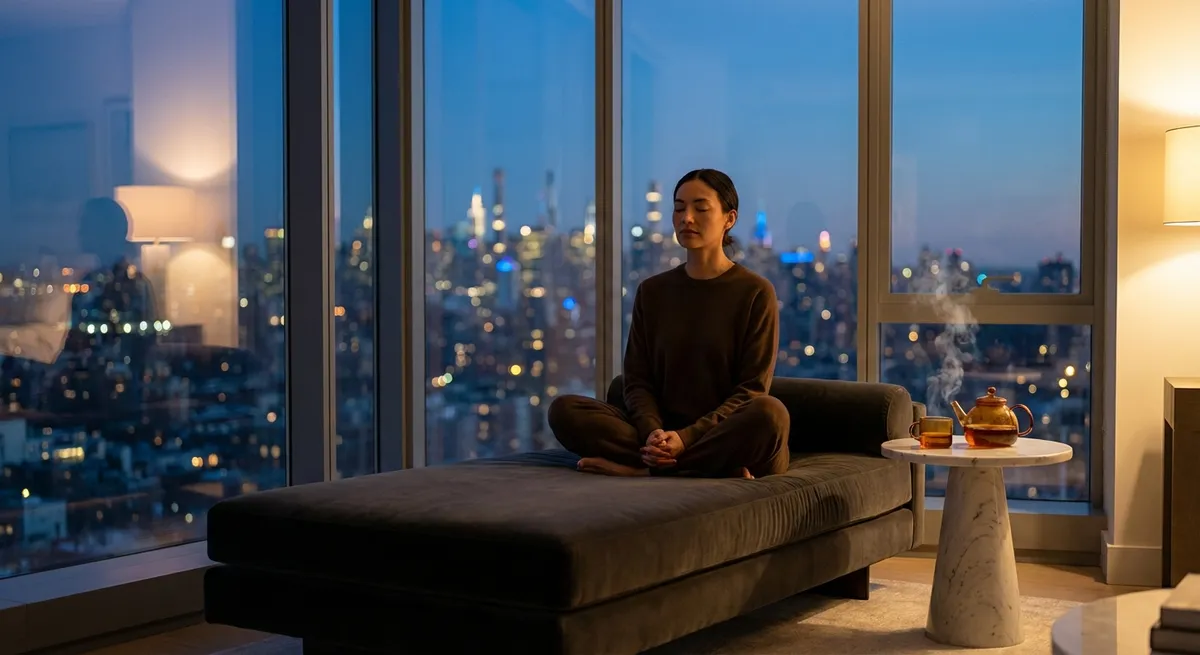
In a culture that measures value by velocity, stillness has become an understated luxury. Meditation, once framed as a basic relaxation tool, is now emerging as a bespoke practice for those who care deeply about the quality of their inner landscape. This is not about squeezing in five rushed minutes between emails; it is about cultivating a refined relationship with your own attention—one that quietly elevates every dimension of your life.
Below, you’ll find five exclusive, less-discussed insights into meditation—designed for those who seek not just calm, but a more artful, intentional way of being.
Meditation as Curation, Not Escape
Meditation is often miscast as an escape hatch: close your eyes, disappear from the world, and return when life feels less sharp. Yet for a discerning mind, meditation isn’t about retreat; it is about curation. Instead of turning away from your experience, you deliberately refine what earns the right to shape your inner climate.
Imagine your attention as a private gallery. Most days, unsolicited images, worries, and notifications flood the walls. A curated meditation practice reintroduces standards: which thoughts deserve display, and which belong in storage? As you sit, you are not erasing experience, but adjusting the lighting, rearranging what is foregrounded, and quietly deciding where your mental energy should be invested.
Over time, this curation becomes instinctive. You notice which thoughts are merely loud, and which are truly important. You differentiate urgency from importance, intensity from truth. Life’s demands don’t disappear; instead, you engage with them from a place of selective, composed presence. Meditation, in this sense, is less a pause button and more an editorial process for the mind.
The Elegance of Micro-Meditations in Transitional Moments
Refined mental wellness doesn’t only live in long, silent retreats—it resides in what you do with the in-between moments. Micro-meditations, when practiced with intention, transform transitions into subtle sanctuaries that no one else can see.
Consider the spaces between obligations: the elevator ride, the walk from your car to your front door, the 90 seconds before a video call begins. Rather than filling these intervals with reflexive scrolling, you can assign them a new function: reset, refine, recalibrate. A single minute of fully conscious breathing before a negotiation, a board meeting, or a difficult conversation can subtly alter your tone, posture, and clarity.
These micro-practices become particularly powerful when you assign each transition a specific “signature”: three deliberate exhales when you close your laptop, five slow breaths when you enter your home, a brief body scan when you step into the shower. When repeated, these rituals evolve into quiet cues to your nervous system: “Now, we soften. Now, we reset.” The result is not dramatic spectacle, but a continuous thread of understated composure woven through your day.
The Nervous System as Your Most Understated Luxury Item
Luxury is often associated with what can be seen—beautiful spaces, exquisite clothing, refined objects. Yet the most consequential luxury you possess is largely invisible: the state of your nervous system. Meditation is one of the few practices that allows you to deliberately invest in its regulation and resilience.
Physiologically, meditative practices that emphasize breath and awareness can temper the stress response by engaging the parasympathetic nervous system—the body’s “rest and digest” mode. Over time, consistent practice can reduce baseline stress hormones, subtly lowering the intensity of your reactions to common triggers. This means that while your external life may still move quickly, your interior no longer operates at a constant sprint.
Mental clarity, emotional discernment, and steady energy are all downstream of a regulated nervous system. You may find you recover more quickly from difficult conversations, experience fewer sharp energy crashes, and feel more able to think elegantly under pressure. In this way, meditation becomes the silent infrastructure that supports every other refined choice you make—from how you lead, to how you love, to how you rest.
Personal Signature Practices: Designing a Meditation Style That Fits
For a cultivated mind, generic advice—“just sit and focus on your breath”—often feels insufficient. The more discerning approach is to design a meditation style that reflects your temperament, aesthetic preferences, and cognitive rhythms. This transforms meditation from a chore into a tailored ritual.
You might discover that you think best in images, and find resonance in visualizations that feel cinematic rather than vague. Or you may be drawn to precise, minimalist practices: counting specific breath ratios, tracking the exact moment the inhale becomes the exhale. Some personalities respond best to structured guided sessions; others prefer quiet, unstructured observation with a single anchor such as the sensation of the breath in the nostrils or the feeling of the body resting on a chair.
Consider also the sensory aspects: the weight of a particular blanket, the auditory texture of a chosen soundscape, or the subtle ritual of preparing tea beforehand. These details are not indulgences; they are design elements that signal to your mind, “This is a chosen space, set aside for refinement.” Over time, your practice begins to carry a distinct signature—your own private culture of stillness that feels both deeply personal and exquisitely considered.
Meditation as an Investment in Cognitive Aesthetics
We often focus on how our environment looks, but neglect how our thinking feels. Meditation offers a way to refine your “cognitive aesthetics”—the tone, texture, and rhythm of your inner dialogue. For someone who values elegance in other areas of life, this dimension of practice can be particularly compelling.
With regular meditation, thoughts begin to arrive less like a torrent and more like a carefully paced conversation. You start to notice when your self-talk becomes unnecessarily harsh or cluttered, and you develop the capacity to soften its edges. The inner noise that once demanded constant attention becomes a quieter backdrop, allowing genuinely original thinking to surface.
This refined cognitive environment has practical consequences: clearer strategic decisions, more nuanced emotional responses, and a greater ability to hold complexity without becoming mentally tangled. The mind shifts from reactive and crowded to spacious and deliberate. In essence, you are not just becoming “calmer”; you are elevating the aesthetic quality of your own thinking—rendering it more precise, more graceful, and more aligned with the life you intend to lead.
Conclusion
Meditation, when approached as a refined, intentional practice, is far more than a simple stress-reduction technique. It becomes a quiet art form: the curation of attention, the stewardship of your nervous system, and the deliberate design of your inner environment. By embracing micro-moments, crafting a personal signature style, and recognizing the luxury of a regulated mind, you transform meditation from something you “try to fit in” into a subtle yet powerful expression of how you choose to live.
In a world that rarely pauses, you retain the rare privilege of moving through it with deliberate stillness—an inner elegance that requires no audience to be profoundly valuable.
Sources
- [National Center for Complementary and Integrative Health: Meditation and Mindfulness](https://www.nccih.nih.gov/health/meditation-and-mindfulness) - Overview of meditation types, potential benefits, and current scientific evidence
- [American Psychological Association: Mindfulness Meditation – A Research Overview](https://www.apa.org/monitor/2012/07-08/ce-corner) - Summarizes research on mindfulness and its effects on stress, cognition, and emotional regulation
- [Harvard Health Publishing: Mindfulness Meditation May Ease Anxiety, Mental Stress](https://www.health.harvard.edu/mind-and-mood/mindfulness-meditation-may-ease-anxiety-mental-stress) - Discusses clinical findings on how meditation influences stress and anxiety
- [Mayo Clinic: Meditation – A Simple, Fast Way to Reduce Stress](https://www.mayoclinic.org/tests-procedures/meditation/in-depth/meditation/art-20045858) - Explains practical aspects of meditation and its impact on physical and mental health
- [National Institutes of Health (NIH): Meditation – In Depth](https://www.nccih.nih.gov/health/meditation-in-depth) - Detailed review of the mechanisms, safety, and research status of meditation practices
Key Takeaway
The most important thing to remember from this article is that this information can change how you think about Meditation.