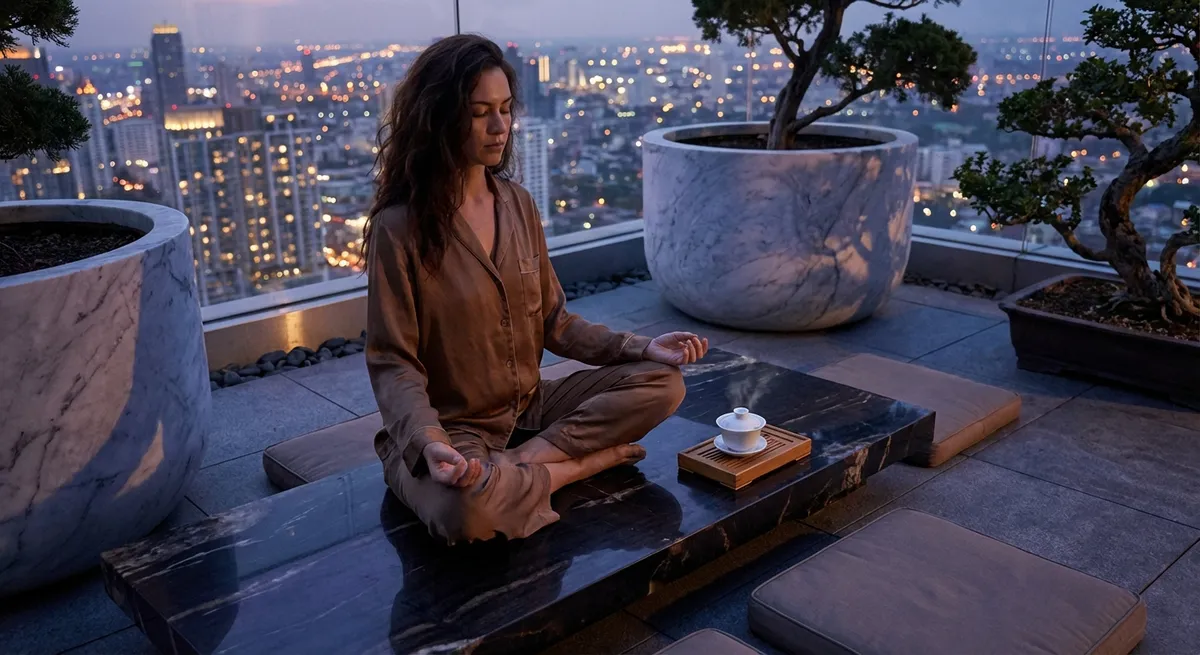
True calm is not an absence of thought, but a refinement of attention. For those who treat mental wellness as carefully as they would a curated wardrobe or a well-planned itinerary, meditation is not a trend; it is a quiet discipline of discernment. This practice, approached with intention and elegance, becomes less about “relaxing” and more about cultivating a mind that feels composed, clear, and quietly powerful.
Below are five exclusive, nuanced insights into meditation—designed for those who value depth over quick fixes, and refinement over routine.
Meditation as Mental Couture, Not Mass Production
Meditation is often presented as a one-size-fits-all solution: sit down, close your eyes, breathe, and wait for peace to arrive. A more sophisticated approach treats meditation as mental couture—deliberately tailored to the contours of your inner world.
A discerning practitioner experiments with styles: breath-based meditation for precision, body scans for somatic refinement, mantra practice for resonance, or open awareness for creative spaciousness. Instead of forcing themselves into a trend-driven technique, they curate a personal “meditation wardrobe” suited to different emotional climates: a grounding style for anxious days, a spacious one for overbooked weeks, a heart-centered approach when connection feels thin. This tailored approach makes meditation feel less like a chore and more like a luxurious, bespoke ritual for the mind.
The Aesthetic of Attention: Designing a Refined Inner Atmosphere
In premium spaces, details matter: lighting, textures, acoustics. The same is true of meditation. A refined practice is not only about what you focus on, but how you craft the aesthetic of your inner attention.
Instead of waging war on thoughts, you might study the texture of your awareness: Does your attention feel rushed, sharp, dull, scattered, or steady? You learn to adjust the “lighting” of your focus—softening when you’re tense, sharpening when you’re lethargic, widening when you’re reactive. Over time, your inner atmosphere becomes less fluorescent and more candlelit: calm, warm, discerning. This quiet design of attention carries into conversations, decision-making, and even conflict—your mind feels less like a crowded street and more like a private gallery.
Slowness as a Luxury: Extending the Moment Between Thought and Reaction
One of the rarest luxuries in a hyper-responsive world is the ability to delay your reaction. Meditation, at its most refined, is the deliberate cultivation of this exquisite gap.
As you meditate, you begin to notice micro-moments: the instant a thought arises, the split-second interpretation, the familiar tug to react. Instead of collapsing into that sequence, you train yourself to linger in the in-between. That lingering is immensely powerful. It allows you to respond to an email without hidden irritation, to receive criticism without immediate defensiveness, to hear difficult news without collapsing into panic. The cultivated pause becomes a private, internal VIP room where your wiser self appears first—before the habitual one has time to rush the stage.
Curating Inner Input: Meditation as a Discerning Filter, Not Escape
For many, meditation is pitched as an escape—a brief vacation from a loud life. A more elevated approach treats meditation as a discerning filter: a way to refine what truly earns the right to occupy your mind.
In meditation, you watch thoughts arrive: obligations, worries, ambitions, social noise. Instead of automatically believing each one, you develop the practiced habit of asking, “Does this deserve my energy?” This question is quietly radical. Over time, you become less impressed by mental clutter and more loyal to what feels genuinely important—health, relationships, values, meaningful work. Meditation ceases to be a temporary respite and becomes a daily act of high-level curation, similar to how you would edit a home, a wardrobe, or a calendar: fewer but finer.
The Discreet Strength of Invisible Practice
The most powerful aspects of a refined meditation practice are often the least visible. There is no applause for choosing not to overreact, no public recognition for the argument you never start, no highlight reel of the stress you metabolize before it spills onto others.
Yet this discreet strength is one of meditation’s most luxurious outcomes. Your sleep becomes subtly deeper. Your conversations become slightly more anchored. Your ability to tolerate uncertainty grows incrementally, then significantly. These shifts rarely announce themselves; they accumulate the way compound interest does—quietly, then unmistakably. Over months, your inner life feels less like something to manage and more like something you have elegantly designed.
Conclusion
Meditation, when approached with discernment, is not a self-help task to check off, but an ongoing refinement of how you inhabit your own mind. It is the art of tailoring your inner world with the same care you devote to your external one—selective, intentional, quietly luxurious.
For the connoisseur of calm, the measure of a meditation practice is not how serene you appear while sitting still, but how composed, precise, and gently powerful you feel while fully engaged in your life. Over time, stillness stops being an interval you visit and becomes the subtle skill that underpins everything you do.
Sources
- [National Center for Complementary and Integrative Health – Meditation: In Depth](https://www.nccih.nih.gov/health/meditation-in-depth) - Overview of different meditation types, benefits, and scientific evidence
- [Mayo Clinic – Meditation: A Simple, Fast Way to Reduce Stress](https://www.mayoclinic.org/tests-procedures/meditation/in-depth/meditation/art-20045858) - Explains practical applications of meditation for stress and wellness
- [Harvard Health Publishing – Mindfulness meditation may ease anxiety, mental stress](https://www.health.harvard.edu/mind-and-mood/mindfulness-meditation-may-ease-anxiety-mental-stress) - Summarizes research on how meditation affects anxiety and stress
- [American Psychological Association – Mindfulness meditation: A research-proven way to reduce stress](https://www.apa.org/topics/mindfulness/meditation) - Details psychological mechanisms and outcomes associated with meditation
- [Cleveland Clinic – What Is Mindfulness Meditation?](https://health.clevelandclinic.org/what-is-mindfulness-meditation) - Clarifies concepts of mindfulness and their impact on daily functioning and emotional regulation
Key Takeaway
The most important thing to remember from this article is that this information can change how you think about Meditation.