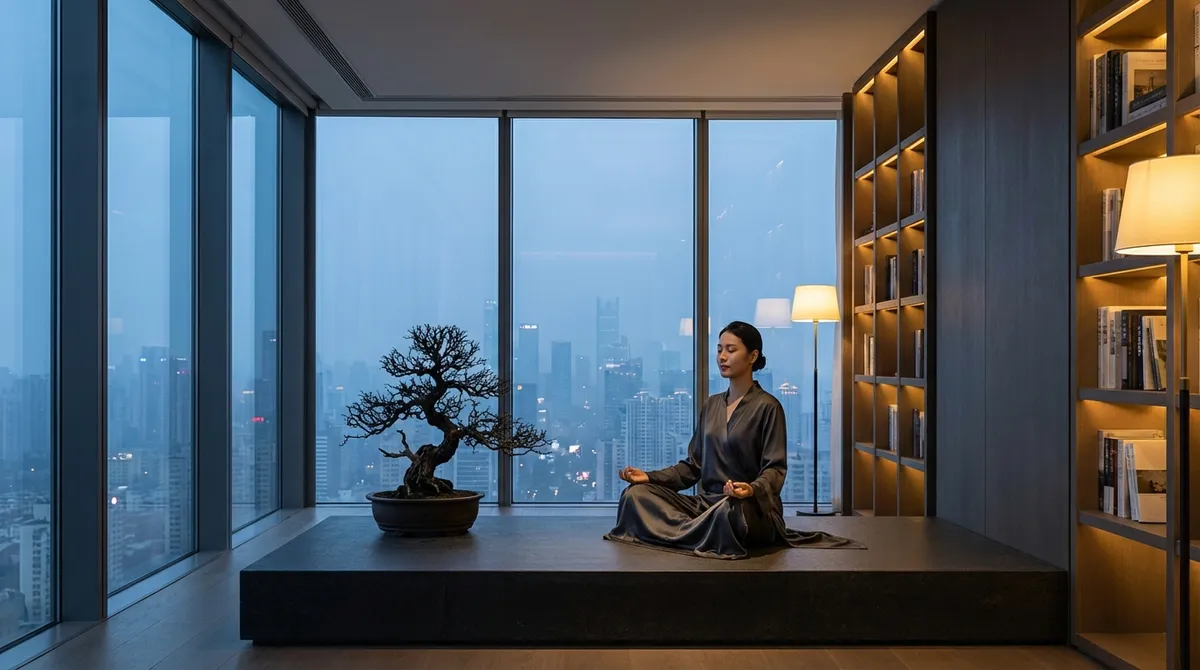
Modern life rewards speed, volume, and visibility. Yet the people who move the world in meaningful ways often possess something quieter: a cultivated stillness that sharpens perception, steadies emotion, and refines decision-making. Meditation, approached with intention and elegance rather than as a hurried wellness trend, becomes less a “habit” and more an invisible infrastructure for a composed, discerning life.
This is not about incense and perfection. It is about training the mind to become a precise, responsive instrument—subtle enough to sense nuance, steady enough to remain clear under pressure, and resilient enough to recover from emotional turbulence with poise.
Below are five exclusive, less-discussed insights into meditation—designed for those who expect their inner life to be as curated as their outer world.
1. Meditation as Cognitive Editing, Not Mental Escape
Meditation is often marketed as a way to “turn off” the mind. In reality, it is closer to the final edit of a finely crafted piece of writing: you are not erasing content, you are refining structure.
When you sit in meditation, you begin to observe how your mind organizes information—what it amplifies, what it repeats, what it rushes past. With regular practice, this observational stance allows you to quietly “re-format” your thinking. Certain thoughts lose their emotional charge; others become clearer and more actionable.
Neuroscientific research shows that meditation can reduce activity in the brain’s default mode network, a region associated with mind-wandering and self-referential rumination. Over time, this recalibration translates into fewer mental “open tabs” and a more curated stream of attention.
For someone making complex decisions or navigating high-stakes environments, this cognitive editing is invaluable: you learn to distinguish noise from signal, urgency from importance, and fear from genuine intuition. Meditation does not remove thought; it organizes it with quiet authority.
2. The Elegance of Micro-Meditations Embedded in Your Day
Long, ceremonial sits are beautiful, but they are not the only sophisticated way to integrate meditation. A truly refined mental practice weaves stillness into the architecture of the day so discreetly that it becomes part of your signature way of moving through the world.
Consider micro-meditations as elegant punctuation marks in your schedule:
- Three conscious breaths before answering a difficult message
- A 90-second eyes-closed reset between meetings
- A brief, grounded pause before entering a room where stakes are high
- A short body-scan while waiting for an elevator or car service
Each of these is too small to feel performative yet substantial enough to recalibrate your nervous system. You are training yourself to default to presence rather than reactivity.
This approach respects the reality of a cultivated, time-sensitive life. Instead of waiting for the perfect conditions to meditate, you become practiced at creating micro-oases of composure within imperfect conditions. Over weeks and months, these tiny insertions of stillness accumulate into an unmistakable aura of calm authority.
3. Emotional Neutrality: The Quiet Luxury Behind the Practice
Luxury, at its most refined, is about quality of experience rather than mere acquisition. In emotional terms, the ultimate luxury is a stable inner climate—neither numb nor volatile, but responsive and grounded.
Meditation gradually nurtures what might be called emotional neutrality: the capacity to feel deeply without being consumed. You begin to notice that sensations—frustration, anxiety, excitement, even elation—arise, peak, and pass. The identity-level story around them (“This always happens to me,” “I can’t handle this”) starts to loosen.
This is not detachment in the cold sense. It is a cultivated spaciousness. Professional settings benefit profoundly from this shift: feedback feels less threatening, negotiations feel less personal, and conflict loses some of its sting. Privately, relationships become more graceful as you respond to others’ emotions without immediately mirroring them.
Research on mindfulness-based interventions shows improvements in emotional regulation and reduced stress reactivity. In lived experience, this translates into fewer regretted messages, more measured conversations, and a quieter internal dialogue after intense days. Emotional neutrality doesn’t dull your life; it refines it.
4. Precision Rituals: Designing a Personal Meditation Environment
For the discerning mind, context matters. The way you enter meditation can be as considered as the way you select a fragrance or set a table. These details are not indulgence; they are part of training the brain to associate certain cues with an immediate softening into presence.
Consider defining a minimal yet precise set of ritual elements:
- A single, recurring place: a particular chair, corner, or window seat dedicated to stillness
- A consistent sensory anchor: a specific candle scent, a particular texture (a throw, a cushion), or even a single piece of instrumental music before silence
- A visual boundary: a cleared surface, an uncluttered wall, or a simple object that symbolizes focus
By keeping the ritual subtle and repeatable, you send a strong signal to your nervous system: “Here, we soften. Here, we observe.” Over time, just seeing that space becomes calming.
From a psychological standpoint, this is classical conditioning put to elegant use: stable environmental cues become shortcuts into a meditative state. Practically, this means you waste less time wrestling with resistance and drop more quickly into depth, even on demanding days.
5. Meditation as an Invisible Asset in High-Performance Living
There is a quiet paradox in serious meditation: the deeper your practice, the less you feel compelled to announce it. It becomes another invisible asset—like good sleep or strong discernment—that subtly informs everything you do.
For those leading teams, building companies, managing portfolios, or navigating complex family and social systems, meditation functions as a behind-the-scenes stabilizer in at least three ways:
- Refined perception: You notice micro-shifts in tone, timing, and dynamics in conversations. This helps you sense when to speak, when to pause, and when to let silence do the work.
- Strategic patience: You become more comfortable allowing situations to unfold without forcing an outcome, which often leads to better timing and more intelligent risks.
- Energy management: You recognize earlier when you are near cognitive or emotional depletion and adjust accordingly, preserving your best focus for what truly matters.
Studies on mindfulness suggest improvements in working memory, attention, and resilience to stress. Translated into a high-performance context, this means fewer impulsive decisions, more clarity under pressure, and a quiet but noticeable stamina over longer horizons.
In a culture that often confuses urgency with importance, meditation restores a quieter, more strategic tempo. It is not a retreat from ambition; it is the refinement of it.
Conclusion
Meditation, when embraced as a sophisticated discipline rather than a passing trend, becomes a subtle architecture for modern mental excellence. It edits your internal narrative, embeds composure into your day, refines emotional tone, elevates your rituals, and acts as a discreet performance advantage.
You do not need dramatic retreats, elaborate accessories, or hours of free time. You need a clear intention, a modest but well-designed environment, and a willingness to return—briefly but consistently—to the still point beneath the noise.
In a world that measures almost everything in public metrics, meditation remains one of the few truly private luxuries: a cultivated mind, known fully only to you, yet quietly evident in every room you enter.
Sources
- [National Institutes of Health – Meditation: In Depth](https://www.nccih.nih.gov/health/meditation-in-depth) – Overview of meditation types, evidence-based benefits, and safety from a U.S. government health agency.
- [American Psychological Association – Mindfulness Meditation: A Research-Proven Way to Reduce Stress](https://www.apa.org/topics/mindfulness/meditation) – Summarizes psychological research on mindfulness and its impact on stress, emotion regulation, and cognition.
- [Harvard Medical School – Mindfulness Meditation May Ease Anxiety, Mental Stress](https://www.health.harvard.edu/mind-and-mood/mindfulness-meditation-may-ease-anxiety-mental-stress) – Discusses clinical evidence on meditation’s effects on anxiety and stress responses.
- [National Center for Biotechnology Information – The Neuroscience of Mindfulness Meditation](https://www.ncbi.nlm.nih.gov/pmc/articles/PMC3679190/) – Peer-reviewed article exploring how meditation alters brain structure and function.
- [Mayo Clinic – Meditation: A Simple, Fast Way to Reduce Stress](https://www.mayoclinic.org/tests-procedures/meditation/in-depth/meditation/art-20045858) – Practical medical guidance on meditation techniques and their health benefits.
Key Takeaway
The most important thing to remember from this article is that this information can change how you think about Meditation.