Mental clarity has become a rare commodity—scarcer, at times, than sleep or free time. For the discerning mind, meditation is no longer a vague “wellness trend,” but a cultivated practice: as intentional as a well-curated library, as precise as a tailored garment. This is not about escapism; it is about an elegant reorientation of attention, so that thought, emotion, and physiology begin to align with quiet authority rather than constant urgency.
What follows is a considered exploration of meditation as a high-level mental craft, with five exclusive insights designed for those who expect their inner life to be as refined as their outer one.
Meditation as Cognitive Design, Not Just Relaxation
Most conversations reduce meditation to “stress relief.” Useful, yet incomplete. For a cultivated mind, meditation is better understood as cognitive design: a way of deliberately shaping the architecture of attention, memory, and emotional response.
Neuroscientific studies suggest that regular mindfulness meditation can alter brain regions associated with attention regulation, emotional processing, and self-referential thinking, including the prefrontal cortex, amygdala, and default mode network. This is less about becoming “calm” and more about gaining editorial control over what occupies your mental front page. Instead of being dragged by every notification, impulse, or worry, you begin to select, refine, and prioritize your inner commentary.
From this lens, your meditation practice becomes an ongoing design project. You are not merely sitting still; you are calibrating the way your mind moves under pressure, how quickly it returns to equilibrium, and how gracefully it can hold complexity without collapsing into noise. Relaxation is a welcome by-product—but the true value is the intentional reconfiguration of your mental operating system.
The Luxury of Single-Task Presence
In a culture that fetishizes multitasking, the decision to be fully present in a single moment is increasingly a luxury move. Meditation is the training ground for this: a private atelier where you practice the almost radical act of doing one thing impeccably well.
During seated practice, that “one thing” is usually observing the breath, sensations, or thoughts with steady, non-reactive awareness. Outside practice, this skill translates into savoring a conversation without simultaneously scanning your phone, or reading a dense report without the compulsion to tab-hop every 30 seconds. Research on attention and mindfulness indicates that focused awareness is linked to better working memory, improved performance, and lower perceived stress.
The refinement lies in quality, not duration. A finely executed three-minute meditation—where attention is intentionally placed, gently returned, and held with composure—can be more transformative than an unfocused half-hour of mental wandering. Over time, this cultivated single-task presence becomes a signature trait: you are the person who actually inhabits the moment they are in, which is felt by colleagues, friends, and partners as gravitas, reliability, and rare attentional generosity.
Emotional Neutrality as a Quiet Superpower
Meditation often gets marketed as a path to constant positivity. For those with nuanced inner lives, this can feel both unrealistic and reductive. A more sophisticated aim is emotional neutrality: not the absence of feeling, but the capacity to register emotion without immediate enlistment.
Through meditation, you learn to witness irritation, anxiety, or excitement with a slight, dignified distance—observing the physiological surge, acknowledging the narrative your mind is spinning, and then deciding, calmly, whether to act, speak, or wait. This does not blunt your sensitivity; it refines your response window. You are no longer obligated to react at the speed of your first impulse.
Studies on mindfulness-based stress reduction (MBSR) have shown decreases in emotional reactivity and improvements in emotional regulation, including reduced activity in the amygdala, the brain’s alarm center. For you, this translates into a less theatrical inner life: fewer mental arguments in silence, fewer nights replaying conversations, fewer moments where a single email defines your entire day.
This cultivated neutrality is not coldness. It is the quiet confidence of knowing you can host intense feelings without being dominated by them. Elegance, in this context, is restraint practiced not out of suppression, but from intimate familiarity with your own emotional landscape.
Precision Rituals: Curating the Micro-Details of Practice
For a discerning mind, the difference between “I tried meditation” and “I maintain a practice” often comes down to meticulous attention to detail. The micro-rituals surrounding your meditation session can either subtly sabotage or significantly support your consistency and depth.
Consider these aspects as elements of a personal protocol rather than decorative extras:
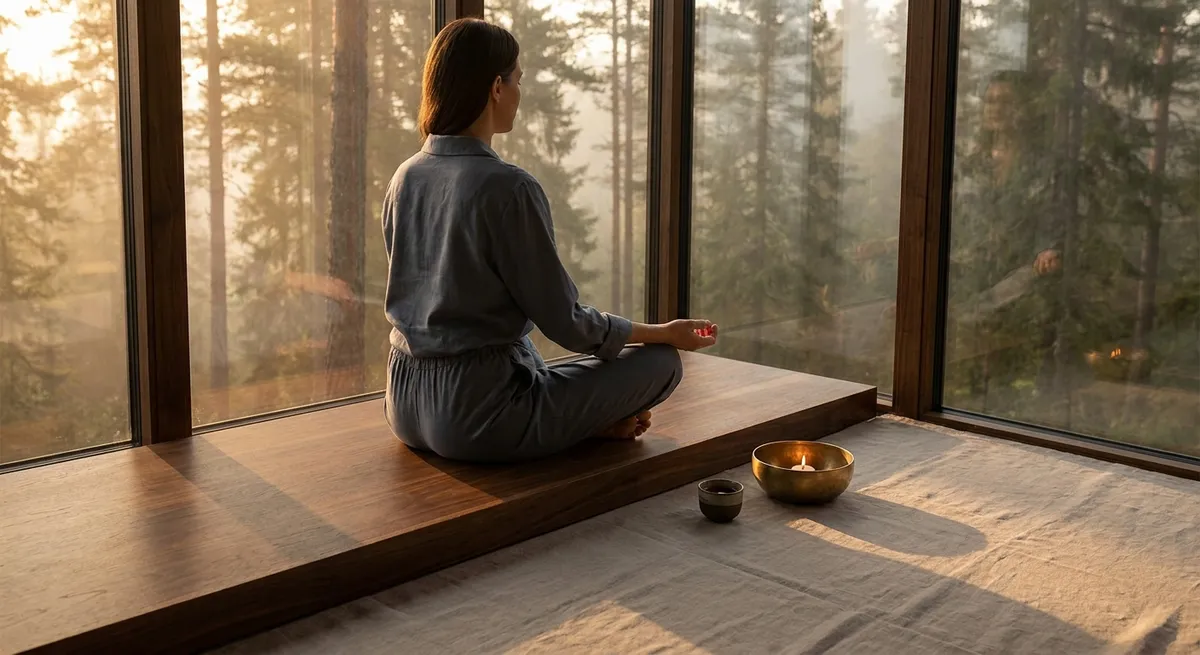
- Spatial composition: A specific chair, a corner with intentional lighting, one unobtrusive object (perhaps a candle, plant, or sculpture) that signals “this is where attention becomes formal.”
- Sensory boundaries: Noise levels, temperature, and scent chosen not for drama, but for neutrality—conditions that do not compete with your focus.
- Temporal framing: A consistent time of day that matches your cognitive profile: perhaps early morning if your mind is freshest, or late evening if that is your natural reflective window.
- Transitional cues: A single chime, a few stretches, or a brief written line in a journal before you begin, to mark the passage from ordinary cognition to intentional practice.
Research on habit formation underscores the importance of cue-based routines and environment design in sustaining behaviors. You are, in essence, curating conditions that make meditation frictionless and naturally repeatable, turning it into a refined daily ritual rather than an aspirational afterthought.
The elegance lies in discretion: nothing overproduced, nothing performative. Just a subtle but unmistakable sense that this is a deliberate appointment with your own mind.
Deep Mental Hygiene: Clearing Cognitive Residue
Physical hygiene is universally accepted. Mental hygiene, at the same level of seriousness, is still oddly underdeveloped. Meditation can function as daily cognitive maintenance: a way of clearing internal residue before it hardens into chronic tension, habitual rumination, or burnout.
Throughout the day, the mind accumulates unprocessed micro-frictions—brief irritations, minor disappointments, subdued anxieties. Left unexamined, they accumulate into a diffuse background heaviness. Taking even ten minutes to sit, notice the day’s mental debris, and let it surface without judgment allows these impressions to be metabolized rather than stored.
Mindfulness practices have been associated with reductions in rumination, improvements in sleep quality, and lower levels of perceived stress. This suggests that regular practice does more than soothe; it systematically declutters recurring thought patterns. Over time, your baseline becomes lighter, not because your life is less demanding, but because you no longer carry yesterday’s mental weight into tomorrow’s obligations.
Think of this as the difference between a workspace that is wiped clean each evening and one where papers, cups, and cables are allowed to accumulate for months. The former projects understated order; the latter erodes clarity even before the work begins. Meditation, practiced with precision, brings that same understated order to your inner desk.
Conclusion
For the cultivated mind, meditation is not a hobby and not a trend. It is a considered discipline: a way of designing cognition, reclaiming single-task presence, cultivating emotional neutrality, perfecting subtle rituals, and maintaining deep mental hygiene.
What makes this practice truly premium is not exotic techniques or elaborate gear, but the standard you bring to it. Ten deliberately crafted minutes a day—in a space you respect, at a time you consistently honor—can recalibrate how you think, feel, decide, and relate.
In an era that rewards constant reaction, meditation becomes an act of quiet distinction: choosing, again and again, to inhabit your own mind with elegance.
Sources
- Harvard Medical School – Mindfulness meditation may ease anxiety, mental stress – Overview of research on how mindfulness meditation affects stress and mental health.
- National Center for Complementary and Integrative Health (NCCIH) – Meditation and Mindfulness: What You Need To Know – Evidence-based summary of benefits, mechanisms, and considerations for meditation.
- American Psychological Association – Mindfulness meditation: A research-proven way to reduce stress – Discusses scientific findings on attention, emotional regulation, and stress reduction through mindfulness.
- National Institutes of Health – Mindfulness-based stress reduction for health benefits – Peer-reviewed article examining MBSR and its effects on psychological and physical outcomes.
- Greater Good Science Center, UC Berkeley – How Does Mindfulness Training Affect the Brain? – Explores brain changes associated with mindfulness and their implications for cognition and emotion.
Key Takeaway
The most important thing to remember from this article is that this information can change how you think about Meditation.