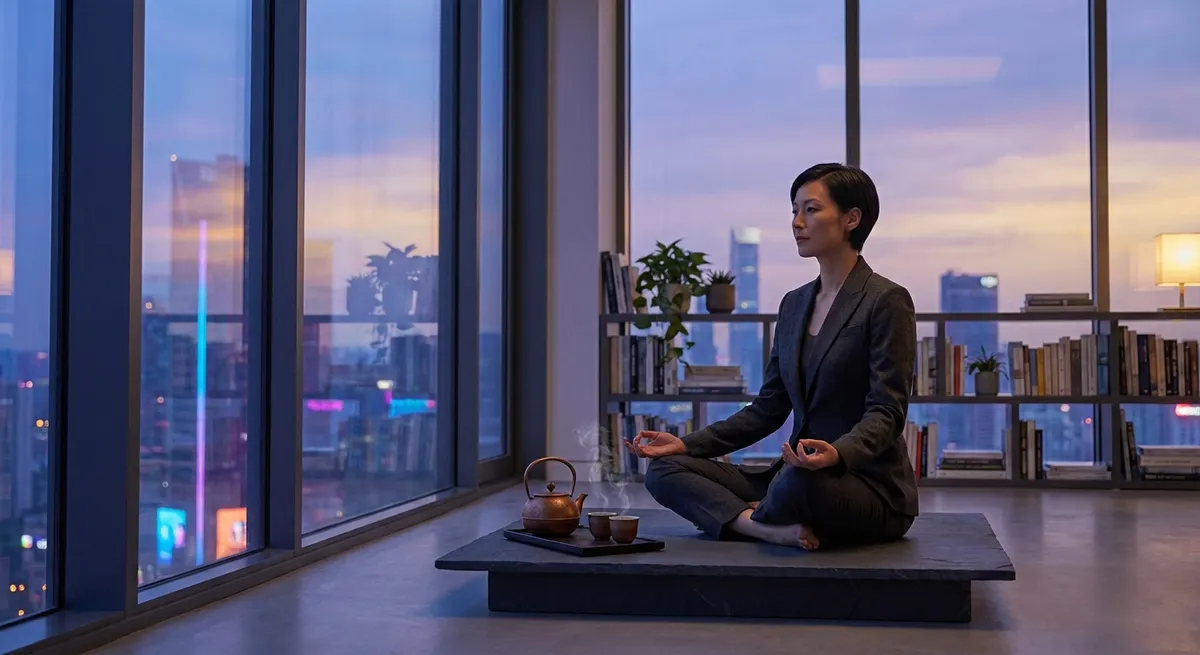
In a culture that confuses speed with importance, meditation is no longer a soft luxury—it is a quiet, strategic advantage. Beyond calming background anxiety, a refined meditation practice becomes an instrument for sharper decisions, emotional discretion, and a more composed way of moving through complexity. This is not about escaping life; it is about inhabiting it with greater taste, precision, and agency.
Below, you’ll find five exclusive, research-aligned insights designed for people who expect their mental wellness practices to be as considered and elevated as the rest of their life.
The Executive Pause: Treating Stillness as a High‑Level Skill
Meditation is often framed as “relaxation”—a pleasant add-on when time allows. A more sophisticated lens sees it as a mental executive function: the deliberate ability to insert a pause between stimulus and response. That pause is not empty; it is where discernment lives.
Neuroscientific research links consistent meditation with changes in regions associated with attention and emotional regulation, such as the prefrontal cortex and anterior cingulate cortex. Over time, your brain becomes more practiced at noticing impulses without having to obey them. In the boardroom, in partnership, while parenting, or when navigating digital noise, this pause becomes a quiet form of power.
Begin by choosing one “executive pause” each day: a 5–10 minute sit just before a significant decision or transition—before opening your inbox, before a crucial call, or before you walk back into your home in the evening. Instead of scrolling for distraction, sit upright, close your eyes, and observe the breath at the tip of the nose. You are not trying to feel calm; you are rehearsing the art of not rushing into the next thing.
Over weeks, you may notice that in difficult conversations or pressured moments, the same quality of inner space appears spontaneously. That is your executive pause embedding itself into your nervous system as a practiced skill, not a fragile mood.
Sensory Minimalism: Curating an Inner Aesthetic for the Mind
A refined meditation practice does not require ornate rituals; it requires exquisite restraint. Think of your meditation environment as sensory minimalism: an intentional curation that communicates to your nervous system, “Here, nothing is demanded of you.”
Rather than a cluttered altar, aim for one or two thoughtfully chosen elements—a single candle, a low, supportive cushion, a light throw, perhaps a subtle natural scent like lavender or sandalwood. The goal is not to create a performance-ready “meditation corner” for social media, but an environment that feels neutrally elegant and psychologically safe.
Sensory minimalism is less about décor and more about signal reduction. Each additional visual object, each notification sound, and each harsh light acts like cognitive static. Evidence suggests that a quieter sensory field supports better sustained attention and reduces mental fatigue. A clean, unbusy space is not an aesthetic indulgence; it is a direct investment in your brain’s capacity to rest and reorient.
When you sit, let your senses register the simplicity around you: the warmth of the fabric beneath your hands, the faint flicker of light through your closed eyes, the quiet in the room. Instead of fighting distraction, you are inviting your mind into an environment designed for ease.
Precision Noticing: Upgrading Mindfulness Into an Art of Detail
For many, mindfulness means “being present.” A more elevated practice involves precision noticing: training the mind to perceive with fine-grained clarity. This is where meditation moves from generic wellness to a high-craft discipline.
During your next session, choose one sensory focus—perhaps the sensation of the breath in the chest. Rather than merely registering “in” and “out,” refine your attention:
- Where does the breath begin to rise first—the lower ribs, the upper chest, the collarbones?
- Is the inhale smoother or more textured than the exhale?
- What is the brief still point between exhale and inhale like?
This kind of microscopic observation strengthens attentional networks in the brain and has been associated with improved working memory and reduced emotional reactivity. In daily life, precision noticing subtly shifts how you experience everything: the way sunlight lands on a table, the exact tone in a colleague’s voice, the first hint of fatigue or irritation in your own body.
Instead of life blurring into one continuous scroll, the world returns as a series of distinct, nuanced impressions. Your choices become less reactive and more informed because you are actually perceiving the details you once hurried past.
Emotional Discretion: Meditating with Boundaries, Not Self‑Erasure
A sophisticated meditation practice is not about becoming unbothered by everything; it is about becoming judicious about what truly deserves your emotional expenditure. This is emotional discretion—a step beyond mere “calm.”
Begin your session by acknowledging the emotional tone of the moment in one understated phrase: “Subtle anxiety is present,” or “Mild resentment is here,” or “Quiet contentment today.” You are not dramatizing or suppressing; you are simply recognizing. Then, during the sit, watch how that emotional weather shifts when you do nothing to fix it.
Research on mindfulness-based interventions consistently shows that labeling emotions and observing them with non-judgmental awareness reduces their intensity and duration. Over time, you cultivate what could be called “emotional selectivity.” Not everything gets full access to your nervous system.
Outside formal practice, you may notice a new inner habit: before reacting to a message, a comment, or a news update, a quiet question appears—“Is this worth my full emotional bandwidth?” Often, the answer is no. That no is not apathy; it is conservation. You are choosing to invest your emotional energy where it can actually create value—relationships that matter, work that aligns, causes that resonate—rather than scattering it across every fleeting disturbance.
The Quiet Rehearsal: Using Meditation to Pre‑Experience Your Best Self
While many approaches emphasize “emptying the mind,” there is a more advanced, highly intentional dimension: using meditation as a rehearsal space for the way you want to show up in life. This is not daydreaming; it is deliberate mental conditioning.
After 8–10 minutes of simple breath awareness, when your mind has partially settled, introduce a refined scenario: a challenging conversation, a complex negotiation, a demanding creative task. Instead of ruminating on what might go wrong, quietly visualize yourself in that context with the qualities you intend to embody—measured tone, grounded posture, unhurried responses, precise language.
Sports psychology and cognitive neuroscience both support the power of mental rehearsal: imagining specific actions activates many of the same neural circuits as performing them. When done from a calm meditative state, you are effectively training your nervous system to associate stressful situations with poise rather than panic.
The key refinement: keep the imagery understated and sensory-based. Notice the feeling of your feet on the ground, your breath in your chest, the weight of your body in the chair as you respond. You are rehearsing not just the outcome, but the internal texture of composure. Later, when you enter the real situation, your nervous system recognizes it—not as a threat, but as something it has already practiced meeting with elegance.
Conclusion
Meditation, practiced with discernment, is far more than a relaxation technique. It is a quiet architecture for a more deliberate life: a cultivated pause under pressure, an uncluttered sensory world, a sharpened attention to detail, a selective emotional economy, and a private studio where your best self is repeatedly rehearsed.
For a modern, ambitious mind, stillness is not withdrawal. It is strategy—subtle, sophisticated, and deeply effective.
Sources
- [National Center for Complementary and Integrative Health – Meditation: In Depth](https://www.nccih.nih.gov/health/meditation-in-depth) - Overview of meditation types, mechanisms, and evidence-based benefits
- [American Psychological Association – Mindfulness Meditation: A Research-Proven Way to Reduce Stress](https://www.apa.org/topics/mindfulness/meditation) - Summarizes research on mindfulness, attention, and emotional regulation
- [Harvard Health Publishing – Mindfulness Meditation May Ease Anxiety, Mental Stress](https://www.health.harvard.edu/mind-and-mood/mindfulness-meditation-may-ease-anxiety-mental-stress) - Discusses clinical findings on how meditation affects the brain and stress response
- [National Institutes of Health – Meditation and the Brain](https://newsinhealth.nih.gov/2012/01/mindfulness-matters) - Explores neural changes associated with meditation and their impact on cognition
- [Mayo Clinic – Meditation: A Simple, Fast Way to Reduce Stress](https://www.mayoclinic.org/tests-procedures/meditation/in-depth/meditation/art-20045858) - Practical, medically reviewed guidance on incorporating meditation into daily life
Key Takeaway
The most important thing to remember from this article is that this information can change how you think about Meditation.