Stress, for many discerning minds, no longer appears as melodramatic crisis but as a constant, low-volume hum—always on, rarely acknowledged, quietly exhausting. In an era that glamorizes busyness, true relief is no longer about quick hacks; it is about cultivating stress management as a quiet form of luxury. Not the loud kind, but the refined, deeply personal kind that feels like slipping into a tailored garment: precise, considered, and completely your own.
Below are five exclusive, less-discussed insights for those who treat mental wellness not as an afterthought, but as an essential part of a well-edited life.
1. The Art of “Cognitive Curating”: Editing What Your Mind Is Exposed To
We often curate our closets, homes, and social feeds—yet neglect to curate what our minds repeatedly encounter throughout the day. “Cognitive curating” is the deliberate, elegant act of choosing which inputs deserve your attention, and which do not.
Begin by assessing your informational intake the way you would evaluate a room: what feels crowded, noisy, or mismatched with the atmosphere you want to inhabit? Constant news alerts, unfiltered group chats, and emotionally draining conversations all represent cognitive clutter. Instead of attempting to “be stronger” or more resilient in the face of excess stimulation, you treat your mental bandwidth as a limited, premium resource.
A refined approach includes quiet boundaries: disabling non-essential notifications, unsubscribing from emotionally taxing content, and allocating specific windows for reading news or checking email. This is not avoidance—it is discernment. Research in stress and attention suggests that constant digital interruptions increase perceived stress and reduce focus, whereas structured, intentional engagement restores a sense of control. Thoughtful restriction becomes a form of inner spaciousness: the less your mind is pulled in a hundred directions, the more fully it can inhabit the present moment.
2. Physiological Precision: Using the Body’s Built-In Calm Switch
While stress is often framed as an abstract mental state, the body interprets it in concrete, physiological terms: heart rate, breath, muscle tension, and hormonal cascades. One of the most elegant stress relief strategies is to learn how to engage the body’s own “calm switch” with precision, instead of relying on vague relaxation techniques.
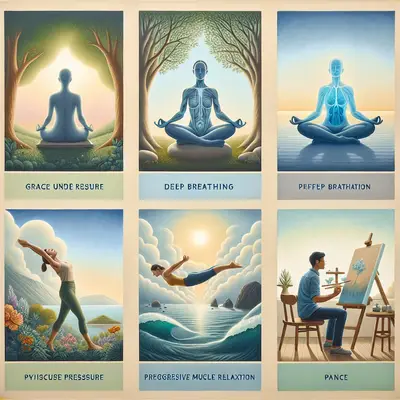
Rather than approaching breathwork as a wellness trend, treat it as a carefully calibrated tool. Extending your exhale slightly longer than your inhale—such as inhaling for four counts, exhaling for six—can help stimulate the parasympathetic nervous system, which is associated with rest, restoration, and recovery. Similarly, gentle, deliberate muscle relaxation (from the jaw to the shoulders, then down through the spine) sends a subtle but powerful message of safety to the nervous system.
What elevates this practice is not its novelty, but its consistency and intentionality. A few minutes of physiologically-informed calm, repeated daily, does more for long-term stress relief than sporadic, dramatic efforts. Over time, your body learns a new default: not frantic readiness, but dignified ease.
3. Creating “Protected Interiors”: Environments That De-escalate Stress
Most conversations about stress relief focus on what we do, not where we are. Yet environment is one of the most underestimated levers of emotional regulation. A “protected interior” is any space—physical or digital—that is designed to quiet your nervous system the moment you enter it.
This does not require lavish renovation. It requires intention. Consider: lighting that is warm rather than harsh; a limited, coherent palette of colors; fewer objects, chosen with care; soundscapes that are soft and stable rather than sharp or sudden. Even a single corner can function as a personal decompression chamber, signaled by a particular chair, throw, or scent you use only when you intend to disconnect from the external rush.
From a psychological perspective, environments that are predictably soothing help counteract the hypervigilance that chronic stress can create. When the mind knows there is at least one place where nothing is demanded of it—no performance, no productivity, no social maintenance—it begins to lower its guard. Over time, simply entering this space becomes a conditioning cue: “Here, I am allowed to release.”
4. Emotional Minimalism: Reducing Over-Engagement with Every Feeling
A sophisticated approach to stress does not mean feeling less; it means engaging more selectively with emotions that demand a response. Emotional minimalism is not repression—it is the art of giving each emotion an appropriate, proportionate amount of attention, rather than allowing every feeling to escalate into a full mental event.
This begins with naming emotions with a bit more nuance: not just “stressed,” but “overcommitted,” “uncertain,” “disappointed,” or “overstimulated.” Research suggests that this subtle act of labeling emotions precisely—sometimes called “emotional granularity”—can reduce reactivity and help people navigate stress more effectively. The more accurately you can describe what you feel, the less likely you are to be overwhelmed by it.
From here, you can choose your level of engagement. Some emotions require conversation or action; others need only to be acknowledged and allowed to pass without analysis. The refined skill lies in not granting every internal fluctuation the power to reorganize your day. You become a calm curator of your emotional life, recognizing which feelings deserve a seat at the table—and which may simply be noted, then gently released.
5. Quiet Micro-Rituals: Seamless Relief Woven into the Day
The future of stress relief is less about dramatic retreats and more about subtle, integrated practices that fit elegantly into the fabric of daily life. Micro-rituals are small, repeatable moments of intentional care that mark transitions throughout your day: waking, beginning work, pausing between tasks, arriving home, preparing for sleep.
These are not elaborate ceremonies, but refined signals to the nervous system. A specific tea you prepare only at the end of demanding meetings. A brief pause at your door before entering your home, accompanied by a deep exhale and a conscious decision to let external tension remain outside. A single stretch sequence you perform each time you close your laptop. A short reflective sentence you write before bed: “What, today, is complete?”
Because they are brief and easily repeatable, micro-rituals are sustainable. Their sophistication lies in their subtlety: they do not require explanation, performance, or documentation. Yet repeated over time, they become a private language between you and your nervous system—a reassuring pattern that says, again and again, “You are safe. You can soften here.”
Conclusion
Refined stress relief is not about withdrawing from life, but about participating in it with greater composure and less internal friction. When you curate your mental inputs, understand your body’s calm mechanisms, shape protective environments, practice emotional minimalism, and weave micro-rituals into your days, stress moves from being an invisible master to a manageable, often informative signal.
The true luxury is not a life without challenges, but a nervous system that no longer collapses under them. Stress may still knock at your door; the difference is that it no longer takes up permanent residence.
Sources
- National Institute of Mental Health – Stress: Coping With Everyday Problems - Overview of how stress affects the body and evidence-based strategies for coping
- American Psychological Association – Stress Effects on the Body - Detailed explanation of the physiological impact of stress and the role of the stress response
- Harvard Health Publishing – Relaxation Techniques: Breath Control Helps Quell Errant Stress Response - Research-backed discussion of breathing practices and how they support the parasympathetic nervous system
- UCLA Mindful Awareness Research Center - Educational resources and programs on mindfulness, emotional regulation, and stress reduction
- Yale Center for Emotional Intelligence – Emotional Intelligence and Well-Being - Research and resources on emotional granularity, labeling emotions, and their impact on stress and mental health
Key Takeaway
The most important thing to remember from this article is that this information can change how you think about Stress Relief.