There is a distinct difference between managing stress and gently rendering it obsolete. Rather than endlessly firefighting tension, a more refined approach is to architect a daily life in which calm is the default setting and stress has fewer places to hide. This is not about retreats or elaborate routines, but about subtle design choices—spatial, social, sensory, and mental—that quietly reorient your nervous system toward ease. For those who treat their inner life with the same discernment as a well-curated home or wardrobe, stress relief becomes less of a task and more of a living aesthetic.
Rethinking Stress as a Design Problem, Not a Personal Failing
Most of us internalize stress as a reflection of personal inadequacy: not organized enough, not resilient enough, not disciplined enough. Yet research in environmental psychology and behavioral science consistently shows that context exerts powerful influence on how often we feel overwhelmed.
When your calendar, space, and digital ecosystem are designed for frantic responsiveness, your nervous system simply complies. Chronic stress, then, is often less a defect of character and more a design flaw in your daily architecture. By reframing stress as a design challenge, you trade self-critique for creative problem-solving.
Consider how rarely we interrogate the architecture of our days: the first sounds we hear in the morning, the light we encounter at our desks, the tempo of our meals, the pacing of our social interactions. Each of these micro-elements sends data to the brain about whether the world is threatening or safe. A life subtly tuned to safety—predictable rhythms, gentle sensory input, elegant systems that reduce friction—creates a baseline of calm that makes acute stress easier to navigate. The goal is not to eliminate demands, but to upgrade the infrastructure that holds them.
Exclusive Insight 1: Curated Transitions as Micro-Luxuries for the Nervous System
We tend to think of stress in terms of sheer volume—too many emails, too many obligations—when in reality, the nervous system is often strained more by sudden shifts than by steady effort. The true tax on your calm is the way you transition between roles, tasks, and environments.
Curated transitions are intentional, micro-luxurious pauses that mark the thresholds of your day: sleep to wake, commute to work mode, work to evening, screen to sleep. Rather than rushing across these invisible borders, you create small rituals that tell your brain, “We are changing states, and we are doing so safely.” This reduces what neuroscientists call “switching costs,” the cognitive and emotional friction of rapidly moving between very different demands.
Examples are delightfully modest but potent:
- A 90-second practice of simply standing at your front door after work, taking three deliberate breaths, and mentally “arriving” home.
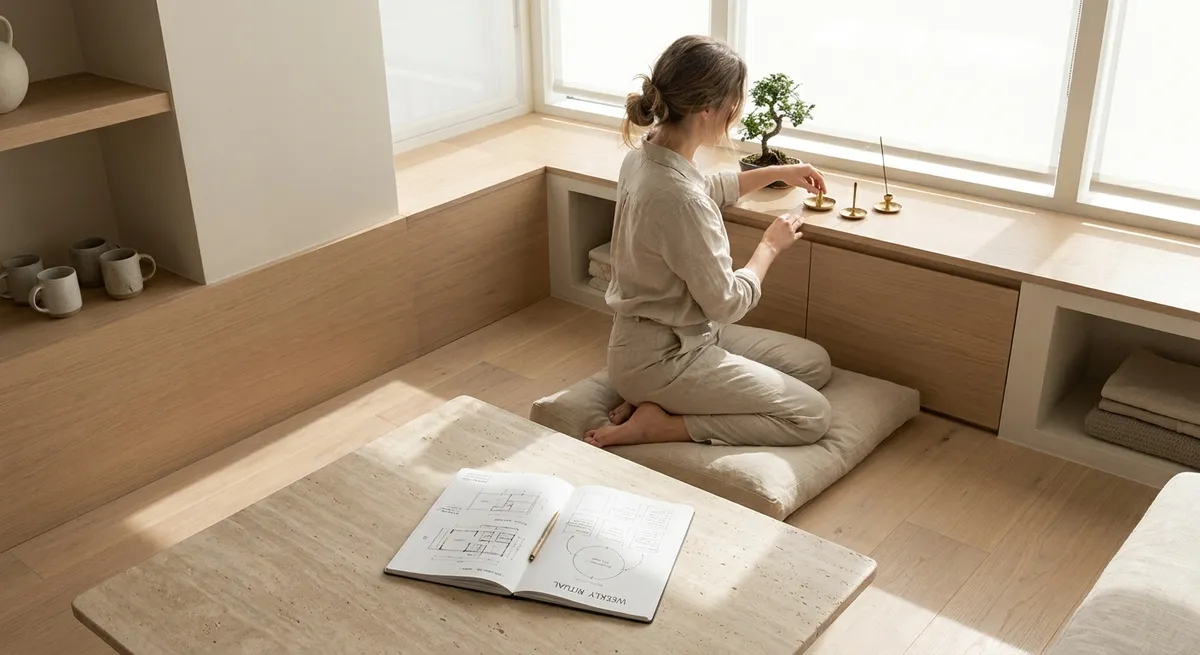
- A single, beautiful object (a candle, a carafe, a small sculpture) that you only touch or use during your wind-down period, teaching your mind to associate it with exhale and closure.
- A dedicated “re-entry song” that plays at the end of the workday, becoming an auditory cue that work belongs to the past and evening life is beginning.
Over time, these curated transitions become like velvet hinges on the doors of your day—quiet, smooth, and protective of what happens on either side.
Exclusive Insight 2: The Aesthetic Nervous System – How Beauty Becomes a Calming Agent
We often treat beauty as optional—nice to have, but frivolous under pressure. Yet emerging research in neuroscience and environmental design suggests that beauty is not a luxury for the nervous system; it is a regulator. Pleasing aesthetics can meaningfully shift your stress response.
Natural light, orderly visual fields, symmetry, and soothing color palettes have all been associated with reduced perceived stress and improved mood. Even brief exposure to visually pleasing environments can decrease activity in brain regions related to threat detection. Beauty, when thoughtfully incorporated, is a quiet signal of safety.
To harness this without renovating your life:
- Edit your field of view where you work and rest. What is directly in front of your eyes for most of the day? Remove visual chaos and add a single, calming focal point—a plant, a framed photograph, a piece of art that feels expansive rather than busy.
- Consider your “first and last” aesthetics: the first thing you see when you wake and the last thing you see before you sleep. Curate these deliberately. A serene image, a clear nightstand, or a neatly arranged chair can be surprisingly regulating.
- Employ tactile beauty—linen, ceramic, wood—materials that invite touch and have weight and texture. When stress rises, grounding through the hands can be as powerful as any mental technique.
In a world saturated with visual noise, creating small pockets of deliberate, refined beauty is not indulgence; it is strategic nervous system care.
Exclusive Insight 3: The Discipline of Gentle Pacing
The modern ideal of productivity silently glorifies compression: doing more in less time, stacking tasks, erasing margins. But the nervous system thrives on pacing, not acceleration. Elegant stress relief often comes from reintroducing space between mental “notes” so your day becomes more like music than static.
Gentle pacing does not require fewer responsibilities; it requires more intelligent spacing of them:
- Avoid cognitive whiplash: do not alternate high-stakes tasks with high-stakes tasks. Instead, interleave demanding work with low-stakes, structured activities—such as routine admin, light organizing, or a short walk—that allow your cognitive load to recalibrate.
- Employ the “soft start” principle: begin demanding cognitive work with 5–10 minutes of simple reviewing and orienting before plunging into execution. This reduces anticipatory anxiety, a significant contributor to stress.
- Protect at least one unfragmented hour per day where you are unreachable. Treat it as a standing appointment with your long-term well-being. This single, protected lane of time often has a calming effect that spills over into the rest of the day.
Pacing is often framed as a concession to fragility. In reality, it is the mark of a life designed for endurance and grace under pressure.
Exclusive Insight 4: Social Editing as an Act of Nervous System Stewardship
Stress relief is frequently pursued in isolation—meditation apps, supplements, quiet time alone—while one of the most powerful levers sits in plain sight: the composition of your social world. Our nervous systems are exquisitely attuned to the emotional tones of those around us; chronic exposure to urgency, sarcasm, volatility, or constant complaint quietly raises our baseline tension.
Social editing is not about ruthless culling of your relationships. It is about discerning which interactions leave your body softer, and which leave it tightened. Then, you gently re-weight your time and availability in favor of the former.
Consider:
- Identify your “regulating people”: those with whom your breathing slows and your thoughts feel less crowded. This may be a friend, a mentor, a family member, or even a colleague with a calm, grounded presence. Protect and prioritize this contact.
- Notice your “residual state” after social encounters. Do you feel subtly braced, like you could be called upon to defend or explain yourself? Or do you feel more fully yourself? Use this information as data, not drama, to guide how frequently and in what contexts you engage.
- When you cannot reduce contact with stress-evoking individuals, construct boundaries that are structural rather than confrontational: shorter calls, clear windows of availability, neutral locations, or shared activities that naturally limit the emotional volatility of the exchange.
Treat your social ecosystem as an extension of your inner environment. Curating it with discretion is one of the most elegant forms of self-preservation.
Exclusive Insight 5: Precision Rest – Restoring the Exact System That Is Depleted
Many people attempt to solve every form of exhaustion with a single intervention: sleep, a weekend away, an evening on the sofa. Yet “rest” is not a monolith. Emotional depletion, cognitive fatigue, sensory overload, and social burnout each require different forms of restoration. When the prescription does not match the deficit, stress accumulates despite our efforts.
Precision rest is the art of matching the type of rest to the system that is actually taxed:
- Cognitive fatigue (your mind feels thick, slow, unfocused) responds well to: gentle physical movement, time outdoors, and simple, non-demanding tasks that restore a sense of completion without requiring deep thinking.
- Emotional exhaustion (you feel flat, brittle, or overly reactive) calls for: warm, non-demanding connection, journaling, or quiet, low-stimulation time where feelings can surface without needing to be “fixed.”
- Sensory overload (you feel invaded by noise, light, or touch) benefits from: dimmed lights, silence or soft ambient sound, minimal screen exposure, and physical stillness.
- Social burnout (you feel performative or energetically drained by others) is best met with: solitude that feels chosen, not punitive; time in which your attention is not required by anyone else—not even via messages or social feeds.
When you learn to diagnose the specific kind of depletion you are experiencing, your stress relief strategies become more targeted and vastly more effective. Rest stops feeling like a vague aspiration and becomes a precise, luxurious medicine.
Integrating These Insights into a Seamless Daily Aesthetic
The quiet sophistication of this approach to stress relief lies in its subtlety. None of these practices demand dramatic life changes, extended retreats, or a rejection of ambition. Instead, they invite you to reimagine your days as a thoughtfully designed ecosystem in which ease is structurally supported, not occasionally rescued.
Curated transitions soften the edges of your schedule. Aesthetic choices become gentle anchors for your nervous system. Gentle pacing transforms your calendar from a relentless timeline into a measured composition. Social editing refines the emotional climate around you. Precision rest ensures that when you restore, you restore what is truly depleted.
In time, this architecture of ease becomes self-reinforcing. Your days grow less jagged; your baseline stress lowers; your capacity to meet inevitable challenges with clarity and poise expands. Stress relief ceases to be an emergency intervention and becomes, instead, a quiet signature of how you choose to live.
Sources
- National Institute of Mental Health – 5 Things You Should Know About Stress - Overview of how stress affects the brain and body, including risk factors and coping strategies
- American Psychological Association – Stress Effects on the Body - Detailed explanation of the physiological impact of chronic stress on various body systems
- Harvard Health Publishing – Understanding the Stress Response - Describes the biology of the stress response and practical ways to modulate it
- Centers for Disease Control and Prevention – Stress Management - Evidence-based guidance on stress management and resilience-building strategies
- University of Minnesota Earl E. Bakken Center – How Does Nature Impact Our Wellbeing? - Explores research on environment, aesthetics, and their effects on stress and mental health
Key Takeaway
The most important thing to remember from this article is that this information can change how you think about Stress Relief.