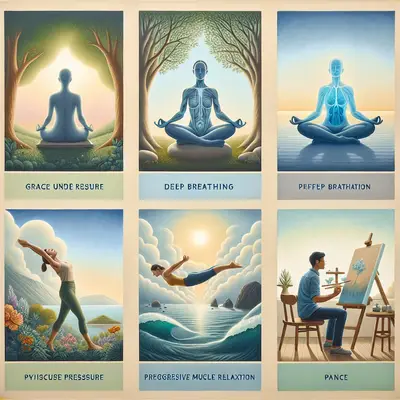
Stress has become less a passing state and more a quiet residency in modern life. For those who live at a refined pace—demanding careers, intricate responsibilities, and an expectation of composure—stress is rarely dramatic. It is subtle: shallow breaths between meetings, a mind that never fully powers down, a body that holds tension as if it were a duty. This article explores stress relief as an elevated practice, offering five exclusive insights designed for those who value nuance, depth, and a quietly luxurious approach to mental wellness.
Stress as a Design Problem, Not a Personal Failure
Many high-functioning individuals unconsciously treat stress as a moral verdict: if you were more disciplined, more organized, more “together,” you would not feel this pressed. This belief is both untrue and corrosive. Stress is, in large part, a design issue—of time, environment, relationships, and even your internal narratives.
Reframing stress as a design problem invites a different question: “How is my life currently designed to produce this level of strain?” This lens shifts you from self-blame to elegant problem-solving. Perhaps your workday is designed with no transition zones, forcing your nervous system to sprint from demand to demand. Perhaps your home environment is acoustically and visually loud, offering your mind no true refuge.
Once you see stress as a byproduct of design, you can begin to edit. This might mean structuring intentional buffers between commitments, curating a quieter digital environment, or renegotiating boundaries that have been left vague for too long. The goal is not to engineer a frictionless life—that is neither realistic nor necessary—but to ensure that your daily architecture does not routinely work against your nervous system. You are not failing; the design may simply need refinement.
Nervous System Literacy: Understanding Your Stress Signature
Refined stress relief begins with nervous system literacy: the ability to recognize how your body and mind uniquely register overload. Beyond generic advice, your stress has a signature—specific patterns that, once understood, become early warning signals rather than sudden crises.
You might notice your stress first in your language: your inner monologue becomes more absolute (“always,” “never,” “impossible”). Or in physical micro-signals: a tightened jaw, a slightly elevated heart rate, tension that pools in the shoulders or solar plexus. Others feel stress as cognitive clutter—a sensation that simple decisions become strangely heavy.
Learning your stress signature allows you to intervene upstream, when stress is still malleable. Rather than waiting for full exhaustion, you can respond to the first signs of accelerated breathing, brittle patience, or compulsive multitasking. This may be the moment to reduce mental inputs, choose a slower task, or physically change locations—even briefly—to signal safety to your nervous system.
Over time, you develop a discrete internal language: “This is my pre-overwhelm phase.” From there, you can employ small but intentional countermeasures—lengthened exhalations, a five-minute visual reset by looking at something natural or distant, or a brief recalibration of priorities. Nervous system literacy transforms stress from something that “happens to you” into something you can steadily, intelligently modulate.
The Luxury of Boundaries: Subtle Limits as Stress Medicine
For many accomplished individuals, boundaries have been framed as inconveniences—things that might disrupt progress, relationships, or opportunity. In reality, boundaries are a form of luxury: the rare privilege of deciding how your time, attention, and emotional energy will be used.
Elegant boundaries are rarely theatrical. They are precise, courteous, and consistent. This might mean setting a firm end to late-night emailing, not as a productivity hack, but as an act of nervous system protection. It might mean defining specific “off-stage” periods where you are fundamentally unreachable, except for true emergencies, clearly communicated in advance.
The premium approach to boundaries is not about rigid rules; it is about congruence. Your commitments, values, and calendar begin to align more faithfully. You say fewer half-hearted yeses, and you honor your no with quiet clarity. This alignment reduces the chronic internal friction that quietly drains you—the mental gymnastics of overpromising, resenting, and then repairing.
Viewed this way, boundaries are a refinement of your life’s texture. You are not shutting people out; you are crafting enough protected space for your mind and body to decompress, integrate, and restore. Your presence, when given, becomes more genuine and generous because it is no longer extracted from an exhausted reserve.
Precision Recovery: Recharging in the Exact Way You Are Depleted
Many stress-relief suggestions fail not because they are ineffective, but because they are imprecise. True refinement lies in precision recovery—restoring yourself in ways that correspond directly to how you are depleted.
If your work is cognitively intense but socially quiet (e.g., deep analytical tasks), you may need social connection as recovery—intimate conversation, shared laughter, or being in the presence of trusted people without performing. If, on the other hand, your life is socially saturated—endless meetings, calls, and obligations—your nervous system may require solitude and sensory softness.
Similarly, if your stress is embodied—tight muscles, headaches, shallow breathing—somatic practices such as gentle stretching, restorative yoga, or unhurried walks can restore you more effectively than scrolling or even reading. If your stress is existential—questions of meaning, identity, or direction—recovery might be found in reflection: journaling, therapy, spiritual inquiry, or immersing yourself in art and literature that expand your perspective.
A premium approach to recovery asks with precision: “What is the nature of my current depletion?” and “What is the most direct antidote?” Over time, you can craft a personal menu of recovery modes—physiological, emotional, cognitive, and existential—and select deliberately, rather than grasping at generic distractions that leave you superficially entertained but fundamentally unrested.
Quiet Micro-Rituals: Invisible Practices with Profound Impact
The most transformative stress-relief practices are often the least visible. They do not always require hours or extravagant settings; they require intentionality and repetition. Think of them as micro-rituals—small, elegant gestures that communicate safety and spaciousness to your nervous system throughout the day.
A micro-ritual might be a 30-second pause before entering a meeting: placing a hand lightly over your chest, taking three slow exhalations, and silently choosing the quality of presence you wish to bring. It might be a specific way of closing your laptop at day’s end—tidying your digital and physical workspace so that your mind receives a clear “completion” signal.
Another might be a transition ritual between roles: a short walk after work before stepping fully into your home life, a change of lighting to mark the move from “doing” to “resting,” or a particular blend of herbal tea prepared only in the evenings to anchor your body in a slowing rhythm.
These micro-rituals are subtle but cumulative. They gradually re-teach your nervous system that life is not a single, uninterrupted demand. Instead, it becomes a series of chapters, each gently punctuated. In a culture that prizes visible productivity, these quiet practices are an act of sophistication—an insistence that your interior life deserves as much design and care as your external accomplishments.
Conclusion
Stress, approached with discernment, becomes less an enemy and more a messenger—revealing where your life’s architecture, boundaries, and recovery strategies need refinement. By viewing stress as a design issue, learning your unique stress signature, honoring boundaries as a form of luxury, practicing precision recovery, and cultivating quiet micro-rituals, you transform relief from a desperate afterthought into a continuous, elevated practice.
This is the art of unburdening: not escaping your responsibilities, but meeting them with a mind and body that are no longer perpetually overdrawn. In a world that praises relentless output, there is something quietly radical—and exquisitely premium—about choosing a life in which your nervous system is not collateral damage, but a central priority.
Sources
- [American Psychological Association – Stress: The different kinds of stress](https://www.apa.org/topics/stress) – Overview of stress types, impacts, and coping recommendations
- [National Institutes of Health – Chronic Stress Puts Your Health at Risk](https://newsinhealth.nih.gov/2015/10/stress) – Explains physiological effects of chronic stress and evidence-based strategies to reduce it
- [Harvard Health Publishing – Understanding the stress response](https://www.health.harvard.edu/staying-healthy/understanding-the-stress-response) – Details the biology of the stress response and its long-term consequences
- [Mayo Clinic – Stress management](https://www.mayoclinic.org/healthy-lifestyle/stress-management/basics/stress-basics/hlv-20049495) – Practical guidance on recognizing stress and implementing lifestyle-based management techniques
- [Yale Medicine – The Effects of Stress on Your Body](https://www.yalemedicine.org/news/what-stress-does-to-your-body) – Reviews how stress affects different body systems and highlights the importance of proactive stress reduction
Key Takeaway
The most important thing to remember from this article is that this information can change how you think about Stress Relief.