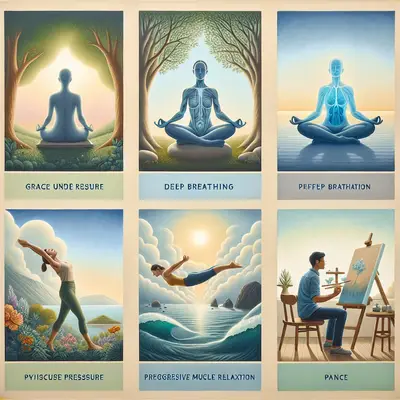
Modern life rarely offers an intermission. Notifications, expectations, and invisible pressures accumulate quietly until your nervous system is running a private marathon no one sees—but your sleep, mood, and clarity of thought certainly do. Stress relief, for a cultivated life, isn’t about escape; it’s about orchestrating your day so calm becomes an intrinsic quality, not an occasional accident.
This is an invitation to design your own “composed hour”—a rhythm of practices that restore elegance to your inner world. Below are five exclusive, research-informed insights tailored for those who seek mental ease with the same discernment they bring to every other aspect of their lives.
Recalibrating the Nervous System: Treating Calm as a Daily Standard
Stress is not the enemy; unrelieved stress is. The nervous system was built to recover, yet many people never give it the chance. What distinguishes elevated stress care from casual self-care is intention: you’re not merely “taking a break,” you’re actively recalibrating a biological system.
Acute stress activates the sympathetic nervous system, sharpening focus and energy. But when the stress response is never truly completed, your body behaves as though the emergency never ends—raising inflammation, impairing sleep, and clouding judgment. Sophisticated stress relief therefore begins with a simple premise: build in rituals that explicitly tell your nervous system, “We are safe now.”
This doesn’t require dramatic gestures. A 5-minute breathing ritual between meetings, a screen-free wind-down before bed, or a quiet pre-dawn coffee without devices each sends powerful signals of safety. Over time, these “micro-declarations of calm” become a baseline, not a luxury. Calm stops being a place you visit and becomes the standard from which you operate.
Exclusive Insight 1: Curating a Sensory Signature for Calm
Most people attempt to de-stress by removing stimuli—turning off notifications, closing laptops, dimming lights. Elevated stress relief goes further: it curates sensory input with deliberate precision.
Your nervous system responds quickly to sensory cues. You can use this to your advantage by designing a personal “calm signature” across scent, sound, texture, and light. For example, selecting one specific fragrance (a single essential oil blend, a particular candle, or a lightly scented lotion) that you reserve only for unwinding teaches your brain: “When I encounter this scent, the nervous system may stand down.” Over time, it becomes an anchor.
Sound can be equally powerful. Instead of defaulting to generic playlists, choose a single album, instrument, or curated soundscape that you associate solely with mental recovery—perhaps soft piano in a minor key, ambient nature recordings, or low-frequency soundscapes that gently slow your internal tempo. Pair this with refined tactile elements—a favorite throw blanket, a weighted eye mask, or a particular chair chosen for its quiet support.
This is not indulgence; it is conditioning. You are training your brain to identify a highly curated sensory pattern as “safe, unhurried, restorative.” Once established, this signature can be deployed in travel, high-pressure seasons, or transitions, turning any space—hotel room, office, airport lounge—into a portable sanctuary.
Exclusive Insight 2: The 20-Second Luxury of High-Quality Breath
Deep breathing is often recommended, but rarely executed with the precision it deserves. A refined approach appreciates that the quality of a few seconds of breath can rival the impact of several minutes of distracted “relaxation.”
The nervous system is particularly responsive to the exhale. Lengthening the exhale relative to the inhale sends a direct cue to the parasympathetic (rest-and-digest) system. A simple, elegant pattern: inhale gently through the nose for 4 seconds, pause for 1–2 seconds, then exhale through the nose for 6–8 seconds. Repeat for just 4–6 breaths. This entire reset can take less than 60 seconds.
What elevates this into a premium practice is where and when you choose to use it: just before joining a demanding meeting, as you step into your front door in the evening, or while waiting for your drink to brew instead of scrolling your phone. Breathwork becomes a quiet luxury of attention—micro-rituals, woven into transitions, that preserve your composure without announcing themselves to the world.
The key is consistency over spectacle. You don’t need 30 minutes in a dedicated room; you need a few impeccably executed, high-fidelity breaths, repeated often enough that your body begins to expect—then crave—this moment of deliberate ease.
Exclusive Insight 3: Strategic Solitude as Cognitive Detox
Stress is not purely physiological; it is also cognitive clutter. Lingering conversations, unresolved decisions, and mental tabs left open consume quiet processing power. For a sophisticated mind, strategic solitude becomes less about being alone and more about giving the brain permission to complete its unfinished thinking.
Unlike social withdrawal, strategic solitude is time-bounded, intentional, and designed. It might be 15 minutes in the same chair every evening with a notebook and no agenda beyond “emptying the mind.” You jot down unresolved loops: conversations replaying in your head, tasks weighing on you, questions you’re quietly carrying. The objective is not to solve everything, but to externalize it.
This written “cognitive offloading” lightens mental load, and research supports its effect on reducing rumination and improving sleep quality. You may choose to pair this with a gentle constraint—no devices, a single pen, a favorite drink—to signal that this is a refined pause, not idle time.
Over time, this practice teaches your mind that it does not need to rehearse every concern on a loop throughout the day. It has a scheduled, respectful appointment with your full attention. That assurance alone can soften stress long before the problems themselves are resolved.
Exclusive Insight 4: Designing a Graceful Descent from High Performance
High-functioning individuals often move from intense focus to abrupt collapse—leaving no structured “landing” between peak performance and exhaustion. This transition, when neglected, is fertile ground for chronic stress, irritability, and restless nights.
Imagine instead a “graceful descent protocol”—a deliberate, 20–40 minute arc at the end of your demanding period (the workday, a major project, caregiving stretch) in which you recalibrate from doing to being. This might include three stages:
- Closure: A 5–10 minute review of what was completed and what must be carried forward, captured in a structured list. This tells the brain: “We are not dropping the ball; we are deliberately placing it down.”
- Decompression: A light, low-stakes physical activity—walking, gentle stretching, or methodical tidying—that lets your body discharge an accumulated stress charge without intensity or performance.
- Transition Ritual: One repeated action that signals you are entering a different state—changing into specific “evening clothes,” brewing a particular tea, or dimming lights and turning on your preferred calm soundtrack.
The elegance lies in repetition. By treating this transition as non-negotiable—like brushing your teeth—you gradually retrain your system to expect a controlled descent, rather than an abrupt shutoff. The result: deeper sleep, more poised evenings, and a mind that doesn’t carry your entire workday into your pillow.
Exclusive Insight 5: Elevating Rest with “Micro-Luxuries” Instead of Escape
Under strain, it’s easy to default to escapist relief: binge-watching, endless scrolling, or numbing with food or alcohol. These offer momentary distraction but rarely true restoration. A refined approach replaces escape with micro-luxuries—brief, deliberate experiences that feel subtly elevated yet are fully compatible with long-term wellbeing.
A micro-luxury might be:
- Drinking your evening herbal tea from your finest cup, even on an ordinary Tuesday.
- Upgrading your bedtime routine with a few drops of high-quality body oil and a 2-minute self-massage for the neck and shoulders.
- Reading a few pages of a beautifully written book instead of scanning headlines.
- Spending five minutes by an open window, simply observing the sky and outdoor sounds, as though you were on a terrace elsewhere.
The power of micro-luxuries lies not in their price but in their presence. They dignify your need for restoration. They transform rest from an act of guilt-ridden escape into a conscious celebration of being alive in your own body, in this exact moment.
With repetition, these quiet luxuries reshape your relationship with stress. You’re no longer waiting for vacations or weekends to feel human; you’re cultivating a daily standard of subtle, sustaining pleasure.
Conclusion
Stress will always be a guest in a meaningful life, but it does not have to be the host. When you refine how you respond—curating your sensory environment, elevating your breath, honoring strategic solitude, choreographing your descent from performance, and embracing micro-luxuries—you begin to move through your days with a more composed, less reactive presence.
This is not about perfection or an impossibly serene existence. It is about making calm operational—installing it into your habits, your spaces, and your nervous system, until resilience feels as natural as breathing. Your composed hour may begin as a handful of small, exquisite choices. Over time, it becomes the architecture of a life that feels both productive and profoundly at ease.
Sources
- [American Psychological Association – Stress Effects on the Body](https://www.apa.org/topics/stress/body) – Overview of how chronic stress impacts multiple bodily systems and why ongoing relief practices matter
- [Harvard Health Publishing – Relaxation Techniques: Breath Control Helps Quell Errant Stress Response](https://www.health.harvard.edu/mind-and-mood/relaxation-techniques-breath-control-helps-quell-errant-stress-response) – Explains the physiology of breathing practices and their effect on the nervous system
- [Cleveland Clinic – Journaling for Mental Health](https://health.clevelandclinic.org/benefits-of-journaling-for-mental-health) – Discusses how expressive writing and cognitive offloading support reduced stress and improved wellbeing
- [National Institutes of Health – The Role of Sleep in Emotional Brain Function](https://www.ncbi.nlm.nih.gov/pmc/articles/PMC3181838/) – Research perspective on how nighttime recovery influences emotional regulation and stress resilience
- [Mayo Clinic – Stress Management: Know Your Triggers](https://www.mayoclinic.org/healthy-lifestyle/stress-management/in-depth/stress-relief/art-20043901) – Practical guidance on understanding and addressing personal stress patterns
Key Takeaway
The most important thing to remember from this article is that this information can change how you think about Stress Relief.