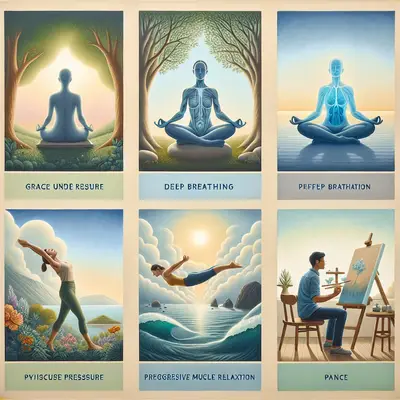
Stress in modern life rarely announces itself with drama. It accumulates quietly—subtle tension in the jaw, a shallower breath, a sense that your attention is fraying at the edges. For a discerning mind, stress relief is not merely about “coping”; it is about curating the inner atmosphere in which thought, creativity, and emotional poise can flourish. This is less a hunt for quick fixes, and more a commitment to moving through the day with considered intention.
Below are five exclusive, elevated insights into stress relief—approaches that move beyond the usual advice and into the realm of refined, sustainable mental ease.
1. Curating Mental Texture: Choosing What Your Mind is Allowed to Touch
Just as one might curate fabrics in a well-appointed home, you can curate the “texture” of what your mind encounters. Most people treat mental input—news, notifications, conversations, background noise—as inevitable. The refined approach is to view them as design choices.
Begin by noticing the first hour of your day. What is the mental texture of what you allow in? Is it jagged, urgent, and crowded? Or measured, spacious, and intentional? Shifting from reactive consumption (scrolling, emails, breaking news) to curated input (a single long-form article, a page of a book, gentle instrumental music) fundamentally alters your nervous system’s baseline for the day.
Research on media consumption and stress suggests that constant exposure to negative or alarming news can exacerbate anxiety and physiological stress responses. By minimizing low-quality input—doomscrolling, chaotic background media—you reduce the frequency of subtle micro-stressors that accumulate over time. This is not about escapism; it is about discernment. You can stay informed without turning your mind into a bulletin board for every urgent headline.
Make it an experiment: for seven days, treat the content you consume as if it were decor for your mind. If it feels abrasive, frantic, or cheap, it doesn’t belong in your inner space. The result is a quieter, more composed baseline from which stress becomes easier to manage.
2. Breathing as Architecture: Designing the Internal Rhythm of Your Day
Breathwork is often presented as a quick trick: inhale for four, exhale for six, feel calmer. A more elevated practice treats breathing as a form of internal architecture—a way of shaping the rhythm and proportions of your entire day.
Instead of occasional “relaxation breathing,” imagine structuring your schedule around deliberate breath intervals. Before stepping into cognitively demanding activities, you might use a few minutes of slow, coherent breathing (around 5–6 breaths per minute) to settle your autonomic nervous system. Evidence suggests that this style of breathing can enhance heart rate variability, a marker of resilience and stress adaptation.
Rather than waiting for stress to peak, you treat the breath as the metronome of your day. Short, intentional breathing sessions punctuate transitions: waking, beginning work, shifting between tasks, preparing for sleep. Over time, the nervous system learns a new pattern: activation followed by a graceful return to calm.
The refined detail here is precision: sitting upright with dignified posture, a soft gaze, and a sense of composure. You’re not slumped in “relaxation”; you’re cultivating poised calm. This quality of intentionality turns a simple physiological exercise into a ritual of psychological elegance.
3. Intelligent Boundaries: Protecting Cognitive Bandwidth as a Luxury Resource
In a world that glorifies availability, one of the most sophisticated forms of stress relief is guarding your cognitive bandwidth as if it were a luxury resource—because it is. Mental overload is not just unpleasant; it erodes decision quality, emotional regulation, and creative thought.
Intelligent boundaries are not only about saying “no.” They are about designing your obligations so they respect your nervous system’s capacity. This might mean:
- Setting specific “deep focus” windows where notifications are entirely silenced.
- Limiting the number of decisions you make before noon by pre-deciding minor details (outfits, meals, scheduling).
- Politely declining emotionally draining conversations when you have no capacity to respond thoughtfully, and scheduling them for a time when you can be genuinely present.
Decision fatigue and continuous partial attention are known contributors to heightened stress. When you decrease unnecessary micro-decisions—what to check, when to reply, how to juggle constant interruptions—you reclaim mental clarity. The premium approach is to treat your attention like a private members-only space, not a public plaza.
This isn’t strict asceticism; it’s refined selectivity. You are choosing quality of engagement over quantity of interaction. The result is a nervous system that is less frayed, and a mind that can meet inevitable stressors with more grace.
4. Sensory Calibration: Using Subtle Physical Cues to Downshift Stress
Most stress relief advice focuses on thoughts and emotions; the elevated approach also attends to the micro-sensory details that quietly govern your state. Your nervous system is constantly reading the environment: light, sound, temperature, texture, even scent. Adjusting these with intention can act as a subtle but powerful lever on stress.
Consider lighting: harsh overhead light late at night quietly signals “daytime” to the brain, interfering with melatonin production and sleep. Replacing it with warmer, dimmer lamps in the evening creates a visual cue for the body to downshift. Or sound: continuous, low-level noise from traffic or devices can keep your system slightly activated; adding moments of genuine quiet or curated gentle soundscapes can restore a sense of inner spaciousness.
Texture and temperature matter as well. A structured chair that supports dignified posture may help prevent the slumping associated with mental fatigue. A cool room for sleep supports deeper rest; a warm shower or bath in the evening creates a comforting drop in core body temperature afterward, a physiological prompt for sleep onset.
By treating sensory inputs as instruments in a carefully tuned orchestra, you create a physical environment that cooperates with your nervous system rather than working against it. Stress becomes easier to manage when your surroundings are not constantly pressing on your capacity.
5. Emotional Refinement: Transforming Stress Signals into Intelligent Data
For many, stress is framed as a malfunction: something to suppress, distract from, or overpower. A more sophisticated stance views stress as intelligent data—evidence that something in your current configuration (habits, boundaries, expectations) is misaligned.
Emotional refinement begins with vocabulary. Instead of labeling everything as “stressed,” you become precise: is it pressure, apprehension, overstimulation, disappointment, resentment, or simple fatigue? Research suggests that emotional granularity—the ability to describe your feelings in nuanced terms—is linked to better regulation and lower distress.
Once you’ve named the feeling with precision, you can ask more intelligent questions:
- If it’s pressure: is the timeline unrealistic, or is your process disorganized?
- If it’s resentment: where was a boundary not set or not honored?
- If it’s overstimulation: which input (social, digital, environmental) has exceeded your capacity?
In this way, stress shifts from being a vague cloud to a series of refined indicators pointing to specific adjustments. You are not merely trying to “feel better”; you are using the information your nervous system provides to craft a more congruent life.
This is the ultimate premium practice: honoring your inner experience as data worthy of careful interpretation, not as a nuisance to be silenced.
Conclusion
A composed life is not free of stress; it is distinguished by a graceful relationship to it. By curating what your mind is allowed to touch, designing your day’s internal rhythm through breath, guarding cognitive bandwidth with discerning boundaries, calibrating your sensory environment, and refining the way you interpret emotional signals, you create more than “stress relief.” You cultivate an inner atmosphere in which clarity, stability, and quiet strength feel natural rather than exceptional.
Stress will still arrive. But in a life arranged with this level of attention, it will meet a nervous system that is practiced in composure—and a mind that knows exactly how to respond.
Sources
- American Psychological Association – Stress: The Different Kinds of Stress - Overview of stress types, impacts, and coping strategies, including psychological and physiological aspects
- Harvard Health Publishing – Take a Deep Breath - Explores how controlled breathing techniques influence the nervous system and stress response
- National Institutes of Health (NIH) – The Effects of News Consumption on Mental Health - Research article examining media exposure, emotional state, and stress-related outcomes
- Cleveland Clinic – Heart Rate Variability: What It Is and Why It Matters - Discusses HRV as an indicator of stress resilience and autonomic balance
- Greater Good Science Center, UC Berkeley – Emotional Granularity - Explains how naming emotions with precision supports better stress regulation and well-being
Key Takeaway
The most important thing to remember from this article is that this information can change how you think about Stress Relief.