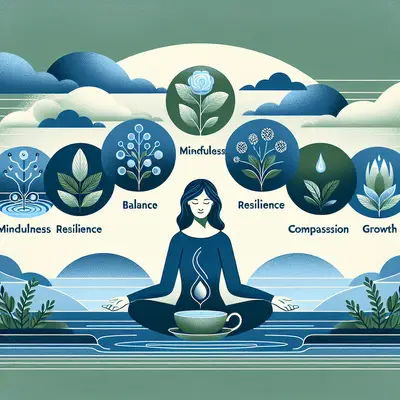
There is a quiet form of luxury that never appears on a receipt: the feeling that your inner world is orderly, spacious, and composed. In an age of relentless notifications and invisible pressures, mental wellness is no longer a soft aspiration—it is a cultivated asset. At Calm Mind Remedies, we regard mental ease not as an afterthought, but as a refined daily standard, honed through deliberate choices and elevated practices.
Below are five exclusive insights designed for those who wish to treat their mind with the same discernment they bring to their home, wardrobe, and relationships. Each is less about doing more, and more about doing differently—curating a mentally luxurious day with intention.
1. Curated Cognitive Input: Treat Your Attention Like a Private Collection
Most people guard their bank accounts more closely than their attention. Yet what you repeatedly allow into your mind becomes the architecture of your inner landscape. Curated cognitive input means you treat information like an art collection, not background noise.
Begin by quietly auditing your daily mental diet. Which news sources, social feeds, podcasts, and conversations leave a residue of anxiety or agitation? Which ones leave you feeling quietly expanded, better informed, and subtly elevated? Without drama or public declarations, start refining: unsubscribe, mute, or gently limit what feels chaotic; deliberately introduce sources that are intelligent, measured, and evidence-based.
This is not about living in a bubble; it is about choosing signal over noise. Consider establishing “premium input windows” in your day—brief, defined periods where you consume only high-quality content: a thoughtful long-form article, a well-researched podcast, a lecture from a respected institution. Over time, this becomes a mental filtration system; your mind stops being a public thoroughfare and becomes a private gallery, curated with care.
2. Micro-Rituals of Transition: Elevating the In-Between Moments
Mental strain often accumulates not in crises, but in the seams of the day—between calls, after emails, before bed. These liminal spaces, when left unmanaged, fill with scrolling, rushing, and low-grade agitation. Transforming them into micro-rituals of transition is one of the most elegant upgrades you can offer your nervous system.
A transition ritual can be as brief as 60 seconds, yet feel quietly opulent. After closing your laptop, place your hands flat on the desk, take three slow, deliberate breaths, and mentally mark the workday as complete. Before entering your home, pause in the car or at the door and decide how you want to feel for the next few hours—unhurried, receptive, present.
These rituals do not need to be dramatic; they should feel natural, almost secret. Lighting a single candle at dusk to signal the shift from doing to unwinding. Changing into a particular garment that signals “off-duty mind.” Playing a specific piece of music that you reserve only for evening decompression. Over time, these cues train your nervous system; your body learns that certain gestures, sounds, and textures mean, “You are allowed to soften now.”
3. Nervous System Literacy: Knowing Your Personal “Luxury Settings”
Refined mental wellness begins with nervous system literacy—the elegant skill of recognizing your own physiological states and adjusting them with precision. Instead of labeling the day as “stressful” or “fine,” you learn to notice subtler gradations: slightly compressed chest, shallow breath, a faint buzzing in the jaw, a tendency to rush speech, or a narrowing of perspective.
Once you can read these cues, you can intervene earlier, before overwhelm becomes your default setting. For some, a two-minute, slow exhale breathing pattern (in for four counts, out for six to eight) is enough to bring the body back into a regulated state. For others, a few moments of grounded movement—pressing feet firmly into the floor, gently stretching the hands and neck—restores a sense of inhabiting one’s own body again, rather than living in the mind’s storyline.
Think of this as designing your personal “luxury settings” for the nervous system: What environment, temperature, light, and sound support your calm? Which scents reliably soothe? Which textures—cashmere, linen, soft cotton—help you exhale more deeply? These are not trivial details; they are levers. When you know how your specific system responds, you can create conditions where calm is not an effort, but a natural consequence of how you live.
4. Discerning Emotional Boundaries: The Art of “Selective Availability”
The truly composed mind is not endlessly accessible. It practices what can be called “selective availability”—a thoughtful, gracious way of deciding when and how your emotional energy is available to others. This is not withdrawal; it is curation.
Notice how often you reflexively say yes: to calls, favors, last-minute meetings, emotional debriefs that you are too depleted to hold. Each unconsidered yes is a small withdrawal from your internal reserves. A more refined approach is to pause—even briefly—before agreeing. Ask yourself: Do I have the bandwidth to offer something wholehearted here, or will this drain my ability to care for myself and others later?
Boundary-setting can be elegant and calm: “I want to give this conversation my full attention, and I’m not able to today. Could we talk tomorrow?” or “I can do that, but I’ll need to pass on something else so I don’t overextend.” Over time, people begin to respect not just your time, but your mental clarity. Your presence becomes more potent because it is not scattered; when you are available, you are fully there.
5. The Quiet Audit: Aligning Lifestyle with Cognitive Performance
Mental wellness is not separate from lifestyle; it is braided into sleep, nutrition, movement, and light exposure. A quiet audit—conducted without self-criticism—can reveal subtle mismatches between how you live and how you wish your mind would perform.
Consider your sleep not just in hours, but in quality: Do you wake refreshed, or groggy and already chasing the day? Are late-night screens and irregular bedtimes eroding your cognitive clarity? Examine your relationship with caffeine and alcohol: Are they gentle enhancements or blunt instruments? Notice the interval between your first screen exposure in the morning and your first moment of natural light—those early minutes shape your circadian rhythm and, with it, your mental stamina.
Instead of radical overhauls, make one or two upgrades that feel quietly luxurious rather than punishing: a sleep environment that feels hotel-level serene, a consistent wake time that supports morning lucidity, a short daily walk outdoors to anchor your mood, or a thoughtfully composed first meal that stabilizes blood sugar and concentration. The goal is not perfection; it is alignment: sculpting your lifestyle so that the mind you experience each day more closely resembles the mind you aspire to have—clear, steady, and unhurried.
Conclusion
Mental wellness, at its highest expression, is not a weekend escape or a temporary reset. It is a composed way of living, built from a series of precise, dignified choices—what you allow into your mind, how you move between activities, how you read your nervous system, who has access to your emotional energy, and how you quietly refine your daily habits.
When you begin to treat your inner life as something worthy of curation and protection, your days take on a different texture. Calm is no longer a rare event to be chased; it becomes an undercurrent—subtle, reliable, and distinctly your own version of luxury.
Sources
- Harvard Health Publishing – Stress Management: Improve Your Well-Being - Overview of how stress management practices support mental and physical health
- National Institute of Mental Health – Caring for Your Mental Health - Evidence-based guidance on daily mental wellness strategies
- Centers for Disease Control and Prevention – How Sleep Affects Your Health - Explains the relationship between sleep quality and mental functioning
- Yale School of Medicine – Understanding the Stress Response - Describes how the nervous system responds to stress and why regulation techniques matter
- American Psychological Association – Building Resilience - Research-backed perspective on habits and attitudes that support long-term emotional resilience
Key Takeaway
The most important thing to remember from this article is that this information can change how you think about Mental Wellness.