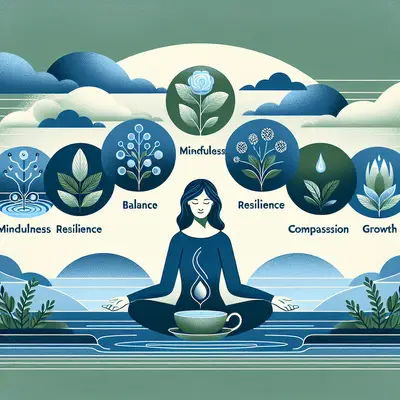
Mental wellness is no longer a side project; it is a design choice that informs how you move through your days, make decisions, and experience yourself. At Calm Mind Remedies, we regard mental wellness not as a fix, but as a refinement—a quiet recalibration of how you allocate attention, energy, and care. This is not about perfection or relentless optimization. It is about cultivating a mind that feels well-appointed: spacious, deliberate, and quietly resilient.
Below, you’ll find five exclusive insights for those who are no longer satisfied with basic “self-care tips” and are ready to treat their inner life with the same discernment they bring to every other domain of their world.
Redefining Calm as Capacity, Not Stillness
Many people chase calm as if it were a static state—an immaculate, interruption-free window where nothing intrudes. That version of calm is brittle. It collapses at the first email, the first unexpected request, the first complication.
A more refined definition of mental wellness views calm as capacity: your ability to remain steady while life moves at its natural pace. Instead of eliminating stimuli, you expand your threshold for them.
This shift is subtle but powerful. Rather than asking, “How can I stop the world from being noisy?” you begin asking, “How can I strengthen the part of me that can hear the noise without being ruled by it?” Practices like breath regulation, micro-pauses between tasks, and deliberate transitions at the beginning and end of the day become less about escaping stress and more about conditioning your nervous system to carry stress with greater poise.
In this model, the goal isn’t an empty calendar or a silent phone; it is the elegant ability to navigate a full life without feeling emotionally overdrawn.
Curating Mental Input with the Precision of a Collector
What you allow into your mind—conversations, media, environments, even visual clutter—subtly sculpts your inner landscape. For many high-functioning people, stress is not only about “too much to do,” but also about “too many unfiltered inputs.”
A sophisticated approach to mental wellness treats attention as a curated gallery, not a public square. This doesn’t mean living in a bubble; it means applying taste, discernment, and intention to what gets a front-row seat in your awareness.
Consider three layers of mental input:
- Front-of-house input – What you actively seek: books, long-form journalism, considered conversations.
- Ambient input – Notifications, background noise, habitual scrolling, other people’s urgency.
- Residual input – The emotional “afterglow” of what you consumed: news headlines that linger, unresolved dialogues, incomplete tasks.
Refined mental wellness is not just about reducing screen time or turning off notifications; it’s about consciously promoting certain inputs from the background to the foreground and demoting others. For example, you might deliberately reserve your most spacious mental state of the day—often the first 60–90 minutes after waking—for inputs that actually elevate your thinking, not the most alarming headlines.
This is not about asceticism; it is about aesthetic: designing your mental inputs so your inner life feels less like a busy feed and more like a thoughtfully composed space.
Treating Emotional States as Data, Not Directives
A premium inner life does not require you to feel positive at all times. Instead, it asks that you relate to your emotions with a more nuanced sophistication: each feeling is information, not an instruction.
Anxiety, for instance, may flag perceived risk, social exposure, or uncertainty. It does not necessarily mean “leave immediately,” “say yes,” or “say no.” Sadness may indicate loss, misalignment, or a lack of fulfillment—it does not automatically mean “everything is broken.”
When you treat emotions as data points, you create a small but meaningful distance between sensation and action. You might ask:
- What is this emotion trying to alert me to?
- Is it responding to the present, or echoing something older?
- If this feeling were a piece of market research about my life, what would it be telling me?
This approach does not diminish emotional experience; it dignifies it. Emotions stop being unruly forces to suppress or obey and become finely textured signals in your decision-making process. Over time, this emotional literacy forms part of your mental “infrastructure”—a stable, reliable system for navigating both turbulence and opportunity.
Designing Ritual Boundaries Instead of Rigid Rules
Rules tend to fail under pressure: the strict evening routine that collapses after one late meeting, the no-phone policy that disappears on the first hectic day. Boundaries, by contrast, can be designed with flexibility and elegance.
A refined approach uses ritual boundaries: repeatable, sensory cues that signal your mind to transition between roles, responsibilities, or environments. The power of these rituals lies less in their duration and more in their consistency.
Examples of ritual boundaries include:
- A specific piece of music or scent that marks the end of your workday, even if that “end” happens at different times.
- A short, structured check-in with yourself before major decisions—three slow breaths, one clarifying question, one intentional choice.
- A designated “decompression threshold” when entering your home: no immediate emails, no new commitments; just a brief return to yourself before engaging with others.
These rituals act as soft partitions in your day, preventing all your roles from bleeding into one endless, indistinct stream. They are less about control and more about choreography—how you move between identities with grace, so no single identity consumes you.
Elevating Recovery: Making Rest as Intentional as Ambition
Ambitious people often bring extraordinary intentionality to their goals—but almost none to their recovery. Rest becomes accidental: whatever is left over when the day has taken what it wants.
Truly elevated mental wellness treats recovery as a first-order priority, not a consolation prize. This does not mean doing less; it means understanding that the quality of what you do is inseparable from how deliberately you recover.
Recovery can be:
- Physical: Sleep depth, nervous system regulation, gentle movement.
- Cognitive: Time away from problem-solving, space for unstructured thought.
- Emotional: Conversations that nourish, not deplete; honest expression rather than constant performance.
- Sensory: Environments that soothe the nervous system—light, sound, textures, and temperature that feel composed rather than chaotic.
When you plan your week, consider asking: “What is my primary source of recovery, and where does it live in my calendar?” You can apply the same specificity you bring to your projects to designing pockets of genuine renewal. Over time, you stop oscillating between overextension and collapse and begin living in a more sustainable, quietly powerful rhythm.
Conclusion
Mental wellness, at its most refined, is not about achieving some flawless, perpetually serene state. It is about inhabiting your life with greater intentionality—choosing what you let in, how you interpret what you feel, when you transition, and how you restore.
The composed mind is not an accident; it is a series of subtle design decisions made repeatedly over time. As you reframe calm as capacity, curate your inputs, treat emotions as data, adopt ritual boundaries, and elevate recovery to the level of your ambitions, you cross a threshold. Your inner life ceases to be something you merely endure and becomes something beautifully, deliberately lived.
Sources
- [National Institute of Mental Health – Caring for Your Mental Health](https://www.nimh.nih.gov/health/topics/caring-for-your-mental-health) - Overview of evidence-based approaches to maintaining mental well-being
- [Harvard Health Publishing – How the Quality of Your Sleep Affects Your Mental Health](https://www.health.harvard.edu/newsletter_article/how-the-quality-of-your-sleep-affects-your-mental-health) - Explores the connection between restorative sleep and emotional regulation
- [American Psychological Association – Building Your Resilience](https://www.apa.org/topics/resilience) - Research-backed guidance on developing psychological capacity in the face of stress
- [Mayo Clinic – Stress Management](https://www.mayoclinic.org/healthy-lifestyle/stress-management/basics/stress-basics/hlv-20049495) - Practical, clinically informed strategies for managing stress more effectively
- [Yale University – The Science of Well-Being (Open Course)](https://oyc.yale.edu/psychology/psyc-157) - Academic exploration of habits and mindsets that support long-term well-being
Key Takeaway
The most important thing to remember from this article is that this information can change how you think about Mental Wellness.