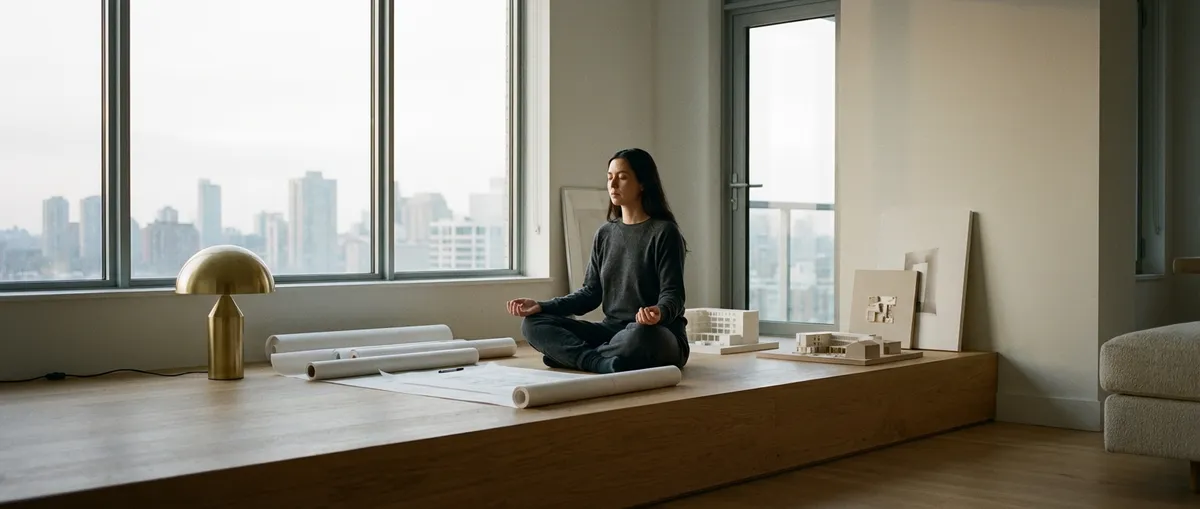
In a world saturated with noise, meditation is often reduced to a wellness checkbox—ten rushed minutes between notifications. But for the discerning mind, it can be something far more elevated: a daily design choice that shapes how your thoughts, time, and energy are curated. When practiced with intention and subtlety, meditation becomes less of a task and more of a quiet architecture for a composed, intelligent life.
Below are five exclusive, under-discussed insights—less about “how to sit” and more about how to refine the entire experience—crafted for those who want their mental wellness practice to feel as considered as every other aspect of their lives.
1. The Pre-Meditation Minute: Curating the Entrance, Not Just the Practice
Most people treat meditation as an on/off switch: you sit, you close your eyes, you begin. But the quality of your practice is profoundly influenced by what happens in the sixty seconds before you start.
Instead of dropping straight into stillness from your inbox or a meeting, design a pre-meditation entrance ritual that signals to the nervous system, “We are shifting states now.” This can be as discreet as adjusting the lighting, placing your phone face down in another room, or taking three slow exhalations while standing before you sit. Think of it as a mental foyer: a small, deliberate space you pass through before entering a quieter interior.
This transition phase gives your nervous system time to downshift from “problem-solving mode” toward receptivity. Over time, your mind will begin to associate that micro-ritual with relief, making it easier to drop into depth more quickly. It’s not about elaborate performance; it’s about repeating the same understated signal often enough that your body recognizes it as an invitation to pause.
2. The Architecture of Your Gaze: Soft Focus as a Sophisticated Tool
Meditation is often portrayed with eyes fully closed, yet there is a more nuanced approach that can influence your mental state: the “soft gaze.” Soft gaze means resting your eyes slightly open, unfocused, with your attention gently diffused. This subtle choice has a remarkable effect on alertness, calm, and presence.
A fully closed-eye practice can invite drowsiness or internal drama for some people, drawing them too deeply into mental imagery. A soft, unfocused gaze—downward toward the floor or a neutral surface—keeps you quietly awake, present, and less likely to drift into fantasy or sleep. It also reduces the sense of “trying to meditate” and instead invites you into simple, relaxed awareness.
You can experiment: on days when you feel over-stimulated, closing the eyes may be soothing. On days when you feel dull or heavy, a soft gaze can keep you finely tuned but grounded. Treat your gaze as part of the architecture of your practice—subtle, adjustable, and responsive to how you actually feel rather than how you think meditation “should” look.
3. Breathing as Texture, Not Technique
Most instruction on breath in meditation is prescriptive: “Inhale for four, exhale for six,” or “Breathe into the belly.” Useful, yes—but there is a more refined layer available when you begin to sense your breath as texture rather than as a task.
Instead of controlling the breath, try observing its qualities as if you were evaluating fabric: Is it coarse or smooth today? Shallow or quietly expansive? Cool at the nostrils, warm in the chest? This approach transforms breath awareness from something you are “doing” into something you are “experiencing.” You are no longer sculpting each inhale and exhale; you are simply becoming exquisitely familiar with them.
This subtle shift reduces the performance pressure that often accompanies meditation—no more wondering whether you’re breathing “correctly.” It also gently trains your mind to notice detail without interfering, an elegant skill that translates into daily life: you become more perceptive, less reactive, and better able to sense your own internal states before they become overwhelming.
4. The Silent Audit: Using Post-Meditation Moments as Mental Strategy
For many, the end of meditation is abrupt: the timer sounds, the eyes open, and the phone appears. But the first 2–3 minutes after you finish are unusually potent. Your mind is quieter, your perception sharper, your reactivity softened. This is an ideal moment not for more content, but for a calm, strategic “silent audit” of your day.
Once your practice ends, remain seated for a short interval and ask yourself one or two precise questions in silence:
- “What actually matters for the next few hours?”
- “Is there one thing I can do today that would make everything else feel lighter or less urgent?”
- “What am I carrying that I can quietly set down?”
Let the answers surface without forcing them; they usually arrive in the form of a simple, grounded knowing. Capture any key insight in a calm, unhurried way—perhaps on a small, dedicated notecard or a refined notebook used only after meditation.
By pairing meditation with a brief, deliberate review of your day, you elevate the practice from mere relaxation to intelligent mental strategy. Your schedule stops being a list of demands and becomes a curated set of chosen actions, informed by a mind that has just been gently re-aligned.
5. Depth Over Duration: Redefining What a “Successful” Practice Feels Like
Much of the modern conversation around meditation revolves around minutes: ten minutes a day, twenty minutes twice a day, and so on. While consistency matters, an overemphasis on duration can quietly erode the elegance of the practice, turning it into another metric to optimize.
A more sophisticated approach is to prioritize quality of presence over quantity of time. Some days, five minutes of genuinely attentive, embodied stillness is more transformative than twenty minutes of internal negotiation and self-critique. Instead of asking, “How long did I meditate?” ask, “For how long was I truly here?”
You might even experiment with having a minimum time (say, seven minutes) and a quality marker—for example:
- Did I notice my breath at least once without judgment?
- Did I return to the present after my mind wandered, even once, with softness instead of criticism?
These subtle metrics cultivate a relationship to meditation that is less transactional and more refined. You are no longer chasing a number on a tracking app; you are cultivating a different standard of inner presence, one that is adaptable, humane, and sustainable across a complex life.
Conclusion
Meditation, practiced with nuance, is less about escape and more about curation—of your attention, your internal tone, and the way you inhabit your own mind. When you attend to the details—the entrance moment, the architecture of your gaze, the texture of your breath, the quiet audit afterward, and the shift from duration to depth—you transform meditation from a wellness obligation into a daily refinement.
Over time, this refined stillness becomes woven into everything else you do. Your choices become more deliberate, your reactions less impulsive, and your inner world more quietly ordered. It is not loud progress. It is the kind of evolution that others may not immediately see—but you will feel it in the way your days begin to unfold with a quieter, more intentional grace.
Sources
- [National Center for Complementary and Integrative Health – Meditation: In Depth](https://www.nccih.nih.gov/health/meditation-in-depth) - Overview of meditation, evidence-based benefits, and different styles
- [American Psychological Association – Mindfulness Meditation: A Research-Proven Way to Reduce Stress](https://www.apa.org/topics/mindfulness/meditation) - Summarizes psychological research on mindfulness and its impact on stress and well-being
- [Harvard Health Publishing – Mindfulness Meditation May Ease Anxiety, Mental Stress](https://www.health.harvard.edu/mind-and-mood/mindfulness-meditation-may-ease-anxiety-mental-stress) - Discusses clinical findings on mindfulness meditation and mental health
- [Mayo Clinic – Meditation: A Simple, Fast Way to Reduce Stress](https://www.mayoclinic.org/tests-procedures/meditation/in-depth/meditation/art-20045858) - Explains health benefits, practical tips, and considerations for integrating meditation into daily life
- [NIH – Exploring the Science of Meditation](https://newsinhealth.nih.gov/2019/02/exploring-science-meditation) - Government-backed summary of current research into the physiological and psychological effects of meditation
Key Takeaway
The most important thing to remember from this article is that this information can change how you think about Meditation.