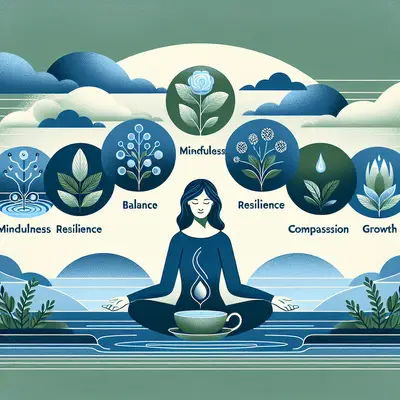
Mental wellness, at its most refined, is less about dramatic transformation and more about curation—of thoughts, environments, rituals, and boundaries. It is the art of designing an inner life that can withstand velocity, complexity, and constant noise without losing poise. For those who value discernment over excess, mental health is not a trend to chase but a standard to maintain quietly, consistently, and with intention.
Below are five exclusive, often overlooked insights that speak to a more elevated approach to mental wellness—practices that feel less like self-help and more like self-respect.
1. The Art of Cognitive Editing: Curating What Enters Your Mind
Most advice focuses on “positive thinking,” but a more sophisticated approach begins one step earlier: selective intake. Your mind is a gallery; what you consume becomes the permanent collection.
Cognitive editing is the disciplined habit of curating what you allow into your mental space—news, conversations, notifications, visuals, even décor. The goal is not to avoid reality, but to avoid unfiltered reality. This might mean reading long-form journalism instead of scrolling headlines engineered for outrage, choosing a single daily check-in with the news, or politely stepping back from chronically dramatic conversations.
Over time, this editorial approach reduces cognitive overload and quiets reactivity. Research on information overload links excessive, fragmented input with increased anxiety, reduced decision quality, and mental fatigue. By deliberately narrowing your channels, you reclaim bandwidth for reflection, creativity, and nuanced thinking. Your mental world becomes less noisy—and far more intentional.
2. Precision Rest: Treating Recovery as a High-Value Asset
Sleep is no longer a luxury; it is performance infrastructure. Yet beyond “get 7–9 hours,” refined mental wellness treats rest with the same precision as a tailored wardrobe: customized, thoughtful, and non-negotiable.
Precision rest looks at quality and timing rather than simply duration. It might include:
- A consistent “shutdown ritual” that marks the end of cognitive labor—closing tabs, writing tomorrow’s priorities, dimming lights.
- Protecting the 60 minutes before bed as a blue-light-minimal, low-stimulation zone—analog reading, warm lighting, calming audio.
- Honoring ultra-brief reset moments during the day: 5–10 minutes of intentional stillness between demanding tasks, rather than endless multitasking.
Clinically, consolidated, sufficient sleep supports emotional regulation, decision-making, and stress resilience. A rested mind is less impulsive, more discerning, and more capable of seeing nuance. In a culture that equates exhaustion with importance, quietly optimizing your rest is an understated act of authority over your own life.
3. Emotional Etiquette: Elevating How You Experience and Express Feelings
Emotional intelligence is often discussed; emotional etiquette is rarely named. Think of it as the refinement of how you experience, contain, and share your emotions—without suppressing them or letting them spill indiscriminately.
This begins with vocabulary. Moving beyond “stressed” or “tired” to more precise descriptors—“mentally saturated,” “socially overextended,” “quietly resentful,” “uncertain but curious”—gives your mind something to work with. Research shows that emotional granularity (accurately naming feelings) is associated with better regulation and less reactivity.
Emotional etiquette also involves calibrating disclosure: knowing when to process privately, when to confide in a trusted ally, and when professional support is appropriate. Rather than venting as default, you might pause to ask: What is the actual request behind this feeling—rest, clarity, boundary, reassurance, or change? This maintains dignity for both you and the people around you, and transforms emotional expression from discharge into deliberate communication.
4. Micro-Boundaries: Invisible Lines That Protect Your Clarity
Boundaries are often framed as dramatic lines in the sand. In reality, the most elegant boundaries are often micro—subtle, repeatable choices that protect your mental clarity without fanfare.
Examples of micro-boundaries include:
- Not responding to non-urgent messages during specific focus windows.
- Declining “quick favors” that repeatedly erode your bandwidth.
- Treating the morning as a protected runway—no social media until after your first substantial task or ritual.
- Ending conversations that dissolve into gossip or chronic complaint with a calm, gentle redirection.
Micro-boundaries preserve your cognitive energy, which psychologists increasingly recognize as finite. They also reduce the quiet resentment that arises when your time and attention are continuously fragmented. Over time, these small, consistent limits create a subtle but solid perimeter around your mental world—a kind of invisible architecture of self-respect.
5. Ritualized Transitions: Designing the Space Between Moments
We tend to focus on what we do—meetings, workouts, social events—but the nervous system is profoundly shaped by transitions, the liminal spaces between roles and tasks. When these transitions are abrupt, the mind never fully arrives anywhere; it remains scattered, half-present, half-anticipating.
Ritualized transitions are brief, repeatable practices that mark the shift from one mental mode to another. A few examples:
- A two-minute breathing pattern when you move from work mode to home mode, ideally at a consistent physical cue (the front door, the car, the elevator).
- A simple “closing ritual” after intense calls or negotiations—standing up, stretching, a glass of water, three slow breaths before opening the next window or door.
- A tactile cue before sleep: applying a specific hand cream, adjusting lighting, or changing the scent in your space to signal “the mind can release now.”
Neuroscience-backed practices such as slow breathing and consistent cues support the parasympathetic nervous system—the body’s “rest and digest” mode—helping you downshift from alertness to calm more efficiently. Ritualized transitions turn the chaos of constant switching into a composed choreography, so your mind is not perpetually dragging echoes of the last moment into the next.
Conclusion
Mental wellness at a higher standard is not about perfection; it is about deliberate refinement. Cognitive editing, precision rest, emotional etiquette, micro-boundaries, and ritualized transitions are not dramatic interventions. They are subtle but powerful upgrades to how you move through your day.
In an age of relentless access and velocity, these practices become a quiet statement: your mind is not public property, nor is your attention an open resource. It is a cultivated space—curated, protected, and worthy of thoughtful design.
Sources
- [American Psychological Association – Information Overload and Mental Health](https://www.apa.org/monitor/2023/07/information-overload) – Overview of how excessive information consumption impacts stress, decision-making, and emotional well-being.
- [National Institutes of Health – Sleep, Learning, and Memory](https://www.ninds.nih.gov/health-information/public-education/brain-basics/brain-basics-understanding-sleep) – Explains the relationship between sleep quality, cognitive performance, and emotional regulation.
- [Harvard Business Review – The Emotionally Intelligent Workplace](https://hbr.org/2017/12/what-people-get-wrong-about-emotional-intelligence) – Discusses emotional intelligence in professional life and how nuanced emotional skills affect performance and relationships.
- [University of California, Berkeley – Greater Good Science Center: Emotional Granularity](https://greatergood.berkeley.edu/article/item/why_we_should_say_how_we_feel) – Explores research on emotional granularity and its link to better emotional regulation.
- [Cleveland Clinic – The Parasympathetic Nervous System](https://my.clevelandclinic.org/health/articles/21298-parasympathetic-nervous-system) – Describes how relaxation practices activate the body’s calming systems and support overall mental wellness.
Key Takeaway
The most important thing to remember from this article is that this information can change how you think about Mental Wellness.