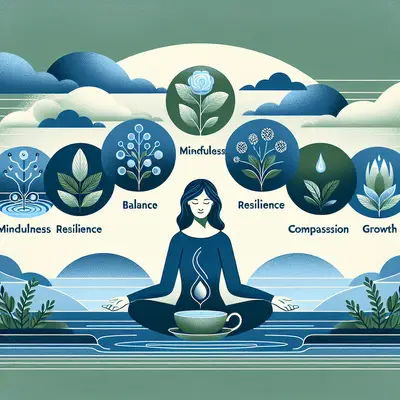
Sustainable mental wellness is less about radical transformation and more about exquisite refinement—small, intentional shifts that change the texture of daily life. In a world saturated with quick fixes and loud advice, there is something quietly luxurious about tending to the mind with discernment, depth, and grace. This is mental wellness not as self-improvement theater, but as a cultivated art: deliberate, understated, and profoundly personal.
Below are five exclusive, subtly powerful insights—practices and perspectives that move beyond clichés and invite a more refined relationship with your inner world.
Insight 1: Design an “Emotional Atelier” Instead of Chasing Mood Hacks
Most wellness advice focuses on hacking your mood in the moment. A more elevated approach is to curate an emotional atelier—a personal studio in which your feelings are observed, shaped, and integrated with intention over time.
Begin by treating emotions as information rather than verdicts. Instead of “I am anxious,” try “Anxiety is present; it is signaling something.” This slight linguistic refinement preserves your dignity while giving you space from the feeling. Then, develop a quiet, recurring ritual for “emotional fittings”—perhaps a 10-minute evening review where you ask:
- What emotion visited me most today?
- What did it try to protect or warn me about?
- What boundary, value, or need was it pointing toward?
Document these in a single, beautiful notebook reserved solely for emotional reflection. Over weeks, patterns emerge: triggers that repeat, themes that recur, environments that consistently soothe or destabilize you. This ongoing atelier-style practice transforms emotions from chaotic intruders into familiar collaborators, allowing you to respond with poise rather than reactivity.
Insight 2: Curate Your Cognitive Environment with the Precision of a Gallery
We are meticulous about the spaces we inhabit—lighting, textures, scents—yet we are often careless about the mental “objects” we allow on display. A premium approach to mental wellness involves curating your cognitive environment as thoughtfully as an art gallery.
Imagine your mind as a private exhibition. Which “pieces” deserve a permanent place—core values, long-term aims, guiding principles—and which are temporary installations (fleeting worries, social media noise, external expectations)? Begin by identifying three to five anchor thoughts that genuinely steady you. These might be:
- “I am allowed to move at a considered pace.”
- “Not every demand is an obligation.”
- “I can be both ambitious and gentle with myself.”
Write them somewhere discreet but visible: inside a planner, on a phone note titled simply “Anchors,” or on a physical card near your workspace. When intrusive or spiraling thoughts appear, you are not obligated to debate them; instead, you deliberately “walk” your attention back to one of your anchors. Over time, this selective, gallery-like curation softens mental clutter and restores a quiet sense of direction.
Insight 3: Practice “Discerning Engagement” with Technology
Digital life often hijacks the nervous system, eroding subtlety and depth in our mental landscape. Rather than adopting extreme digital detoxes, a more refined strategy is discerning engagement—a premium level of intentionality in how you let technology touch your mind.
Begin by identifying high-quality digital nourishment—long-form essays, in-depth interviews, educational talks—versus low-res stimulation like constant scrolling or clickbait outrage. Commit to a simple, elegant rule: for every period of low-quality input, you follow with a period of elevated input or deliberate quiet. For example:
- After 10 minutes of social scrolling, listen to a 5-minute guided breathing audio or a calming instrumental track.
- After reading news headlines, read at least one longer, context-rich article to restore nuance and prevent reactive anxiety.
Add temporal boundaries that feel luxurious rather than restrictive: a “no-phones-before-the-first-glass-of-water” morning, or a nightly “digital curfew” where the last 30 minutes before sleep are reserved for analog experiences only—reading, stretching, or simply thinking in peace. These deliberate constraints create a sense of sanctuary around your attention, which is one of your most valuable wellness resources.
Insight 4: Adopt Micro-Restorative Intervals as a Daily Signature
Instead of waiting for vacations or rare spa days, cultivate micro-restorative intervals throughout your day—brief, impeccably intentional pauses that restore composure and clarity without fanfare. Think of them as your signature wellness gesture: discreet, repeatable, unmistakably yours.
Examples include:
- A 60-second posture reset before each virtual meeting: feet grounded, shoulders relaxed, jaw softened, breath lengthened by just one count on the exhale.
- A consistent “threshold pause” at your front door: a single deep breath where you mentally set down the day before entering your home space.
- A mindful beverage ritual: the first three sips of tea or coffee taken in complete stillness—no phone, no email, just temperature, taste, and breath.
The elegance of these intervals is in their scale and sustainability. They do not announce themselves. They do not demand a new identity. Yet over weeks, they accumulate into something profound: a nervous system that trusts you to create tiny pockets of safety and calm, even in demanding environments.
Insight 5: Refine Your Inner Dialogue to Match How You’d Address a Respected Peer
Many people speak to themselves in tones they would never use with anyone they respect. Mental wellness at a sophisticated level requires upgrading the etiquette of your inner dialogue—not as performative positivity, but as alignment with your true standards of respect and refinement.
Instead of forcing affirmations you don’t believe, focus on upgrading tone and precision:
- Replace “I messed everything up” with “That didn’t go the way I intended; what’s the most constructive adjustment I can make?”
- Shift “I’m so behind” to “I’m progressing at a pace informed by my current bandwidth and priorities.”
- Trade “I should have done more” for “Given what I knew and had available, I made a considered choice. Now I can refine.”
This subtle linguistic refinement preserves accountability while dissolving unnecessary self-contempt. Over time, your inner voice starts to sound like a wise, composed advisor rather than a relentless critic. The impact on mental steadiness is both profound and quietly transformative.
Conclusion
Mental wellness, at its most elevated, is not a spectacle—it is a calibration. The choices are small but exquisitely deliberate: a notebook reserved solely for emotional insight, an inner gallery curated with care, a phone picked up or put down with intention, a single breath taken in a doorway, a phrase softened from harsh judgment to measured clarity.
These five insights are not trends; they are practices of mental craftsmanship. Adopt even one with sincerity, and your daily experience begins to acquire a new quality—less rushed, less reactive, more attuned. Over time, this is how a mind becomes not just calmer, but truly cultivated.
Sources
- [National Institute of Mental Health – Caring for Your Mental Health](https://www.nimh.nih.gov/health/topics/caring-for-your-mental-health) - Overview of evidence-based approaches to mental health and self-care
- [American Psychological Association – The Road to Resilience](https://www.apa.org/topics/resilience) - Explores how thoughts, behaviors, and actions can be learned and developed to build resilience
- [Harvard Health Publishing – Mindfulness: Benefits of Practice](https://www.health.harvard.edu/mind-and-mood/mindfulness-practice-may-decrease-stress) - Reviews research on how mindful attention can reduce stress and improve mood
- [Mayo Clinic – Stress Management: Enhance Your Well-being](https://www.mayoclinic.org/healthy-lifestyle/stress-management/in-depth/stress-management/art-20044151) - Discusses practical, medically informed strategies for managing daily stress
- [National Library of Medicine – Self-Compassion and Psychological Wellbeing](https://www.ncbi.nlm.nih.gov/pmc/articles/PMC3615119/) - Research-based analysis of how a kinder inner dialogue supports mental health and resilience
Key Takeaway
The most important thing to remember from this article is that this information can change how you think about Mental Wellness.