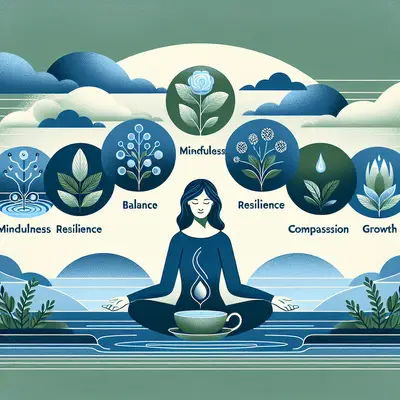
Mental wellness is no longer a peripheral concern; it is the quiet foundation beneath every considered decision, every meaningful relationship, every vision worth pursuing. For the discerning individual, the question is not simply how to “reduce stress,” but how to curate an inner life that feels composed, lucid, and quietly assured—even when the outer world is anything but. This is less about self-help and more about self-stewardship: a deliberate, sophisticated approach to how the mind is tended, restored, and refined over time.
Below are five exclusive insights for those who view mental wellness not as an emergency repair, but as an ongoing, elegant discipline.
Insight 1: Treat Mental Energy as a Limited, Luxurious Currency
Most people manage time; very few manage cognitive capital. Yet mental energy is both finite and exquisitely valuable. Research on decision fatigue suggests that repeated choices, even minor ones, erode self-control and clarity across the day. For the refined mind, this calls for an upgrade in how we structure our lives.
Curating “automatic elegance” in daily routines—pre-decided breakfast options, a signature work uniform, fixed times for email—reduces low-value decisions and preserves bandwidth for what truly matters. This is not about rigidity, but about selectively automating the trivial so that attention can be lavishly invested in the significant.
A practical refinement: schedule high-cognition work (strategy, creative thinking, complex conversations) during your mentally brightest hours and reserve low-stakes tasks (administration, routine errands) for times when your energy naturally dips. Over weeks and months, this reallocation of cognitive capital cultivates a mind that feels less scattered and more sovereign.
Insight 2: Design Your Sensory Environment as a Psychological Instrument
Mental wellness is not purely internal; it is continuously shaped by the environments we inhabit. Clean, intentional design is not mere aesthetics—it is cognitive hygiene. Clutter, harsh lighting, and digital noise all demand micro-processing from the brain, subtly fraying attention and composure.
The refined approach is to become a curator of your sensory world. This can mean favoring warm, indirect lighting over overhead glare, choosing a restrained color palette in your workspace, and minimizing visual clutter on your desk and digital desktop alike. Each deliberate edit removes friction from your nervous system.
Neuroscience suggests that predictable, low-threat environments reduce the brain’s background vigilance, freeing up resources for reflection, creativity, and calm. Your surroundings should not shout at you; they should whisper permission to focus, to breathe, and to be fully present. Over time, your environment becomes not just where you live and work, but a silent collaborator in your mental clarity.
Insight 3: Upgrade Rest from “Breaks” to “Neural Precision Intervals”
Rest is often treated as an absence of productivity, a gap to be filled or a concession to exhaustion. In reality, high-quality, strategically timed rest is a mark of mental sophistication. The brain is not built for perpetual linear output; it functions best in oscillations—periods of sustained effort followed by brief, intentional recovery.
Rather than mindless scrolling between tasks, consider precise, restorative intervals: a five-minute breath-led pause between major meetings; a short walk without your phone after a demanding decision; a brief visual reset by looking at a distant horizon or natural scene. These micro-recoveries help the nervous system shift from heightened arousal toward balance, improving focus and emotional regulation.
Deep sleep remains the apex of mental restoration. Prioritizing consistent sleep and creating a sleep ritual—dimmed lights, reduced screens, a predictable wind-down sequence—transforms rest from something accidental into something architectural. The result is a mind that meets the day not as a depleted responder, but as an intentional architect of its own responses.
Insight 4: Practice Emotional Articulation as a Form of Intellectual Refinement
Sophisticated mental wellness is not about eliminating difficult emotions, but about naming and navigating them with nuance. Research shows that “affect labeling”—accurately putting feelings into words—can reduce the intensity of emotional reactivity and engage brain regions responsible for regulation rather than impulse.
Instead of defaulting to blunt terms like “stressed” or “upset,” aim for precision: “I feel mentally saturated and under-resourced,” or “I feel overlooked in this conversation,” or “I feel anticipatory anxiety about an outcome I can’t fully control.” This level of detail transforms emotion from an indistinct cloud into something observable and therefore more manageable.
Over time, building an elegant emotional vocabulary becomes a quiet superpower. It enhances communication in your relationships, strengthens your capacity to self-advise in challenging moments, and deepens your understanding of your own patterns. Emotional articulation is not indulgence; it is the grammar of an internally coherent life.
Insight 5: Align Your Inner Narrative with Your Chosen Identity
Beneath all techniques and practices lies a more subtle determinant of mental wellness: the story you tell yourself about who you are. The mind is constantly scripting meaning—about success and failure, about setbacks and opportunities, about your worth and your trajectory. A refined approach is to edit that script with intention.
Emerging research in psychology and neuroscience suggests that self-talk and personal narratives influence motivation, resilience, and even how we experience stress physically. Instead of defaulting to narratives like “I am overwhelmed” or “This always happens to me,” consider identity-based perspectives: “I am someone who handles complexity with deliberation,” or “I am learning to meet pressure with clarity rather than haste.”
This is not empty affirmation, but iterative authorship. When your narrative is aligned with your chosen identity—perhaps “thoughtful strategist,” “graceful leader,” or “calm decision-maker”—your daily choices begin to harmonize with that story. Over time, the mind experiences less internal conflict, and mental wellness becomes not an outcome you chase, but a natural extension of who you understand yourself to be.
Conclusion
Mental wellness, at its most refined, is not a single practice, remedy, or ritual. It is an ongoing curation of how you spend your mental energy, how you shape your environment, how you oscillate between exertion and recovery, how you speak the language of your own emotions, and how you author the story of who you are becoming.
When approached with this level of discernment, mental wellness ceases to be a reactive project and becomes a quiet, enduring form of luxury: a cultivated mind that moves through complexity with poise, clarity, and understated confidence.
Sources
- American Psychological Association – Stress Effects on the Body – Overview of how stress impacts physical and mental health, reinforcing the importance of strategic rest and regulation
- Harvard Business Review – Manage Your Energy, Not Your Time – Explores the concept of energy as a finite resource, aligning with treating mental energy as a luxurious currency
- National Institutes of Health – Sleep and Mental Health – Details the relationship between sleep quality and emotional regulation, supporting the idea of precise, deliberate rest
- UCLA Mindful Awareness Research Center – Mindfulness Research – Summarizes research on attention, emotional regulation, and brain changes associated with mindful practices
- Stanford Medicine – Emotion Regulation and the Brain – Discusses how labeling emotions can alter brain responses and reduce emotional intensity
Key Takeaway
The most important thing to remember from this article is that this information can change how you think about Mental Wellness.