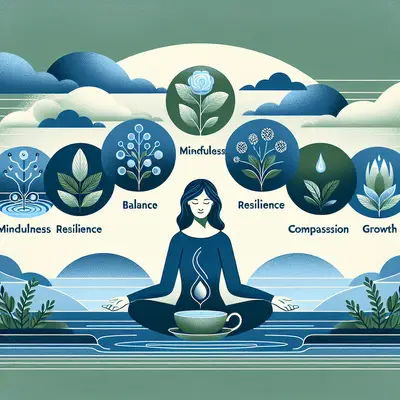
Mental wellness, at its most refined, is less about dramatic breakthroughs and more about curated micro-choices that accumulate into quiet strength. In a world that rewards urgency, the truly discerning mind learns to move at a different tempo—measured, intentional, and quietly resilient. This is not self-help in its hurried, generic form; it is the thoughtful cultivation of an inner environment where clarity, poise, and emotional intelligence can actually thrive.
What follows are five exclusive, nuanced insights—less about “fixing” the mind and more about stewarding it with the same care one might devote to a well-designed home or a cherished collection. Each is subtle in practice, but profound in its cumulative impact.
Insight 1: Treat Your Attention as a Luxury Resource, Not a Utility
Most wellness advice focuses on time management; truly elevated mental wellness begins with attention management. Your attention is not an infinite tap you can leave running—it is a luxury resource that determines the quality of your inner life.
Begin by noticing where your attention “leaks.” Endless notifications, unintentional scrolling, reflexive email checks—each fragment quietly taxes your cognitive bandwidth and emotional stability. When attention is scattered, anxiety often follows; the brain is attempting to process more stimuli than it can meaningfully integrate, resulting in a low-grade, persistent mental noise.
A sophisticated approach is to curate your attentional landscape with the same discernment you bring to your physical environment. Design specific windows for deep focus, undistracted rest, and intentional connection. Silence non-essential notifications. Move your most nourishing tasks—reading, reflection, creative thinking—into times when your mind feels most receptive. Over time, this repositions your attention from something perpetually “on call” to something intentionally invested.
There is a quiet power in knowing not just what you are paying attention to, but what you are deliberately refusing to attend to. That refusal is itself a form of mental protection—and, ultimately, self-respect.
Insight 2: Replace “Self-Improvement” with “Inner Stewardship”
The language of self-improvement can be subtly aggressive: better, faster, more productive, more optimized. It often frames the self as a project to be upgraded rather than an ecosystem to be tended. This can lead to chronic dissatisfaction and the persistent sense that one is never quite “enough.”
Inner stewardship offers a more refined paradigm. A steward does not attack or conquer; they observe, understand, and care for. Applied to mental wellness, stewardship means approaching your emotional and cognitive states with curiosity rather than judgment, responsibility rather than perfectionism.
This shift becomes especially powerful during difficult emotional periods. Instead of asking, “What’s wrong with me?” a steward asks, “What is this feeling asking me to notice or adjust?” A spike of irritability might indicate exhaustion. A fog of apathy might reflect misalignment between your values and current commitments. Rather than forcing yourself through with sheer discipline, you refine the conditions in which you operate.
Stewardship also honors cyclical energy. Some days are ideal for strategic thinking; others are better suited for routine tasks or replenishment. Accepting these natural fluctuations—without dramatizing them—reduces inner friction and preserves mental dignity. Over time, this creates a baseline of calm competence instead of boom-and-bust mental cycles.
Insight 3: Design Micro-Rituals That Signal “Psychological Safety” to the Brain
The brain is exquisitely responsive to cues of safety and threat. Much of what we call “stress” is not the event itself, but the nervous system’s interpretation of that event. One of the most elegant approaches to mental wellness is to create micro-rituals that reliably communicate, “You are safe enough in this moment to soften.”
These rituals need not be elaborate. The key is intentionality and consistency. It might be the deliberate act of placing your phone in another room for twenty minutes while you sip tea and do nothing in particular. It might be a three-breath practice before entering a meeting, or the specific lighting and scent you use in the evening to mark the transition from performing to unwinding.
From a neurobiological perspective, such predictable rituals can help stabilize the stress response system, signaling that not every stimulus requires high alert. When the nervous system internalizes this pattern, baseline tension begins to decrease—not through force, but through repeated experiences of genuine safety and decompression.
What distinguishes a micro-ritual from a habit is the layer of meaning and care. Rather than “I should do this,” it becomes “This is how I choose to host my own mind.” That subtle shift renders the practice less brittle and more sustainable.
Insight 4: Curate an Emotional Vocabulary as Carefully as a Wardrobe
Sophisticated mental wellness demands equally sophisticated language. Many people live with an impoverished emotional vocabulary: everything is “stressed,” “fine,” “tired,” or “busy.” This lack of nuance forces complex inner experiences into crude categories, making it difficult to respond skillfully.
Expand your emotional lexicon with intention. There is a quiet precision in distinguishing between “overstimulated” and “overwhelmed,” between “resentful” and “disappointed,” between “lonely” and “under-connected.” Each nuance points to a different underlying need—and therefore, a different form of relief.
Research in emotional granularity suggests that people who can more precisely label their emotions often demonstrate better regulation and resilience. In practice, this might look like pausing during the day and asking not just “How do I feel?” but “What is the most accurate word for this experience?” You might even keep an evolving list of emotional terms that resonate with you—words that allow you to articulate layers you previously glossed over.
This is not about linguistic ornamentation for its own sake. Precise inner language reduces wasted emotional effort, minimizes misdirected reactions, and enables more refined self-care. It is the difference between wearing whatever is clean and intentionally dressing for the specific climate and occasion of your inner life.
Insight 5: Anchor Your Day with One “Non-Negotiable for the Mind”
Modern wellness culture can unintentionally overwhelm with extensive routines: elaborate morning rituals, evening protocols, productivity systems. For the discerning mind, over-engineering self-care can create yet another domain of pressure and self-critique.
An elegant alternative is the concept of a single, daily non-negotiable—one chosen practice that exists primarily to protect your mental landscape. It should be modest enough to be realistic on even your most demanding days, yet meaningful enough to create a perceptible shift in mental tone.
This non-negotiable might be ten minutes of undistracted walking, a brief journaling check-in, a quiet coffee without screens, or a few minutes of breathwork. The specific practice is less important than its unwavering role: “This is the one thing I give my mind every single day, regardless of circumstances.”
Over time, this becomes a stabilizing anchor. Even when the day is chaotic, you have kept a promise to your inner world. That consistency builds trust with yourself, which is an underrated ingredient in mental wellness. When the mind knows it will not be perennially sacrificed to external demands, it can relax its constant vigilance and operate from a more grounded, composed place.
Conclusion
Elevated mental wellness is not a performance; it is a cultivation. It emerges from how you allocate your attention, the way you relate to your inner states, the subtle signals you send your nervous system, the precision of your self-understanding, and the promises you quietly keep to your mind each day.
The cultivated mind does not chase constant positivity or relentless optimization. Instead, it seeks a more discerning equilibrium—capable of depth without collapse, ambition without self-erasure, and sensitivity without overwhelm. With each small, intentional refinement, you are not merely coping with modern life; you are designing the internal conditions under which you can move through it with quiet authority and enduring ease.
Sources
- National Institute of Mental Health – Caring for Your Mental Health - Overview of evidence-based strategies for supporting mental wellness
- American Psychological Association – The Power of Language in Emotion - Explores emotional granularity and how precise labeling improves regulation
- Harvard Health Publishing – Relaxation Techniques: Breath Control Helps Quell Errant Stress Response - Describes how simple practices can calm the nervous system
- Centers for Disease Control and Prevention – Stress and Coping - Discusses the impact of stress and practical coping strategies
- Greater Good Science Center, UC Berkeley – How to Reduce Stress by Managing Your Attention - Examines the link between attention, stress, and well-being
Key Takeaway
The most important thing to remember from this article is that this information can change how you think about Mental Wellness.