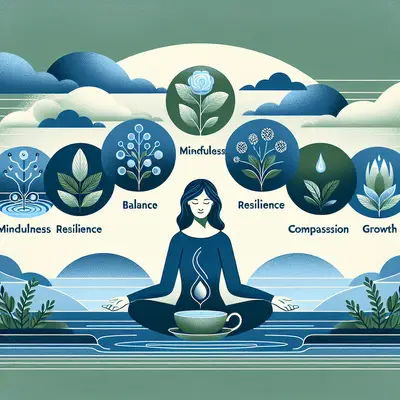
Mental wellness, at its finest, is not a rescue mission—it is a curation. Like a considered wardrobe or a well-edited home, a truly composed inner life is the result of quiet, consistent choices that honor nuance, pacing, and restraint. For those who value refinement in all things, mental clarity becomes less about quick fixes and more about cultivating a sustainable, elegant relationship with one's own mind.
Below are five exclusive, elevated insights—less trend, more timeless—that support a mentally sophisticated life.
1. Treat Cognitive Load as a Luxury Commodity
In a premium lifestyle, not everything earns a place. The same should be true of what occupies your mind. Cognitive load—the total amount of mental effort being used at a given time—is a finite, high-value resource. Instead of merely “managing stress,” think in terms of curating what is allowed to claim your attention.
Begin by reframing decisions as tiers. High-tier decisions (health, relationships, financial foundations, meaningful work) deserve your freshest mental energy. Low-tier decisions (nonessential emails, minor scheduling details, inconsequential social media discourse) should be streamlined or delegated whenever possible. This might mean standardizing aspects of your routine: a small rotation of meals, a signature morning ritual, or a simplified wardrobe that removes dozens of micro-choices each week.
Set explicit limits on informational intake: define a small number of trusted news sources and specific times for checking them, rather than grazing all day. Reducing mental “background noise” creates a sense of cognitive spaciousness that feels both luxurious and deeply stabilizing. Over time, you will notice that your best thinking, emotional balance, and creativity emerge not from doing more, but from permitting less to intrude.
2. Design a Personal “Psychological Signature” Ritual
Refined interiors and signature scents are expressions of taste; your mental wellness deserves a similar level of intentional design. A “psychological signature” ritual is a brief, repeatable sequence that tells your nervous system, with absolute clarity: you are now entering a state of composed presence.
This is not simply a morning routine. It is a precise, sensory-anchored pattern that you can perform in under ten minutes, anywhere—hotel rooms, offices, airports. For example:
- A consistent beverage (a specific tea or warm water with lemon) sipped slowly
- A tactile anchor (hand cream, a particular pen, a smooth stone in your palm)
- A fixed breath pattern (e.g., exhale slightly longer than you inhale for 3–5 minutes)
- A signature phrase repeated silently (e.g., “Unrushed. Clear. Deliberate.”)
The power lies in repetition and specificity. Over time, your nervous system learns to associate this micro-ritual with calm focus and emotional equilibrium. It becomes a portable sanctuary—an inner signature space you can access amid demanding days, travel, or uncertainty. Instead of waiting for the world to quiet down, you carry your own cultivated calm into it.
3. Upgrade Rest from Passive Breaks to Strategic Recovery
Most people treat rest as the absence of doing; a refined approach treats it as precision recovery. True mental luxury is not merely having downtime, but ensuring that downtime is restorative at the level of brain and nervous system.
Begin by distinguishing three forms of recovery:
- Sensory recovery – Reducing visual and auditory stimulation: dimmer lighting, fewer screens, silence or gentle soundscapes rather than constant chatter.
- Cognitive recovery – Time with low or no problem-solving: walking without podcasts, simple manual tasks, gazing out a window, letting thoughts drift without agenda.
- Emotional recovery – Practices that allow feelings to surface and settle: journaling, slow conversation with a trusted person, quietly naming what you feel without judgment.
Instead of defaulting to scrolling or streaming, choose one of these categories deliberately and give it 10–20 minutes. Protect at least one “high-quality recovery interval” per day as non-negotiable, the way you would protect a key meeting. Sleep then becomes one layer of restoration, not the only one. The result is a mind that feels unhurried, sharper, and more resilient—less prone to impulsive reactions and more inclined toward balanced, thoughtful responses.
4. Curate Your Inner Dialogue with the Precision of a Fine Edit
Mental wellness is not only about what happens to you, but the narrative you quietly apply to events. A refined mind does not indulge in unchecked self-critique or melodrama; it practices a measured, discerning inner voice, even under pressure.
Instead of attempting generic “positive thinking,” aim for precise, grounded self-talk. When you notice an internal statement like, “I always fail at this,” treat it as a draft, not a verdict. Ask:
- Is this accurate, or merely familiar?
- What is a more exact version of this thought that is still honest?
- What would a composed, future version of me say about this moment?
A revised thought might become: “This outcome is disappointing, but I’ve handled similar challenges before and I’m capable of improving this.” The goal is not saccharine optimism, but dignified clarity—thoughts that are both true and stabilizing.
Over time, this inner editing process becomes second nature, much like refining language in a carefully written email. Your internal conversation turns into a subtle but steady source of support rather than an unseen saboteur. This is one of the most quietly luxurious shifts you can make: a mind that speaks to itself with elegance, discipline, and respect.
5. Align Your Environment with Your Nervous System, Not Just Your Aesthetic
Many people design their spaces for visual beauty alone, yet your nervous system responds to more than what you see. True mental refinement considers light, sound, texture, and rhythm—not simply décor.
For mental ease, consider a few understated but powerful adjustments:
- Light hierarchy: Brighter, cooler light for focused work; warm, dimmer lighting in evening zones to cue winding down and support better sleep.
- Acoustic curation: Gentle sound barriers (soft furnishings, rugs, curtains) to reduce harsh echoes. Use sound intentionally: silence for deep thought, low instrumental music for gentle momentum, nature sounds for decompression.
- Tactile signals of calm: Natural materials—linen, wood, ceramics—often feel more grounding than highly synthetic textures. One or two intentional tactile objects (a heavy mug, a smooth wooden armrest, a textured throw) can become subtle anchors of stability.
- Visual breathing space: Open surfaces and intentional negative space allow your eyes—and mind—to rest. A single, meaningful object on a surface is more calming than clusters of minor items competing for attention.
The question to ask is not only “Does this look elegant?” but “Does this lower the background tension in my body?” When your surroundings quietly reduce your baseline stress, your emotional bandwidth expands. Decisions feel less pressured, your threshold for irritation rises, and your mind experiences a daily, understated sense of ease that feels both sophisticated and sustainable.
Conclusion
A refined approach to mental wellness is not about dramatic reinventions or rigid self-discipline. It is about subtle calibrations—treating your attention as a luxury resource, crafting personal rituals that travel with you, approaching rest as strategic recovery, editing your inner dialogue with care, and shaping your environment to gently support your nervous system.
When you begin to live this way, mental wellness stops feeling like a project and becomes more like a signature style: quiet, consistent, unmistakably your own.
Sources
- American Psychological Association – Cognitive Load – Overview of research on cognitive load and its impact on performance and mental functioning
- National Institutes of Health – Mindfulness and Emotion Regulation – Explores how mindful practices influence emotional processing and self-talk
- Harvard Health Publishing – The Importance of Rest and Recovery – Discusses how different forms of rest support mental and physical health
- CDC – Sleep and Mental Health – Details the relationship between restorative sleep, stress, and emotional wellbeing
- Yale School of Medicine – Environmental Factors and Stress – Examines how environmental cues like light, noise, and surroundings influence stress and mood
Key Takeaway
The most important thing to remember from this article is that this information can change how you think about Mental Wellness.