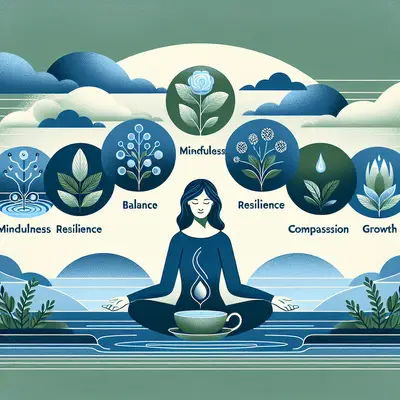
Mental wellness is no longer a mere absence of distress; it is a cultivated aesthetic of inner life. Just as one might refine a wardrobe or a living space, the mind, too, can be curated with intention, elegance, and discernment. In an age of constant stimulation, the true luxury is not escape, but the ability to inhabit one’s own thoughts with composure and clarity. What follows is an exploration of mental wellness as a quiet form of mastery—anchored by five exclusive, nuanced insights for those who seek more than generic advice.
Mental Wellness as an Interior Design of the Self
Consider mental wellness as the interior design of your inner world: textures of thought, lightness of mood, and the architecture of your daily rhythms. Just as a thoughtfully designed room feels both functional and beautiful, an intentionally cultivated inner life supports both productivity and ease. This perspective moves wellness beyond self-help clichés into the realm of artistry—where boundaries become elegant lines, routines become rituals, and rest becomes a deliberate design choice.
This reframing also encourages discernment. Not every practice is worth your time, and not every trend is aligned with your nervous system’s needs. The discerning mind selects approaches that feel sustainable, not performative; grounded, not grandiose. Instead of chasing constant optimization, you begin to edit—removing what disturbs your equilibrium and amplifying what quietly nourishes it. Mental wellness, then, becomes less about “fixing” yourself and more about creating a refined environment for your thoughts to live in.
Exclusive Insight 1: Curating Cognitive Input Like a High-End Collection
Most wellness advice focuses on what you do, not what your mind endlessly consumes. Yet the quality of your mental state is directly shaped by the “cognitive diet” you allow in: news, conversations, social feeds, even background noise. The discerning approach is to curate mental input with the same care one might bring to a private art collection—selective, intentional, and periodically reviewed.
Begin by identifying your “premium inputs”: sources that leave you clearer, not more agitated; informed, not inflamed. This might mean subscribing to one or two high-quality news sources instead of grazing across sensational headlines, or favoring long-form essays over fragmented content. Limit low-grade mental noise: ambient outrage online, constant notifications, unnecessary group chats that sap bandwidth. Over time, this careful filtration calms the nervous system, sharpens attention, and subtly elevates your inner dialogue—because what you repeatedly allow in eventually becomes the voice of your own mind.
Exclusive Insight 2: Practicing Emotional Minimalism Without Emotional Avoidance
Minimalism is often applied to objects, but there is an equally powerful concept in emotional life: emotional minimalism. This is not suppression or detachment; it is the deliberate simplification of emotional clutter. Many people carry unnecessary resentments, outdated narratives, or inherited anxieties that no longer serve their current life. Emotional minimalism invites a quiet, ongoing audit: What am I still carrying that no longer belongs to me?
A refined approach involves distinguishing between emotions that require action and emotions that simply require acknowledgment. Not every feeling must be debated, defended, or dramatized. Some need only to be noticed, named, and gently allowed to pass. Practices such as brief, structured journaling—focused not on retelling events, but on clarifying what is truly yours to hold—can be invaluable. Over time, you create more emotional white space: fewer replays, less rumination, more room for subtle pleasures and nuanced thinking. The result is not emotional numbness, but emotional precision.
Exclusive Insight 3: Nervous System Literacy as a Modern Form of Intelligence
Emotional intelligence is now widely discussed; nervous system literacy is still an underappreciated luxury. Understanding how your body orchestrates stress, calm, alertness, and recovery grants you a quiet authority over your internal landscape. Rather than interpreting every sensation as a problem or flaw, you begin to recognize patterns: “My heart is racing; my body thinks it’s under threat,” or “I feel foggy; I’m likely in a low-energy, protective state.”
This understanding allows you to respond with precision instead of panic. For example, when you notice signs of over-activation—shallow breathing, agitation, mental racing—you can choose targeted interventions such as extended exhalation, posture adjustments, or a brief walk in natural light. When you sense under-activation—lethargy, disengagement, emotional flatness—you might use gentle stimulation: uplifting music, movement, or meaningful conversation. This is not about rigid biohacking, but about an elegant partnership with your physiology. Nervous system literacy transforms mental wellness from guesswork into a sophisticated, responsive practice.
Exclusive Insight 4: Refining Boundaries as a Form of Cognitive Conservation
In a culture that glorifies availability, one of the most sophisticated forms of self-respect is the strategic conservation of cognitive energy. Boundaries are not only about saying no; they are about preserving the rare, high-value resource of your focused attention. Each unfiltered request, impulsive commitment, or emotional firefight taxes your cognitive reserves—and over time, this erosion of bandwidth can masquerade as anxiety, irritability, or “burnout.”
A refined boundary practice is subtle and anticipatory rather than reactive. It might involve establishing “protected hours” where you are unreachable, or standard phrases that gracefully decline invitations misaligned with your current capacity. It can also mean limiting your role as the perpetual confidant for those who routinely offload but rarely reciprocate. Boundaries of this nature are not aggressive; they are architectural. They create shape and structure around your mental energy, ensuring that what remains is invested in what truly matters—creative work, meaningful relationships, and your own restoration.
Exclusive Insight 5: Designing Micro-Moments of Psychological Luxury
We often imagine mental wellness as dependent on long vacations, retreats, or extensive morning routines. Yet for many discerning individuals, the true art lies in micro-moments of psychological luxury woven discreetly into ordinary days. These are brief, intentional experiences that signal to your nervous system: you are safe, you are valued, and you are not in a perpetual state of emergency.
A micro-moment might be a two-minute ritual of stillness before opening your inbox, performed with the same respect one might give to a ceremonial tea. It may be the deliberate choice of a tactile object—a favorite pen, a particular mug, a weighted throw—used only during focused work or decompression, creating a sensory association with calm. It could be a ritualized transition between roles: a specific playlist for leaving work behind, or a short walk that symbolically “clears the stage” before entering your home. Over time, these micro-luxuries create a finely stitched tapestry of ease and self-respect, subtly yet consistently stabilizing your mental state.
Conclusion
Elevated mental wellness is not a performance; it is a private refinement. It evolves in the quiet choices you make about what enters your mind, how you process your emotions, how you collaborate with your nervous system, and where you invest your finite attention. When approached with discernment, mental wellness becomes less about grand gestures and more about understated mastery—small, consistent alignments that accumulate into a life of inner coherence and calm authority.
To live this way is to treat your inner world as something worthy of design, not improvisation. You are not merely coping; you are curating. And in that deliberate curation lies a rare, enduring luxury: the ability to move through a restless world with a mind that feels, unmistakably, like home.
Sources
- National Institute of Mental Health – Caring for Your Mental Health - Overview of foundational mental health practices and evidence-based recommendations
- Harvard Health Publishing – Understanding the Stress Response - Explains the physiology of the stress response and its impact on body and mind
- American Psychological Association – Building Better Mental Health - Research-informed strategies for enhancing mental well-being and resilience
- Yale Medicine – The Science of Emotions - Discusses how emotions function in the brain and body, supporting the idea of emotional literacy
- Cleveland Clinic – The Importance of Setting Healthy Boundaries - Practical, clinically informed guidance on boundaries as a component of mental wellness
Key Takeaway
The most important thing to remember from this article is that this information can change how you think about Mental Wellness.