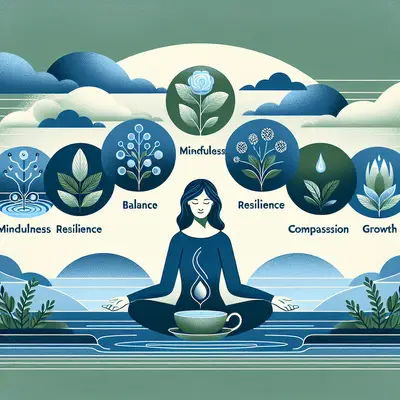
Mental wellness is often marketed as a dramatic makeover: a 30-day reset, a radical detox, a “new you” by next Monday. In reality, the mind responds far better to quiet calibration than to aggressive overhaul. It thrives on subtle, repeatable gestures that signal safety, clarity, and self-respect. When those gestures are chosen with discernment, mental wellness begins to feel less like a project and more like an atmosphere you live inside.
This is where refinement matters. Not perfectionism, but the thoughtful curation of what you allow into your inner world—your attention, your time, your conversations, your rest. Below are five exclusive, quietly powerful insights designed for people who are not simply trying to “cope,” but are ready to steward their mental landscape with care and intention.
1. Treat Your Attention as a Private Membership, Not a Public Utility
Most advice focuses on managing time; truly grounded mental wellness starts with managing attention. Time is finite, but your attention is the currency that shapes your emotional reality. Every notification, every headline, every half-watched video is an invitation into someone else’s urgency.
Begin by treating your attention as something people must earn access to. Turn off non-essential notifications—not as a digital detox stunt, but as a permanent standard. Curate your information diet the way you’d curate a fine library: intentional, limited, and aligned with what you want more of in your life. This is not about avoidance; it is about sovereignty.
Research in cognitive psychology and neuroscience shows that constant task-switching increases mental fatigue and reduces cognitive performance. Chronic distraction doesn’t just waste time; it heightens stress and erodes your capacity for deep calm and clear thinking. When you protect attention, you are not being “difficult”—you are designing the emotional texture of your day.
2. Redefine Rest as a Skill, Not an Interruption
Many people think of rest as what is left over after they “finish everything.” This is a subtle but damaging hierarchy: productivity first, recovery if there’s time. For long-term mental wellness, rest must be elevated from an interruption to a skill you practice with as much respect as any professional commitment.
High-quality rest is not simply the absence of work; it is the presence of deliberate down-regulation. That might mean learning to shift your body out of a stress state through controlled breathing, gentle stretching, or a quiet walk without your phone. It might mean setting a pre-sleep ritual that feels almost ceremonial—dimmed lights, consistent timing, no last-minute email checks, a single comforting scent or sound.
When practiced consistently, this reframing of rest reshapes your nervous system’s baseline. Sleep quality improves, emotional reactivity softens, and mental clarity stabilizes. Rest becomes not a reward you must earn, but a non-negotiable input that allows you to show up as the version of yourself you actually like.
3. Build Emotional Range, Not Just Emotional Control
Mainstream wellness language often glorifies “staying positive” or “staying in control.” But a refined approach to mental wellness is less concerned with controlling every emotional wave and more concerned with expanding your emotional range—the capacity to experience a fuller spectrum of feeling without being overwhelmed by it.
This begins with precise emotional vocabulary. Instead of “I feel bad,” you might distinguish between feeling disappointed, lonely, ashamed, restless, or mentally foggy. That nuance is not indulgent; it gives your brain and body better information about what you actually need. For example, loneliness may call for connection, while overstimulation may call for quiet, and shame may call for self-compassion rather than more self-critique.
Developing emotional range also means learning to stay present with discomfort in small, manageable doses: a difficult conversation you don’t flee from, a moment of sadness you don’t instantly cover with noise, a twinge of envy you meet with curiosity instead of denial. Over time, this practice builds psychological flexibility—a key predictor of resilience and long-term mental health.
4. Curate Micro-Rituals That Signal “You Are Safe Here”
The nervous system is exquisitely sensitive to cues of safety and danger. Many people focus heavily on coping strategies for crises but overlook the subtle, daily rituals that teach their system: “You are safe enough to relax.”
Think in terms of micro-rituals—brief, repeatable actions anchored to everyday moments. For example:
- A consistent first-minute-of-the-day ritual: placing your feet on the floor, inhaling deeply, and consciously choosing one intention for how you want to feel, not just what you want to do.
- A transition ritual between work and personal time: a short walk, a specific playlist, a change of lighting that signals “the demanding part of the day is complete.”
- A brief grounding ritual before difficult interactions: a hand over the heart, three slow breaths, a simple internal phrase such as “I can respond, I don’t have to react.”
These gestures can be 30 seconds long yet profoundly reorganizing. Repetition teaches your mind and body to associate these actions with calm. Over weeks and months, these micro-rituals weave into a personal language of safety that quietly upgrades your baseline mental state.
5. Choose Relationships That Refine Your Inner Dialogue
Your inner voice is not formed in isolation; it is shaped, in part, by the voices you allow closest to you. One of the most understated yet powerful levers for mental wellness is the quality—rather than the quantity—of your relationships.
Notice how you feel after spending time with someone: Do you feel subtly shrunk or quietly fortified? Do you feel like you are constantly justifying your needs, or like your needs are allowed to exist without explanation? Do you leave conversations feeling more scattered or more anchored?
Prioritizing relationships that support mental wellness does not mean only seeking people who are relentlessly cheerful. It means seeking those who can handle nuance: who can hear “I’m not okay today” without immediately trying to fix you or make it about themselves. Low-drama, high-honesty connections become an emotional regulator in their own right.
Just as importantly, be intentional about your own presence in the lives of others. When you practice thoughtful listening, boundaries stated calmly, and repair after conflict, you contribute to a relational ecosystem where everyone’s nervous system can loosen its armor. Over time, these refined connections become part of your mental hygiene, as essential as sleep or movement.
Conclusion
A truly clear mind is rarely the product of dramatic transformation. It is the result of many quiet decisions, made repeatedly: to protect your attention, to practice rest as a skill, to expand your emotional range, to anchor your days with micro-rituals of safety, and to invest in relationships that refine your inner landscape.
This is the work of mental wellness at its most elegant—not loud, not performative, but deeply felt in how you move through the world. When you begin to live this way, the goal is no longer to escape your own mind, but to inhabit it with a sense of calm authority and quiet confidence that others can feel, even if you never name it.
Sources
- American Psychological Association – Multitasking: Switching Costs – Overview of how frequent task-switching impacts attention, performance, and stress
- National Institutes of Health (NIH) – Sleep and Mental Health – Explains the bidirectional relationship between sleep quality and mental wellness
- Harvard Health Publishing – Emotional Awareness and Health – Discusses how naming and understanding emotions supports better psychological outcomes
- Centers for Disease Control and Prevention (CDC) – Social Connectedness and Health – Summarizes research on the importance of supportive relationships for mental and emotional well-being
- Greater Good Science Center, UC Berkeley – The Science of Breathing – Explores how specific breathing practices help regulate the nervous system and reduce stress
Key Takeaway
The most important thing to remember from this article is that this information can change how you think about Mental Wellness.