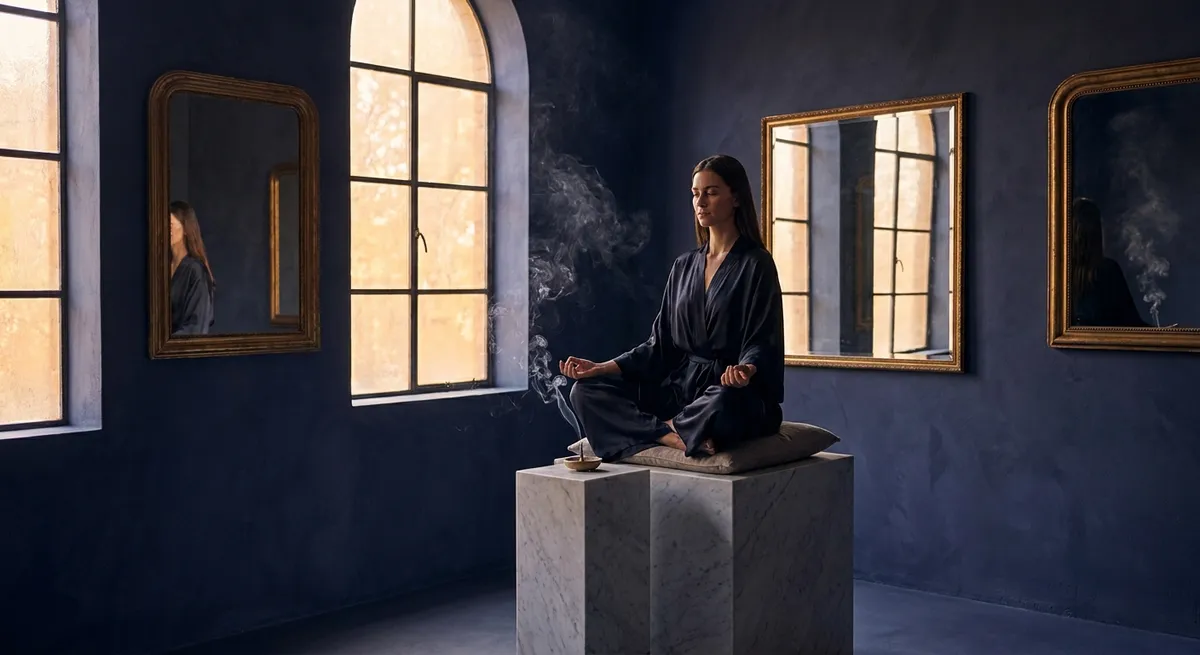
In a culture that celebrates constant motion, meditation offers something quietly radical: the luxury of unhurried attention. It is not an escape from life, but a return to it—more attuned, more deliberate, and more discerning. For those who view mental wellness as an extension of a refined life, meditation becomes less a “self-help tool” and more a cultivated practice in elegant living: a way of inhabiting time, thought, and emotion with intention.
Below are five exclusive, nuanced insights—less about technique checklists, more about the subtle art of how meditation can shape a truly composed inner life.
Meditation as a Curator of Attention, Not an Escape
Many approach meditation hoping to turn down the volume on life. In reality, meditation heightens your capacity to choose what matters. Think of it as curatorship: you cannot empty the museum of your mind, but you can decide what is given the prime wall.
This shift—from resisting thoughts to refining attention—changes the entire texture of practice. Instead of “failing” every time your mind wanders, you are training the subtle muscle of noticing and returning. Each return is a micro-decision about your priorities.
Over time, this curatorial habit spills elegantly into daily life. You begin to notice which conversations drain you, which digital habits fray your focus, which environments sharpen or cloud your thinking. Meditation becomes an apprenticeship in attentional taste—discerning what deserves your inner spotlight and what does not.
For those interested in mental wellness at a higher standard, this is key: mental health is not only about feeling better; it is about becoming exquisitely selective with what you allow to shape your inner landscape.
The Tempo of Stillness: Refining Your Personal Pace
Modern life runs at a pre-set speed—fast. Meditation invites you to discover your own tempo instead. Rather than forcing yourself into a rigid 60-breath practice or a 10-minute timer, consider meditation as a way to calibrate your inner metronome.
Some days, the mind calls for a slower, elongated breath, like stretching silk from one point to another. On other days, a gentle, alert stillness—minimal breath manipulation, maximum clarity—feels more honest. This responsiveness to your own interior pace is an advanced, often overlooked dimension of practice.
When you refine your internal tempo on the cushion, you begin to move through the day with a more deliberate rhythm: responding instead of reacting, pausing before agreeing, resting before exhaustion demands it. In a world addicted to urgency, choosing your pace becomes a quiet form of luxury.
This is not about laziness; it is about precision. Your nervous system learns that slowness can coexist with excellence, and that composure does not diminish productivity—it upgrades it.
Emotional Etiquette: How Meditation Polishes Your Inner Dialogue
A sophisticated mind is not one that never feels anger, envy, or fear—it is one that knows how to host these emotions with decorum. Meditation refines what might be called your emotional etiquette: the way you internally speak to, respond to, and integrate your own feelings.
In meditation, you frequently encounter discomfort: restlessness, boredom, self-critique, old narratives resurfacing. The transformative moment is not their appearance, but your manner of reception. Do you slam the door on them, argue with them, or offer a neutral seat in the back row?
Over time, you learn a more elevated internal language: “Ah, anxiety is present,” instead of “I am an anxious person.” “Sadness is visiting,” instead of “I am broken.” This subtle grammatical shift—from identity to observation—creates a dignified distance. You remain the host, not the emotion.
In daily life, this refined etiquette shows up as fewer outbursts, less impulsive messaging, and more composed responses in conflict. You are not suppressing emotion; you are granting it structure and timing. The result is a kind of internal civility: even when you are turbulent, you are not chaotic.
The Architecture of a Private Mental Sanctuary
Meditation is often treated as a portable app—open when needed, close when finished. But when you elevate it, it becomes more like architecture: a private mental room you can enter at will, regardless of external noise.
With consistent practice, you begin to recognize a familiar inner configuration: a posture of the body, a texture of the breath, a particular quality of awareness that feels like “home.” This is not mystical; it is well-rehearsed neural patterning. Your brain and body learn what inner sanctuary feels like.
Eventually, a few deliberate breaths at your desk, a moment of grounded awareness in a crowded train, or a brief pause before a difficult conversation can trigger access to this interior room. You don’t need candles, cushions, or silence. You carry the architecture with you.
For those serious about mental wellness, this is a quietly powerful advantage. While others depend on perfect conditions to feel calm, you are cultivating a composure that travels—compact, discreet, and always available.
Elegant Integration: When Meditation Infuses Daily Micro-Moments
The most sophisticated meditation practice is rarely the most visible. It does not announce itself as a 30-minute session twice a day; it weaves itself elegantly into the micro-moments that define your mental life.
You might notice it in the way you sip your morning coffee fully present for the first three breaths, resisting the urge to scroll. In the half-second pause before replying to a message that stings. In the softening of your jaw during a tense meeting. These are tiny, almost invisible acts of inner refinement.
This is where meditation ceases to be a separate activity and becomes a style of being. You bring the same quality of attention you would offer a cherished guest to an ordinary moment: tying your shoes, washing your face, walking from one room to another. Life itself becomes the practice room.
The outcome is cumulative, not dramatic. Over weeks and months, your days feel less like a series of emergencies and more like a crafted sequence of choices. Stress still appears, but it no longer owns the entire stage. You are no longer merely surviving your schedule; you are quietly, intentionally composing it.
Conclusion
Meditation, at its most refined, is not about perfection, blank minds, or austere routines. It is about cultivating a more deliberate presence: curating your attention, choosing your pace, elevating your emotional etiquette, building an inner sanctuary, and allowing that quality of awareness to permeate ordinary moments.
For a life already invested in quality—of objects, spaces, relationships—meditation is the natural next frontier: the refinement of your own consciousness. In an era of distraction, a deeply trained, elegantly composed mind is not only a wellness asset; it is a rare luxury.
Sources
- National Center for Complementary and Integrative Health – Meditation: In Depth - Overview of meditation types, benefits, and scientific research from a U.S. government health agency
- American Psychological Association – Mindfulness Meditation: A Research-Proven Way to Reduce Stress - Summarizes evidence on how meditation and mindfulness affect stress, emotion regulation, and well-being
- Harvard Health Publishing – Mindfulness Meditation May Ease Anxiety, Mental Stress - Discusses clinical findings on meditation’s impact on anxiety and stress from Harvard Medical School
- Mayo Clinic – Meditation: A Simple, Fast Way to Reduce Stress - Practical explanation of meditation’s health benefits and basic approaches
- National Institutes of Health – Meditation and the Brain (NIMH / PubMed Resource) - Research review on how meditation practice alters brain structure and function
Key Takeaway
The most important thing to remember from this article is that this information can change how you think about Meditation.