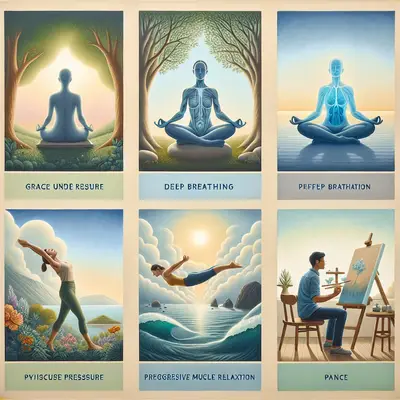
Stress rarely arrives as drama. For many high-functioning, discerning individuals, it appears as a quiet tightening: a slightly shortened breath, a subtle clench in the jaw, a mind that never fully powers down. This article is an invitation to treat stress relief not as crisis management, but as an elevated life skill—an intentional refinement of how you move through your days.
Below are five exclusive, nuanced insights for those who value precision, discretion, and quality in their mental wellness practices.
1. Treat Your Attention as a Luxury Asset, Not a Free Commodity
Most stress-management advice targets time. Yet for the refined, overextended mind, attention—not time—is the true scarce currency. Stress often escalates because your attention is fragmented across too many low-value demands.
Begin to manage your attention the way a curator manages a gallery: selectively, with discernment, and a bias for what deserves to be on display.
Set gentle, deliberate boundaries around:
- Morning exposure: Delay email, news, and social media for the first 30–60 minutes. Protect this window as “cognitive priming” time—when you choose what shapes your mindset rather than letting algorithms decide.
- Context switching: Every pivot between tasks demands a “re-entry” fee from your brain. Group similar tasks together and create dedicated focus blocks—no notifications, no split screens, no casual tab surfing.
- Emotional contagion: Notice conversations, group chats, or digital spaces that reliably leave you agitated or diminished. Quietly mute, unfollow, or reduce exposure. This is not isolation; it is curation.
- Decision noise: Reduce micro-decisions that drain you—pre-plan meals, default outfits, or recurring routines. Fewer trivial decisions leave more psychological bandwidth for what genuinely matters.
When you treat your attention as rare and exquisite rather than endlessly available, stress begins to loosen its grip—not with force, but with quiet, structural elegance.
2. Design “Micro-Sanctuaries” Instead of Waiting for Vacations
Many high performers endure stress in long, stoic stretches, banking on future holidays to compensate. The nervous system, however, responds more generously to small, consistent signals of safety and rest than to occasional, dramatic escapes.
Micro-sanctuaries are brief, intentionally crafted pockets of restoration woven into ordinary days.
Consider creating:
- A transition ritual between work and personal time: a particular piece of music, a specific tea, a three-breath pause at your front door. Repeating it trains the brain to recognize, “Now, we soften.”
- A visual refuge: a single chair by a window, a curated corner with one candle and one book you only touch when you consciously unplug. The predictability of this setting becomes calming in itself.
- A sensorial reset: two minutes of fully experiencing one sense—warm water on the hands, the scent of a favorite essential oil, the texture of a soft throw. Immersion in a single sense gently lowers mental noise.
- A digital boundary: one room or one hour in your home that remains screen-free—no laptop, no phone, no television. The simplicity feels unexpectedly luxurious.
These interludes need not be lengthy to be powerful. The refinement lies in repetition, intention, and the sense that you have deliberately constructed spaces where your nervous system can exhale.
3. Use Precision Breathing as a Subtle, On-Demand Reset
Breathing techniques are often presented generically, yet there is a quiet sophistication in matching the breath to the kind of stress you’re experiencing. Rather than “just take deep breaths,” use calibrated strategies that honor your physiology.
Two refined approaches:
For agitation and mental overdrive
Emphasize a longer exhale to gently downshift the nervous system.
- Inhale through the nose for a count of 4
- Pause for 1–2 counts
- Exhale softly through the nose or pursed lips for a count of 6–8
- Repeat for 2–5 minutes
This extended exhale subtly stimulates the parasympathetic (“rest and restore”) response, without drawing public attention. It’s ideal in meetings, on flights, or between high-stakes conversations.
For depletion and low, flat stress
When stress shows up as numbness, fatigue, or dullness rather than anxiety, a different pattern helps.
- Inhale through the nose for 3–4 brisk, slightly fuller counts
- Exhale for 3–4 counts, steady and controlled, not overly long
- Occasionally add a gentle “sigh out” to refresh the breath
- Continue for 1–3 minutes, then return to normal breathing
This approach returns a sense of alert, grounded energy—a quiet “switching on” rather than a jolt.
The sophistication lies not only in the technique, but in discretion. You can adjust your breathing at a dinner, in a boardroom, or during a commute. No apps, no props, just a subtle, private intervention that restores command over your inner tempo.
4. Curate Inputs as Carefully as You Curate Your Wardrobe
Stress is not only what you do; it is what you continually absorb. Information, noise, visuals, and conversations all leave physiological traces. Just as you choose fabrics and tailoring that complement your body, you can refine an “input wardrobe” that complements your nervous system.
Consider these discreet upgrades:
- News with intention: Replace constant scrolling with a once- or twice-daily check-in from a single, trusted source. Avoid late-night and first-thing-morning news, when your brain is most impressionable.
- Aesthetic environment: Clutter, harsh lighting, and chaotic visuals keep your nervous system on alert. Even a small, orderly surface—a bedside table, a work tray—can act as a cue for calm amidst busyness.
- Soundscapes by design: Notice how different sound environments affect you: café noise, silence, instrumental music, nature sounds. Create playlists or ambient options that genuinely soothe and support focus, not merely distract.
- Social refinement: Seek relationships where you leave feeling both seen and slightly more spacious inside. Quietly reduce exposure to those whose presence reliably leaves you tense, rushed, or emotionally drained.
You are not obligated to be perpetually available to every source of information or every demand on your time. Curating inputs is not indulgence; it is sophisticated nervous system hygiene.
5. Elevate Recovery to the Same Status as Achievement
Many accomplished individuals treat rest as a reward for performance, not as an integrated component of it. The result is a subtle but chronic stress pattern: never quite enough, never fully done, rest earned only when exhaustion becomes undeniable.
A more refined model views recovery as an essential pillar of excellence.
You might:
- Schedule restoration with the same seriousness as obligations: Block calendar time for sleep, walks, creative hobbies, therapy, or massage. Treat those entries as non-negotiable rather than “nice if there’s time.”
- Redefine productivity to include restoration: A truly premium standard measures the quality of your presence—clarity, patience, creativity—not only the quantity of your output. Rest becomes a performance enhancer, not a threat.
- Introduce closing rituals: End your workday with a short written “shutdown note”: what you completed, what matters next, and what can wait. This simple practice reduces mental rumination and signals, “For today, it is enough.”
- Honor sleep as a luxury practice: Calming pre-sleep routines—dimmed lights, a consistent bedtime, a cooling bedroom, a brief journaling session—form a nightly signal of self-respect. Sleep quality is one of the most powerful levers for stress resilience.
When recovery is elevated rather than treated as an afterthought, your baseline stress softens. You meet challenges with more grace, absorb fewer emotional shocks, and sustain a sense of inner dignity, even when the day is crowded.
Conclusion
Refined stress relief is not about escaping life; it is about inhabiting it with greater discernment and poise. By honoring your attention as a luxury asset, integrating micro-sanctuaries into ordinary days, practicing precise and discreet breathing, curating what you allow into your mental space, and elevating recovery to the same level as achievement, you create a life that is not merely less stressed—but more elegantly lived.
The true sophistication is not in dramatic gestures, but in quiet consistency: small, intentional practices that say, again and again, “My inner state is worth protecting.”
Sources
- [American Psychological Association – Stress Effects on the Body](https://www.apa.org/topics/stress/body) – Overview of how chronic stress impacts different systems in the body
- [Harvard Health Publishing – Relaxation Techniques: Breath Control Helps Quell Errant Stress Response](https://www.health.harvard.edu/mind-and-mood/relaxation-techniques-breath-controls-quell-errant-stress-response) – Explains the physiology behind breathing practices for stress relief
- [National Institute of Mental Health – 5 Things You Should Know About Stress](https://www.nimh.nih.gov/health/publications/stress) – Evidence-based insights into stress, its impact, and coping strategies
- [Mayo Clinic – Stress Management](https://www.mayoclinic.org/healthy-lifestyle/stress-management/basics/stress-relief/hlv-20049495) – Practical, research-informed approaches to managing stress in daily life
- [Cleveland Clinic – Why Sleep Is Important to Your Health](https://health.clevelandclinic.org/why-is-sleep-important) – Details the link between quality sleep, stress regulation, and overall well-being
Key Takeaway
The most important thing to remember from this article is that this information can change how you think about Stress Relief.