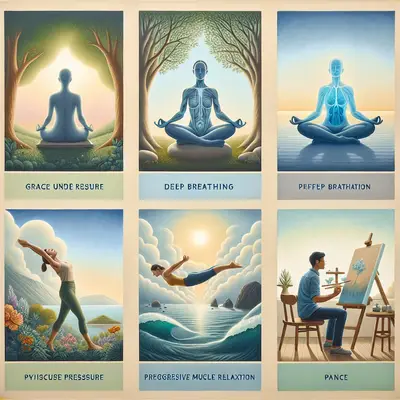
In a culture that glorifies urgency, true luxury is not found in what we acquire, but in how unhurriedly and intentionally we move through our days. Stress, when left unchecked, corrodes that sense of quiet power. This is not simply about “relaxing” after a long day; it is about restoring the kind of inner order that allows you to think clearly, feel deeply, and respond—rather than react—to the demands of a complex life.
What follows is a collection of five exclusive, high-caliber insights into stress relief—approaches that honor nuance, precision, and a refined standard of wellbeing. Each one is less about escape and more about mastery: creating a poised interval in which your nervous system, your mind, and your values can realign.
1. Designing a Personal Decompression Ritual, Not a Routine
Most stress advice focuses on routines: meditate, stretch, drink tea. A decompression ritual, by contrast, is something more deliberate and symbolic—a personalized “off-ramp” from performance mode into restoration mode.
Begin by defining a clear, daily threshold moment: the five minutes when you move from one identity to another (executive to partner, caregiver to individual, creator to human being). Attach a ritual to that threshold that engages all the senses. Perhaps it’s dimming the lights by a single level, changing into a specific garment you wear only at home, playing one carefully chosen instrumental track, and pouring a non-alcoholic botanical drink into a glass you reserve exclusively for winding down.
This is less about the objects and more about constraint. When the same sequence, sounds, textures, and scents are associated with “safe to exhale,” your nervous system learns to anticipate calm. Repetition imprints safety. Over time, just beginning the ritual can lower heart rate and soften muscular tension because your body recognizes the pattern as a cue to stand down from hypervigilance.
The key distinction: a routine is something to get through; a ritual is something to arrive in. Treat this short interval with the respect you would give an important meeting. It may be the most consequential appointment of your day.
2. Curating Cognitive Quiet: Editing What Enters Your Mind
We often speak about managing stress by adding practices—more breathing exercises, more affirmations, more tools. Far fewer people consider editing what is allowed to enter their mental field in the first place.
Think of your mind as a gallery with extremely limited wall space. Every notification, headline, or digital interaction is effectively asking for a frame. High achievers, in particular, tend to underestimate the cost of constant low-grade informational “noise” on their stress levels. Research in cognitive psychology indicates that even brief interruptions can degrade focus and elevate perceived stress, as the brain must repeatedly reorient and re-engage.
Curating cognitive quiet can be approached as an aesthetic project:
- Set “exhibition hours” for news and social media. Rather than constant grazing, choose one or two specific windows per day when you engage. Outside those hours, information is “closed for viewing.”
- Promote what matters to prime positioning. Keep one key question accessible—on your desk, your phone background, or a physical card: “Does this deserve my attention today?” This acts as a quiet filter against impulsive mental clutter.
- Impose elegance on your inputs. Follow fewer but more thoughtful sources; unsubscribe from low-value newsletters; remove apps that reward agitation more than understanding.
The result is not isolation, but intentionality. By elevating the threshold of what may claim your attention, you reduce the background noise that quietly inflames stress chemistry throughout the day.
3. Using Micro-Precision Recovery Instead of Waiting for a Vacation
Many people operate on a “deferment model” of stress relief: absorb the strain now, recover later—on a weekend, a retreat, or a holiday. Physiologically, this is a poor exchange. Chronic stress alters inflammatory markers, sleep architecture, digestion, and mood long before any extended break arrives.
Micro-precision recovery is the practice of inserting finely tuned, short, high-impact restoration moments into the architecture of your day. These are not random breaks; they are strategically placed interventions based on your personal stress pattern.
Consider three dimensions:
- Timing: Identify your daily “pressure peaks” by tracking energy, mood, and tension for a week. Do your shoulders tighten at 11 a.m.? Does your mind spiral at 9 p.m.? Place 3–5 minute interventions directly before these predictable spikes, not after them.
- Modality: Tailor each micro-break to your stress signature. If you somaticize stress (tight jaw, shallow breathing), a 3-minute guided respiratory practice or progressive muscle relaxation is more effective than scrolling or snacking. If you ruminate mentally, a brief cognitive reset—like writing down three current worries and one concrete next step for each—helps unstick looping thoughts.
- Environment: Anchor these micro-practices to specific locations: the left corner of your sofa, a particular chair by a window, a bench outside your building. Consistency transforms these spaces into psychological “recovery zones.”
Research on brief, structured breaks shows tangible reductions in perceived stress and improvements in performance and mood, even when interventions last under 10 minutes. The sophistication here lies not in duration, but in precision: the right practice, at the right moment, in the right place.
4. Recalibrating Your Stress Aesthetic: From “Busy” to “Beautifully Managed”
Stress is not only biochemical; it is cultural and aesthetic. Many environments still equate visible busyness with significance: the rushed walk, the overflowing calendar, the reflexive “I’m slammed” as a badge of honor. Without realizing it, we can internalize an aesthetic of strain as proof of importance.
Refined stress relief begins with quietly updating your internal aesthetic standard. Ask: What does a beautifully managed life look like—and feel like—for me? Then observe where your current habits visually contradict that standard.
Some subtle shifts:
- Posture as a philosophy. Notice whether your default posture suggests bracing or openness. Gentle postural alignment practices—Alexander Technique, clinical Pilates, or even mindful standing—can become a physical manifesto: “I meet my life upright, not collapsed.”
- Speed as a signature. Experiment with walking 5–10% slower in non-urgent moments. This is not laziness; it is a controlled refusal to let external pace dictate your internal tempo. Over time, moving slightly more deliberately can lower perceived overwhelm.
- Language as design. Replace drama-infused self-narratives (“I’m drowning,” “It’s chaos”) with descriptive but non-catastrophic language (“This week is dense,” “Today requires discernment”). Your nervous system listens to the metaphors you choose.
When you consciously design an aesthetic of composed effectiveness rather than frantic productivity, you give your psyche permission to operate from steadiness. Stress relief becomes less about crisis management and more about everyday elegance.
5. Practicing Nervous System Literacy as a Form of Self-Respect
A truly elevated approach to stress relief goes beyond tactics and enters the realm of literacy: understanding how your nervous system actually works and collaborating with it, rather than fighting it or ignoring it.
Begin by learning to distinguish between three basic states:
- Mobilized stress (fight-or-flight): Heart rate up, breath shallow, mind scanning for problems, impulse toward action or argument.
- Collapsed stress (freeze/shutdown): Exhaustion, emotional numbness, procrastination, difficulty initiating even simple tasks.
- Regulated engagement (safe and connected): Steady breath, flexible thinking, warmth toward self and others, a sense of choice.
Throughout the day, pause for 10 seconds and ask: Which state am I in? What evidence do I see in my body, thoughts, and behavior? This simple check-in, repeated regularly, builds a kind of internal “etiquette” with your own biology.
From there, you can match interventions to states:
- In mobilized stress, downshifting practices—lengthening your exhale, splashing cool water on your face, stepping outside into natural light—signal safety to your autonomic nervous system.
- In collapsed stress, gentle upshifting helps: slow walks rather than high-intensity workouts, soft social contact with someone you trust rather than complete isolation, one very small actionable task instead of an ambitious to-do list.
This literacy transforms stress relief from random self-soothing into strategic co-regulation with your own body. It is a subtle yet profound act of self-respect: acknowledging that your physiology is not an obstacle to overcome, but an intelligent system to be listened to, understood, and guided.
Conclusion
Stress relief, at its most refined, is not a single technique but an ecosystem—of rituals, edits, micro-recoveries, aesthetics, and literacy. It is the art of creating poised intervals throughout your day where you can return to yourself, reset your nervous system, and remember that your worth is not measured by your level of strain.
By designing a decompression ritual rather than a mere routine, curating what enters your mind, practicing micro-precision recovery, redefining your stress aesthetic, and becoming literate in your own nervous system, you move beyond quick fixes and into enduring, cultivated calm. The reward is not just feeling less stressed; it is moving through your life with a kind of grounded elegance that others can sense, even when you say nothing at all.
Sources
- [American Psychological Association – Stress Effects on the Body](https://www.apa.org/topics/stress/body) - Overview of how chronic stress impacts multiple body systems, including cardiovascular, musculoskeletal, and nervous systems
- [National Institutes of Health – Chronic Stress and Health](https://newsinhealth.nih.gov/2016/03/struggling-stress) - Explains the long-term consequences of unmanaged stress and basic strategies for mitigation
- [Harvard Health Publishing – The Importance of Rest and Breaks](https://www.health.harvard.edu/mind-and-mood/give-me-a-break) - Discusses how even short, intentional breaks can improve mood, focus, and stress levels
- [Cleveland Clinic – Autonomic Nervous System and Stress](https://my.clevelandclinic.org/health/articles/21202-autonomic-nervous-system) - Describes how the autonomic nervous system functions and responds to stress
- [Mayo Clinic – Stress Management](https://www.mayoclinic.org/healthy-lifestyle/stress-management/in-depth/stress-relievers/art-20047257) - Practical overview of evidence-based stress-relief techniques and lifestyle approaches
Key Takeaway
The most important thing to remember from this article is that this information can change how you think about Stress Relief.