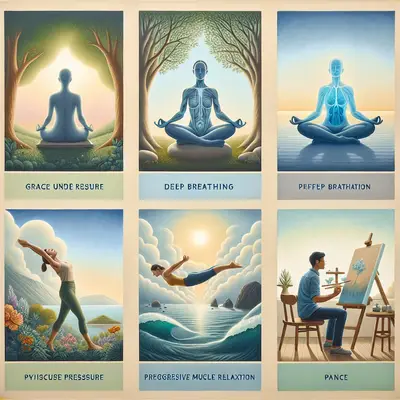
Modern life rewards velocity; the nervous system was built for nuance. Somewhere between those two facts, stress quietly accumulates. At Calm Mind Remedies, we approach stress relief not as emergency repair, but as an artful recalibration of how you inhabit your day. This is less about escaping your life, and more about inhabiting it with greater composure, discernment, and grace.
Below are five exclusive, elevated insights—subtle, precise shifts designed for those who value both performance and poise.
The Architecture of Calm: Designing Micro-Intermissions into Your Day
Stress rarely appears suddenly; it is layered—email by email, demand by demand, decision by decision. A refined approach to stress relief requires designing the architecture of your day so that nervous system recovery is not an afterthought, but a built-in feature.
Instead of waiting for a full evening to “finally unwind,” consider strategically placed micro-intermissions: 60–180 second pauses that recalibrate your physiology. These are not generic breaks; they are intentional transitions. Closing your laptop and placing both feet flat on the floor. One slow exhale to signal safety to the body. A deliberate gaze out of a window to widen your visual field, which in turn softens your internal state.
Research on stress recovery suggests that short, consistent breaks are more effective for sustained cognitive performance than infrequent, long ones. By weaving in these micro-intermissions between meetings, tasks, or difficult conversations, you are quietly training your system to return to equilibrium more quickly. Stress becomes less of a chronic storm and more of a passing weather pattern—noticed, managed, then released.
The key is ritualization. Use elegant anchors: a specific mug, a particular chair by the window, a beautiful timer, a favorite instrumental track. Over time, these cues become shorthand for your nervous system: here, we decompress.
The Subtle Science of Luxury Breathing
Breathwork is often discussed, rarely refined. A premium approach treats breathing not as an emergency fix, but as a daily luxury—an exquisite, portable form of self-regulation.
From a physiological standpoint, exhalation length is your most direct, accessible lever for calming the nervous system. When the exhale gently exceeds the inhale, the parasympathetic (“rest and digest”) system is invited to step forward. Rather than counting in a rigid, mechanical way, you can approach this as an elegant practice:
- Inhale through the nose as if smelling something faint and exquisite—unhurried, dignified.
- Pause gently for a beat, not as a hold, but as a moment of appreciation.
- Exhale through the nose or softly parted lips, slightly longer than your inhale, as though you are fogging the edge of a cold window.
This transforms breath from a mere technique into a sensory experience. Textures, sounds, and pacing matter. Soft fabrics against the skin, low lighting, and a quietly curated playlist can turn three minutes of extended exhales into a private, restorative ritual.
What distinguishes this approach is its discretion. You can apply it in a boardroom, on a flight, or in the back of a car. No one needs to know that you are actively steering your physiology toward composure. Over time, this becomes less of a deliberate practice and more of a refined default—your breath, by habit, remains a touch slower, steadier, and more luxurious.
Emotional Minimalism: Curating What You Choose to Carry
Stress is not only what happens to you; it is also what you continue to carry after it happens. Emotional minimalism is the art of intentionally choosing which psychological “items” remain in your inner space, and which are gently returned to the shelf.
This is not about emotional avoidance. Instead, it’s a composed, almost editorial approach to your inner life. When a stressful event occurs—a curt email, a difficult conversation, a minor failure—emotional minimalism invites you to pause and ask:
- Does this require rumination or resolution?
- Is this mine to hold, or someone else’s projection?
- What is the smallest, cleanest action I can take here?
From there, you act once (or decide consciously not to act), and then practice releasing the residue. You might write a three-line summary in a journal and close it, symbolizing closure. Or you might take a short walk, assigning the first half of the walk to thinking, and the second half to intentionally switching your focus to something sensory: the sound of your steps, the feel of the air, the temperature of your hands.
By treating your emotional bandwidth as a limited, premium resource, you naturally become more selective about what occupies it. Over time, this refinement leads to less chronic stress, because far fewer minor irritants are allowed to become long-term tenants in your nervous system. You are no longer flooded by everything; you are curating with discernment.
The Elevated Evening: Transitioning from Performance to Restoration
For many high-functioning individuals, evenings become a continuation of the workday—just with a different screen. A sophisticated stress relief strategy acknowledges that your evening is not a leftover segment of the day; it is the foundation of tomorrow’s resilience.
Instead of a long, rigid evening routine, think in terms of a transition sequence: a deliberate, 20–45 minute shift from performance mode to restoration mode. That sequence can be minimal yet elevated:
- A warm shower or bath, not rushed, with attention to temperature and texture: how the water feels on your skin, the scent of your body wash, the weight of your towel.
- A “no negotiation” boundary for the final 30–60 minutes before sleep: no work emails, no contentious conversations, no intense news.
- A single analogue activity that signals calm: reading, stretching, applying skincare slowly, arranging your space for the next day.
Physiologically, this supports sleep onset and quality; psychologically, it teaches your mind that the day has a clear closing bracket. High-quality sleep is not merely rest; it is active nervous system repair. When treated with the same dignity as an important meeting, your evening ceases to be a blur and becomes a quiet, powerful investment in stress resilience.
The elevated evening need not be elaborate or expensive; its luxury lies in its intentionality and its resistance to intrusion.
Quiet Boundaries: Protecting Your Nervous System with Grace
Boundaries are often framed as confrontational; in refined stress management, they become an understated form of self-respect. Quiet boundaries are subtle, consistent structures that protect your nervous system without theatrics or apology.
Examples might include:
- A clear “no-response window” during certain hours, even if your phone is nearby.
- A graceful script for declining invitations that would erode your bandwidth: “That sounds meaningful, and I want to be fully present when I say yes. Right now, I don’t have the capacity to do it well.”
- A personal rule that you do not make major decisions when sleep-deprived or emotionally flooded.
These boundaries are not performative; they are quietly enforced norms that determine who and what has access to your energy. From a stress perspective, well-maintained boundaries reduce the number of unexpected demands that reach you, and they shorten recovery time when stress occurs, because overwhelm is no longer your default setting.
Over time, those around you learn the contours of your availability and respect your clarity. The result is not distance, but cleaner, more sustainable connection. Your nervous system receives a consistent message: you are protected, considered, and not constantly under siege.
Conclusion
Stress will always be part of a modern, ambitious life. What distinguishes a refined approach is the way you orchestrate your internal and external worlds so that stress does not become your identity, only a temporary state.
By designing micro-intermissions, treating breath as a daily luxury, practicing emotional minimalism, elevating your evenings, and holding quiet boundaries, you create a life in which calm is not a rare event, but a cultivated atmosphere. This is the essence of a poised mind: not an absence of pressure, but the presence of elegance in how you meet it.
Sources
- American Psychological Association – Stress Effects on the Body - Overview of how chronic stress impacts multiple systems in the body and why regulation practices matter
- National Institutes of Health – Stress Management: Improving Your Health - Evidence-based guidance on stress management and lifestyle adjustments for resilience
- Harvard Health Publishing – Relaxation Techniques: Breath Control Helps Quell Errant Stress Response - Explains the physiology of breathwork and its influence on the parasympathetic nervous system
- Cleveland Clinic – The Importance of Taking Breaks - Discusses how short, regular breaks can improve focus, productivity, and stress recovery
- National Sleep Foundation – How Sleep Affects Stress - Details the bidirectional relationship between sleep quality and stress levels
Key Takeaway
The most important thing to remember from this article is that this information can change how you think about Stress Relief.