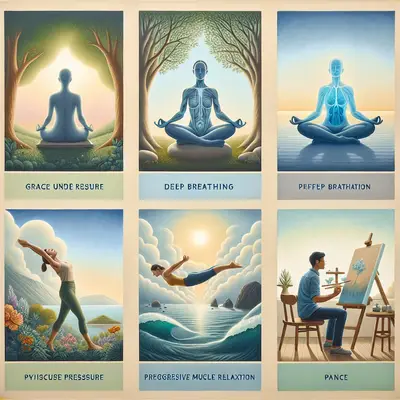
Stress, in a cultivated life, is not something to be “managed” hastily but to be addressed with quiet precision. Rather than chasing quick fixes, the discerning mind treats stress relief as an intentional practice—one that deserves the same care as a well-curated home or a thoughtfully chosen wardrobe. This is not about perfection; it is about crafting an inner environment where calm is not an accident, but a decision repeated gracefully over time.
Below are five exclusive, elevated insights for those who view mental wellness as a refined, ongoing art form rather than an emergency measure.
Reframing Stress as Data, Not Drama
For many, stress is experienced as a vague, overwhelming force. A more sophisticated approach is to treat stress as a stream of data—neutral information about the misalignment between your current demands and your internal resources.
Instead of asking, “Why am I so stressed?” consider, “What exactly is my nervous system telling me?” Is it signaling chronic overcommitment? Sleep debt? Emotional boundary violations? By assigning language and specificity to your stress—“I am mentally fatigued from decision overload” rather than “I’m overwhelmed”—you convert emotional fog into actionable insight.
This reframing also helps soften self-judgment. The stress response is an ancient, well-designed system, not a personal failure. Recognizing that your body is trying to protect you invites a more collaborative relationship with yourself. From this vantage point, stress relief becomes a process of listening and adjusting, not suppressing and powering through.
Designing Micro-Transitions as Invisible Stress Valves
Most people underestimate how violently they shift between roles: inbox to family, video call to bed, problem-solving to supposed “relaxation.” The nervous system registers these abrupt pivots as micro-shocks. Over time, they accumulate into a quiet, chronic tension.
An elegant antidote is to design intentional micro-transitions—brief, ritualized pauses that signal to your brain, “We are changing chapters now.” This might be two minutes of standing by a window before your first meeting, a short walk around the room between tasks, or a deliberate moment to close your laptop slowly instead of snapping it shut.
The sophistication lies in their subtlety. These transitions do not need to be dramatic or time-consuming. What matters is consistency and symbolism: the same candle you light when you finish work for the day, the same song you play as you move from productivity into rest, the same deep exhale before you enter a room that requires your presence. Over time, your nervous system begins to anticipate relief in these small, repeating gestures—and tension has fewer places to hide.
Curating a Sensory Signature of Calm
Stress lives in the body, not just in thoughts, which is why purely intellectual approaches to calm often feel incomplete. A refined stress relief practice engages the senses with intention, creating what could be called a “sensory signature” of calm that is unique to you.
This might include a particular texture (a weighty throw, a cool porcelain cup), a temperature (slightly cool air with warm hands), a muted color palette, or a specific scent associated only with unwinding. When these elements appear together, they become a quiet signal to your nervous system: this is a safe, off-duty space.
Instead of flooding yourself with generic spa aesthetics, choose a minimal set of sensory cues and use them consistently. Perhaps you reserve a particular tea blend exclusively for late evenings when you intend to decompress, or you use a specific fragrance only before sleep. The exclusivity of these cues increases their potency: your body learns to associate them with decompression, making the mere act of engaging them a form of anticipatory stress relief.
Practicing Discreet Boundaries as Nervous System Maintenance
Boundary-setting is often discussed in emotional or interpersonal terms, but it is also a physiological practice. Every “yes” that contradicts your capacity is effectively a small withdrawal from your nervous system’s reserves. Over time, these withdrawals manifest as irritability, brain fog, or somatic tension.
A sophisticated approach to boundary-setting is discreet rather than dramatic. It involves quietly adjusting your life architecture so that you say “no” less reactively and more preemptively. This might mean:
- Placing structured limits on notification windows so your brain is not perpetually on call.
- Scheduling “non-negotiable white space” into your calendar that is defended as fiercely as a high-level meeting.
- Clarifying one or two absolute personal policies (for instance, no major decisions after 8 p.m., or no back-to-back social commitments on weeknights).
The elegance here is that these boundaries rarely need to be announced loudly; they are simply lived. Protecting your nervous system becomes part of your personal standard, like wearing clothes that fit or choosing quality over volume. The result is a quieter, more sustainable baseline, where stress rises less often and recedes more easily.
Adopting Recovery as a Status Symbol, Not Exhaustion
In many circles, visible exhaustion has become a distorted badge of honor—proof of importance, ambition, or indispensability. An elevated perspective reverses this value system: it treats recovery, not depletion, as the ultimate mark of discernment.
This shift is subtle but profound. Instead of asking, “How much can I get done today?” the more refined question becomes, “How well can I perform while still preserving a margin of calm?” You begin to design your days with built-in recovery loops: a brief midday reset rather than caffeine escalation, an evening that downshifts gradually rather than a sudden collapse, a weekend that includes intentional stillness rather than merely catching up on what you could not do during the week.
This does not mean a life devoid of intensity. It means that periods of demand are bracketed by deliberate restoration, so your nervous system is not perpetually sprinting on a track with no finish line. Over time, this approach enhances not only mental ease but cognitive performance, mood stability, and the quiet confidence that you are living at a pace that respects your biology rather than exploits it.
Conclusion
Stress will never vanish from a meaningful life, nor should it; challenge and depth often travel together. But the manner in which you relate to stress can be transformed—from something that erodes you to something that informs you. By treating calm as a deliberate art, designing subtle transitions, curating a personal sensory language of ease, maintaining discreet boundaries, and elevating recovery to a central value, you create a life where composure is not a rare event but a practiced state.
In such a life, stress relief is no longer a rescue operation. It is a quiet, ongoing refinement—an elegant, daily decision to meet the world with a mind that is both engaged and at ease.
Sources
- American Psychological Association – Stress: The different kinds of stress – Overview of stress types, physiological responses, and coping strategies
- National Institute of Mental Health – 5 Things You Should Know About Stress – Evidence-based information on how stress affects the body and ways to address it
- Harvard Health Publishing – Understanding the stress response – Explains the biology of stress and its impact on long-term health
- Mayo Clinic – Relaxation techniques: Try these steps to reduce stress – Practical overview of relaxation methods to calm the nervous system
- Cleveland Clinic – The Importance of Rest and Recovery – Discusses why structured recovery is essential for physical and mental well-being
Key Takeaway
The most important thing to remember from this article is that this information can change how you think about Stress Relief.