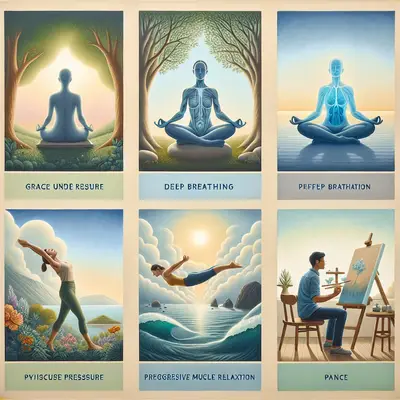
Stress, for many high-performing people, is no longer a spike in the calendar—it is the background noise of everyday life. Yet genuine elegance in modern living is not measured by how much we can endure, but by how consciously we curate what our minds and bodies carry. Stress relief, then, becomes less about “coping” and more about cultivating a quiet, deliberate advantage: the ability to remain composed, clear, and discerning, regardless of pace or pressure.
This is not about wholesale life overhaul. It is about refined, precise shifts—each one small, but together, transformative. Below are five exclusive, quietly powerful insights for stress relief that speak to those who value discretion, depth, and exceptional standards of wellbeing.
Stress as a Design Problem, Not a Personal Failing
Stress is often treated as a character concern: if only we were stronger, tougher, more resilient. In reality, much of chronic stress is architectural—an outcome of how your days, decisions, and environments are designed.
Rather than asking, “Why am I so stressed?” consider, “What in my design is inviting this level of strain?” This subtle repositioning does three important things. First, it shifts you from self-blame into informed authorship. Second, it encourages you to examine the structural elements of your life—inputs, rhythms, boundaries—with the same care you would devote to curating your home or wardrobe. Third, it frames stress management as an ongoing design process: observe, refine, test, and evolve.
A practical starting point: map one ordinary weekday with honesty and precision. Note not only what you did, but what each activity demanded cognitively and emotionally. You will likely find two or three “design leaks” immediately—unnecessary context-switching, avoidable interruptions, or commitments misaligned with your actual priorities. Stress relief begins not with doing more, but with editing better.
The Luxury of Selective Attention
In a culture that glorifies constant connectivity, selective attention is a quiet luxury—and an understated superpower. Cognitive science suggests that our working memory and attentional bandwidth are finite; every notification, every minor decision, every mental tab left open adds to the load your nervous system must manage.
Viewing attention as your most premium resource reframes how you engage with your day. Rather than asking, “What do I need to get done?” experiment with, “Where is my attention truly worthy?” This distinction invites a more elevated standard. Not every email deserves immediate entry into your inner world; not every message merits an emotional reaction.
Two discreet practices can change your stress baseline:
- Architect intentional “low-noise” zones. Choose one or two daily windows—perhaps the first 60 minutes of your morning and a late-afternoon block—where your environment is deliberately quiet: no social feeds, minimal notifications, and only one primary focus. Treat these as non-negotiable appointments with your clearest self.
- Upgrade your “no” to a refined standard. Instead of declining with guilt, decline with discernment: “To protect the quality of my work and wellbeing, I’m not taking on additional commitments this month.” Protecting your attention is not selfish; it is a prerequisite for sustainable excellence.
As you become more selective with what you allow into your awareness, stress begins to loosen—not because life is easier, but because you are no longer scattering your mind across everything at once.
Nervous System Etiquette: How You Treat Your Own Physiology
Modern stress relief often overlooks a simple truth: your nervous system is not a machine to be optimized; it is a living, exquisitely sensitive system that responds, moment by moment, to the way you treat it. Adopting “nervous system etiquette” means engaging with your physiology as you would with a distinguished guest—respectfully, attentively, without unnecessary harshness.
This etiquette includes knowing your personal indicators of overload (for example, shallow breathing, irritability, or compulsive scrolling) and having pre-agreed responses when you observe them. Think of it as a personal protocol: when X appears, I gently do Y.
Subtle yet powerful interventions include:
- Regulated breathing as a daily standard, not an emergency tool. Practices like slow diaphragmatic breathing or the 4–6 exhale-focused pattern (inhale for 4 counts, exhale for 6) have been shown to cue the parasympathetic nervous system, the body’s “rest and digest” mode. Woven into your day—between meetings, in a ride-share, before sleep—this becomes a quiet, continuous recalibration.
- Micro-pauses as physiological courtesies. Ten seconds of deliberate stillness between tasks—eyes softened, jaw unclenched, shoulders dropped—teaches your nervous system that transitions do not have to be jarring. Over time, these refined pauses accumulate into noticeably lower baseline tension.
When you treat your own physiology with elegance—neither ignoring nor dramatizing it—stress becomes something you respond to consciously, not something that silently erodes your wellbeing.
Crafting a Personal “Psychological Sanctuary”
For many, home is visually curated but psychologically cluttered. The mind never receives the signal that it is allowed to soften. A psychological sanctuary is not a specific room; it is any space, physical or ritualized, that your nervous system gradually learns to associate with downshifting.
This sanctuary can be a particular chair by a window, a specific lamp you turn on only in the evening, a brief sequence you repeat nightly—such as writing three lines in a notebook, making a particular herbal tea, dimming lights, and reading one non-digital page. The details matter less than the consistency and the message they send: here, we are off-duty.
Over time, this repetition creates a form of Pavlovian ease. Your body begins to anticipate calm the moment you enter that space or begin that ritual. It becomes a private refuge from cognitive noise, even if only for 15 minutes. The key is to keep this sanctuary free from work, devices, or emotionally charged conversations; it must remain a protected territory of low demand.
For those whose schedules are exceptionally full, the sanctuary may be time-bound rather than space-bound: a particular 20-minute evening interval, or a recurring Sunday ritual. The sophistication lies not in the extravagance of the ritual, but in the clarity of its purpose: this is where stress is not allowed to follow.
Refining Stress Relief into a Personal Aesthetic
Perhaps the most overlooked insight: stress relief becomes sustainable when it aligns with your aesthetic sensibilities—when it feels like an extension of how you already choose to live, rather than an obligation added on top.
If your taste skews toward minimalism, your stress-relief practices might involve simplifying environments, reducing visual clutter, and savoring quiet, unadorned routines. If you are drawn to sensory richness, your approach might include beautifully blended teas, curated soundscapes, textured textiles, or intentionally chosen scents that signal calm. The goal is not to mimic popular wellness trends, but to create a personal language of relief that you find genuinely inviting.
Two questions can guide this refinement:
- What kind of environment makes my mind exhale? Is it clean-lined and sparse, or layered and tactile? Recreate small elements of this wherever you spend the most time.
- Which practices feel naturally luxurious—not performative? This might be a slow shower with high-quality products, 20 minutes of reading something beautifully written, or a quiet walk without your phone. When stress relief feels like a personal privilege rather than a chore, consistency follows with far less effort.
In this way, stress relief ceases to be a corrective measure and becomes part of your signature—how you carry yourself, how you transition between demands, how you quietly protect what matters most: a clear, composed inner life.
Conclusion
A calmer mind is not the absence of responsibilities; it is the presence of thoughtful structure, selective attention, nervous system respect, intentional sanctuary, and a personal aesthetic of relief. When approached with discernment, stress relief is no longer a response to crisis, but a quiet, ongoing art—a way of inhabiting your days with more intention, more clarity, and more understated ease.
You do not need to escape your life to feel less burdened by it. You need, instead, to refine it—one small, precise, beautifully considered adjustment at a time.
Sources
- [American Psychological Association – Stress Effects on the Body](https://www.apa.org/topics/stress/body) – Overview of how chronic stress affects different body systems and why regulation matters
- [National Institute of Mental Health – 5 Things You Should Know About Stress](https://www.nimh.nih.gov/health/publications/stress) – Evidence-based explanation of stress, its impact, and basic coping strategies
- [Harvard Health Publishing – Breath-control Can Help Quell Errant Stress Response](https://www.health.harvard.edu/mind-and-mood/breath-control-can-help-quell-errant-stress-response) – Discusses how specific breathing techniques activate the body’s relaxation response
- [Mayo Clinic – Stress Management](https://www.mayoclinic.org/healthy-lifestyle/stress-management/basics/stress-basics/hlv-20049495) – Research-informed guidance on practical lifestyle approaches to managing stress
- [Cleveland Clinic – Autonomic Nervous System](https://my.clevelandclinic.org/health/body/23263-autonomic-nervous-system) – Explains the sympathetic/parasympathetic systems and their relevance to stress and relaxation
Key Takeaway
The most important thing to remember from this article is that this information can change how you think about Stress Relief.