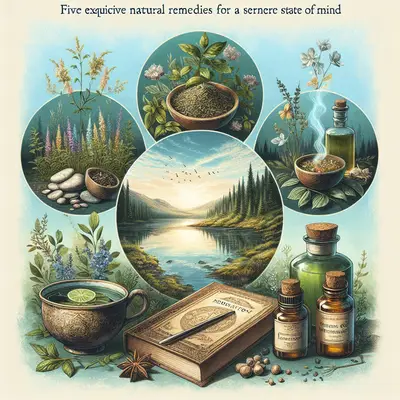
There is a particular luxury in caring for the mind with intention—choosing remedies that are gentle, precise, and quietly powerful. In a world saturated with hurried fixes and noisy wellness trends, natural remedies offer something more refined: a slow, intelligent kind of support that respects both body and mind. This is not about folklore for its own sake; it is about discerning which botanicals, rituals, and sensory experiences can meaningfully shape your mental landscape.
Below, you’ll find a curated exploration of natural approaches to mental ease—anchored in research, but elevated in execution. Woven into the narrative are five exclusive insights for those who treat their inner life with the same care they give to a well-appointed home or a perfectly tailored garment.
The Art of “Tonal” Calm: Moving Beyond Generic Relaxation
Most conversations about relaxation flatten calm into a single state—as if feeling better were simply “less stressed.” In reality, your nervous system moves through nuanced emotional tones: quiet focus, soft contentment, grounded alertness, serene detachment. Natural remedies can be selected and combined to match these finer gradations.
A warm infusion of chamomile and lemon balm, for instance, leans toward a soft, drowsy ease—ideal for evenings when your mind won’t fully release the day. By contrast, green tea or rosemary, with their gentle stimulation, are more suited to a refined alertness that doesn’t tip into agitation. When you begin to think of calm in “tones” rather than as a single destination, you can curate remedies the way one curates a playlist, fragrance wardrobe, or art collection.
Exclusive Insight #1: Design a “calm palette” instead of a single remedy.
Identify three emotional tones you value—perhaps “clear,” “soft,” and “deeply restful.” Then, associate each with specific natural supports: a bright, clarifying scent like rosemary for “clear,” a floral infusion like linden or chamomile for “soft,” and a magnesium-rich bath or lavender oil for “deeply restful.” Over time, your body learns to associate each ritual with a distinct mental state, giving you a more sophisticated toolkit than blanket relaxation.
Botanical Precision: Curating Herbs Like a Fine Collection
Herbal remedies are often spoken about in broad strokes—“this herb is calming,” “that herb is energizing.” But the most elegant approach is precise: understanding not just what an herb does, but how and when it does it.
Lavender, for example, has been studied for its potential to ease mild anxiety and promote relaxation, both in aroma and oral preparations. Passionflower is thought to gently modulate excitatory brain activity, making it particularly suited to looping, ruminative thoughts. Lemon balm has a soft, mood-brightening quality that can take the edge off mental tension without dulling you. These are not interchangeable; each has its own personality, tempo, and ideal context.
Exclusive Insight #2: Assign “roles” to your herbs.
Instead of keeping a miscellaneous collection of calming teas, designate a role for each botanical in your cabinet:
- The Diffuser: A herb for scattered, unfocused tension (often lemon balm or tulsi).
- The Grounder: A herb for overthinking and mental noise (often passionflower or skullcap).
- The Night Gatekeeper: A herb reserved for evenings when sleep feels distant (such as chamomile, valerian in careful doses, or lavender).
By giving each herb a defined role, you create a structured, almost architectural approach to mental calm—one that feels deliberate, not improvised.
Always consult a healthcare professional before starting herbal supplements, especially if you’re pregnant, nursing, on medication, or managing a health condition.
Sensory Architecture: Using Scent, Sound, and Texture as Gentle Medicine
Natural remedies are not limited to what you ingest. The environment that meets your senses acts as a kind of daily, low-dose medicine—subtle, but cumulative. Carefully curated scent, sound, and texture can become a personal “sensory architecture” that continuously invites the nervous system toward equilibrium.
A few drops of high-quality essential oil (such as lavender, bergamot, or frankincense) in a diffuser can gently signal to the brain that it is safe to soften. Soft, repetitive sounds—rain recordings, rustling leaves, a faintly humming fan—provide auditory “white space” that quiets mental clutter. Even tactile choices matter: a cool linen pillowcase, a weighted throw, or a smooth stone held in the palm can anchor you physically when your thoughts feel untethered.
Exclusive Insight #3: Establish a “sensory entry ritual” for transitions.
Rather than reserving natural sensory supports for rare spa-like moments, employ them at key transitions: when you arrive home, when you close your laptop, or when you begin your pre-sleep routine. For example:
- One specific scent that only appears when work ends for the day.
- A particular instrumental track that opens your evening.
- A single tactile object—perhaps a weighted eye pillow or a textured ceramic cup—that you touch only during your wind-down ritual.
Over time, your nervous system begins to anticipate calm at the mere suggestion of these cues, much like a well-trained palate anticipates flavor from a familiar aroma.
The Quiet Power of Micro-Nourishment
Nutritional psychiatry has emerged as a sophisticated field, exploring how what we consume influences mood, clarity, and resilience. This is not about restrictive regimes or dramatic cleanses. Instead, think of it as “micro-nourishment”—small, consistent inclusions that subtly fortify the mind.
Omega-3 fatty acids (from fatty fish like salmon or plant-based sources such as flax and chia), magnesium (found in leafy greens, nuts, seeds, and cacao), and polyphenol-rich berries appear frequently in research on mood and cognitive support. Fermented foods—yogurt, kefir, kimchi, sauerkraut—support the gut microbiome, which communicates continuously with the brain via the gut-brain axis.
Exclusive Insight #4: Treat each meal as a quiet dose of emotional infrastructure.
Instead of chasing superfoods, choose one or two mental-health-supportive ingredients to anchor most meals:
- A consistent omega-3 source several times per week (e.g., salmon, sardines, or ground flax).
- A reliable magnesium-rich element—spinach, pumpkin seeds, or a square of high-quality dark chocolate after dinner.
- A small, daily portion of fermented food to support gut-brain signaling.
The elegance lies in repetition. When these elements appear with regularity, they form an invisible scaffolding beneath your mood and mental stamina, rather than a series of sporadic “health experiments.”
Deliberate Slowness as a Natural Remedy
Among all natural remedies, time is the most undervalued—and yet, the nervous system responds exquisitely to pace. Slowness itself is medicinal. The act of choosing to do one thing at a measured tempo, even for a few minutes, can signal safety to the body in a way that herbs and supplements alone cannot.
This does not require hours of free space or dramatic lifestyle changes. It can be as simple as walking at half your usual speed for the first five minutes after you step outside, or stirring your evening tea with full attention instead of scrolling. These seemingly minor gestures are, in reality, powerful messages to the brain: we are not in crisis; we can afford to move slowly.
Exclusive Insight #5: Choose a single daily act to perform at “luxury speed.”
Select one ordinary activity—brushing your hair, applying face oil, making coffee, arranging your workspace—and commit to doing it at a fraction of your usual speed. Let this be your non-negotiable daily ritual of unhurried presence.
Over weeks, this repeated micro-gesture of slowness becomes a natural remedy of its own—training your nervous system to recognize that ease is not a rare event, but a daily standard.
Conclusion
Natural remedies for the mind are at their most powerful when approached not as desperate interventions, but as expressions of taste, care, and discernment. A thoughtfully chosen herb, a familiar calming scent, a nutrient-rich meal, a single act done at a luxurious pace—these are quiet, intelligent forms of support that accrue their effects over time.
The ultimate refinement is not a life empty of stress, but a life furnished with subtle, reliable ways to meet it. In crafting your own “quiet apothecary,” you are not merely collecting remedies; you are designing an environment—internal and external—in which your mind is consistently invited to feel both held and free.
Sources
- National Center for Complementary and Integrative Health (NCCIH) – Relaxation Techniques - Overview of evidence-based relaxation methods and their effects on stress and mental wellbeing.
- Mayo Clinic – Lavender: A Calming Herb - Discusses the potential uses of lavender for anxiety and relaxation, including safety considerations.
- Harvard Health Publishing – Nutritional Psychiatry: Your Brain on Food - Explores how diet influences mood and mental health through the gut-brain connection.
- Cleveland Clinic – Magnesium and Your Health - Reviews the role of magnesium in the body, including its impact on stress, sleep, and muscle relaxation.
- American Psychological Association – The Gut-Brain Connection - Examines research on how the gut microbiome interacts with the brain and affects mood and anxiety.
Key Takeaway
The most important thing to remember from this article is that this information can change how you think about Natural Remedies.