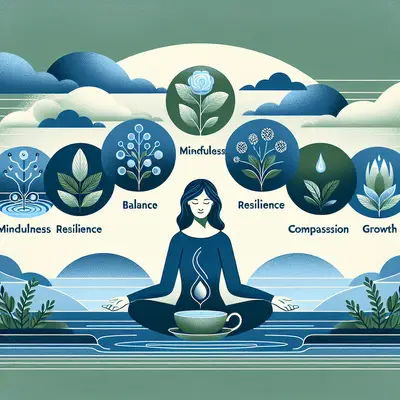
In a world that constantly invites us to scatter our attention, a resilient mind is no longer a luxury—it is a private form of quiet architecture we curate for ourselves. Mental wellness is not merely the absence of distress; it is the deliberate crafting of inner rooms where clarity, composure, and nuance can exist without being rushed. At Calm Mind Remedies, we treat mental wellness as an elevated practice: something you design with intention, rather than something you passively hope to stumble upon.
What follows is not a list of quick fixes, but a collection of refined, quietly powerful practices—subtle shifts that feel less like “self-help” and more like the ongoing curation of a life you actually want to inhabit. These insights are meant to be savored, revisited, and shared with those who understand that the most exquisite upgrades are often the ones no one else can see.
1. Curating Mental Inputs Like a Private Gallery
Just as a curator selects each piece in a gallery to shape an emotional experience, your mind is constantly arranging the “art” of what you consume—news, conversations, social media, physical environments. Most people allow these inputs to arrive by accident, then wonder why their inner world feels cluttered, noisy, or harsh. Mental wellness begins to shift when you approach your inputs with the discernment of a gallery director rather than a passive attendee. That means auditing your feeds, your inbox, the people you text first thing in the morning, and the soundscape of your day.
Refined mental care is not about total avoidance; it is about selective exposure. You can still be informed without bathing in outrage. You can still be ambitious without marinating in comparison. Imagine your attention as a limited number of “invitations” you send each day—only a chosen few influences should earn their place on that guest list. Over time, this quiet curation doesn’t just change what you see; it transforms how you feel, what you believe is possible, and the emotional tone of your inner monologue.
2. Emotional Granularity: Upgrading Your Inner Vocabulary
Most of us have been taught to describe our emotional states in blunt categories: “stressed,” “fine,” “tired,” “overwhelmed.” This lack of nuance quietly impoverishes our self-understanding. Emotional granularity—naming your inner world with precision—is a sophisticated upgrade in how you relate to yourself. Instead of “I feel bad,” you begin to recognize, “I feel under-stimulated and restless,” or “I feel quietly disappointed but not hopeless,” or “I feel socially saturated yet still lonely.”
This refinement matters because the nervous system responds differently depending on the specific emotion at play. Restlessness may call for creative expression, while depletion requires genuine rest, and quiet grief needs gentleness and spaciousness. When you label your experience accurately, you can choose a remedy that actually fits. A resilient mind is not one that never struggles; it is one that can distinguish between its shades of struggle. Expanding your emotional vocabulary—through journaling, reading, or therapy—is a premium investment in psychological clarity that pays dividends in every relationship, especially the one you have with yourself.
3. Designing Micro-Rituals as Invisible Nervous System Anchors
Grand routines often fail because life is rarely that accommodating. Micro-rituals, however, are small, repeatable gestures that become quiet anchors for your nervous system. They take less than a few minutes, require almost no setup, and can be woven into your existing day without fanfare. Think of a deliberate 30-second pause before opening your laptop, a specific way you make your tea or coffee, a single deep breath every time you close a door, or a brief check-in question before bed: “What did my mind handle well today?”
The elegance of micro-rituals is that they are both understated and potent. By pairing them with existing habits—sitting in the car, washing your hands, waiting for a page to load—you create an architecture of calm that travels with you. Over time, your body begins to associate these tiny acts with safety and stability, lowering baseline tension without you having to “try harder” to relax. These rituals are not public performances of wellness; they are private agreements between you and your nervous system that say: “We will not rush ourselves to the point of fracture.”
4. Practicing Boundaried Compassion: Caring Without Absorbing
Many people seeking mental wellness are deeply empathetic, and this sensitivity, while beautiful, can become quietly exhausting. Boundaried compassion is the art of caring deeply without allowing another person’s emotional weather to become your permanent climate. It is the difference between sitting with someone in the rain and deciding to live indefinitely in a storm that was never yours to begin with. This is not coldness; it is a sophisticated form of self-respect.
Practically, boundaried compassion might mean listening fully but refusing to replay the conversation in your mind all night. It might mean saying, “I care so much about you, and I also need to protect my energy—can we talk about solutions rather than only revisiting the pain?” It may look like declining certain conversations when you are already emotionally saturated. The nervous system is not designed to carry the full weight of everyone you love. When you honor that limitation, your empathy becomes more sustainable, less resentful, and more precise. You remain available, but not absorbent—a vessel with a strong, intact shape rather than a sponge that soaks up everything nearby.
5. Treating Rest as a Strategic Asset, Not a Moral Failure
In many modern cultures, rest is treated like a guilty indulgence—something to be earned, justified, or explained away. A refined approach to mental wellness reframes rest as a strategic asset: an intelligent allocation of resources that allows your mind to perform at a higher, more sustainable level. You would never expect a finely tuned instrument to play with clarity if it were never re-tuned; yet we routinely expect our minds to produce insight, empathy, creativity, and focus without ever stepping out of demand-mode.
There are different tiers of rest: sensory (reducing light, sound, and screens), cognitive (ceasing active problem-solving), emotional (taking a break from emotionally taxing conversations), and social (pausing performative interaction). When you begin to discern which type of rest you’re actually starving for, your recovery becomes more precise and effective. The most powerful shift is psychological: you stop seeing rest as evidence of weakness and start regarding it as a mark of discernment. In this light, choosing rest is not opting out of your life but preserving the clarity with which you live it.
Conclusion
Mental wellness, at its most elevated, is not a performance; it is a quiet standard you hold for the way you treat your own mind. By curating your inputs like a gallery, enriching your emotional vocabulary, weaving in micro-rituals, practicing boundaried compassion, and regarding rest as a strategic asset, you are not merely coping—you are designing a more livable interior world. These are subtle shifts, often invisible from the outside, yet they add up to a form of inner luxury that no one can revoke.
Share these practices with the people in your life who value depth over spectacle and substance over quick fixes. The architecture of a resilient mind is built slowly, but once it stands, it becomes the most exquisite place you know.
Key Takeaway
The most important thing to remember from this article is that this information can change how you think about Mental Wellness.