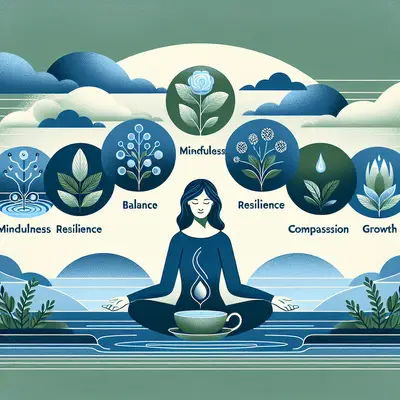
Mental wellness is not an accidental state; it is an architecture—quietly designed, attentively maintained, and refined over time. In a world saturated with noise and urgency, a resilient mind becomes a form of discreet luxury: it moves through uncertainty with poise, recovers from disruption with grace, and protects its own clarity with intention.
This piece explores a more elevated approach to mental well-being—one that favors discernment over trends and depth over quick fixes. At its center are five exclusive insights that go beyond generic advice, offering a more nuanced path for those who wish to cultivate mental resilience as thoughtfully as they curate the rest of their lives.
Reframing Mental Wellness as Emotional Craftsmanship
For many, mental wellness is treated as damage control: something to address only when life becomes unmanageable. A more refined approach considers mental wellness as ongoing craftsmanship—an art of shaping one’s inner world with the same care given to a beautifully designed space or a carefully curated wardrobe.
This shift in perspective changes the conversation. Instead of asking, “How do I stop feeling stressed?” the question becomes, “How do I design the conditions in which my mind feels safe, clear, and inspired?” Emotional craftsmanship acknowledges that our internal state is shaped by micro-choices: the way we begin our mornings, how we respond to minor irritations, the boundaries we honor around our time and attention.
A crafted inner life does not seek perfection or constant calm; it seeks coherence. It allows for a full range of emotions but insists on a consistent foundation of self-respect, self-awareness, and self-trust. From this vantage point, mental wellness is not solely about coping—it is about curating.
Exclusive Insight 1: The Practice of Cognitive Minimalism
Just as a beautifully designed room gains its elegance from what is not there, a refined mind benefits from cognitive minimalism—the deliberate reduction of unnecessary mental clutter.
Cognitive minimalism is not about thinking less; it is about thinking more selectively. This includes limiting low-quality input (doom-scrolling, performative outrage, constant notifications) and reserving your cognitive energy for what truly matters. Research shows that every switch in attention carries a cognitive cost, gradually eroding decision-making quality and emotional regulation over the day.
A cognitively minimalist routine might include:
- Designated “information windows” instead of constant checking of news or messages
- A deliberate pause before engaging with emotionally charged content
- A short evening review to mentally “file away” key events and release the rest
The result is an internal environment that feels less crowded, less reactive, and more discerning—an ideal condition for mental resilience to flourish.
Exclusive Insight 2: Emotional Range as a Marker of Strength, Not Instability
In many high-performing or aesthetically driven lifestyles, there is subtle pressure to be “unbothered” at all times. Yet the most resilient minds are not those that feel the least—they are those that can feel widely, deeply, and still remain anchored.
Emotional range is the capacity to experience a broad spectrum of feelings without becoming defined or derailed by them. Instead of labeling emotions as “good” or “bad,” a sophisticated approach treats them as data: information about needs, values, boundaries, and desires.
For example:
- Irritation may be data about a boundary being crossed
- Envy may be data about an unlived desire
- Sadness may be data about what you deeply value
Research in affect labeling (the simple act of naming emotions) suggests that identifying what we feel can reduce the intensity of emotional activation in the brain, allowing greater clarity and control. This transforms emotions from internal chaos into a refined, living feedback system—subtle, precise, and deeply informative.
Exclusive Insight 3: Building a “Recovery Reserve” Instead of Waiting for Burnout
Most people treat rest as a reaction to exhaustion. A more elevated approach is to create a “recovery reserve”—a built-in buffer of restoration that prevents your internal systems from running on fumes.
Think of this as the emotional and cognitive equivalent of maintaining a luxury car: you don’t wait for the engine light to flash before scheduling service. You respect the mechanism enough to care for it proactively.
A recovery reserve is constructed not only through sleep and vacations but through understated daily rituals that are non-negotiable:
- A consistent wind-down ritual that signals to your nervous system that the day is complete
- Micro-pauses between tasks to allow mental reset and prevent cognitive fatigue
- Protected time during the week where you are not “available on demand” to others
Over time, this reserve becomes visible in your life: you respond instead of react, recover more quickly from disruption, and experience pressure without the chronic undertone of depletion. Your baseline becomes steadier, which is the essence of true resilience.
Exclusive Insight 4: Curated Relationships as Mental Hygiene
Mental wellness is often discussed as a purely internal project, yet the people surrounding us act as powerful regulators of our emotional and cognitive state. Curated relationships are not about exclusivity for its own sake; they are about mental hygiene—an intentional protection of one’s psychological ecology.
This means discerning:
- Who leaves you more grounded after conversation, and who leaves you mentally scattered
- Which relationships invite authenticity, and which reward performance or emotional suppression
- Whether your closest connections normalize chronic stress or gently reinforce balance
Neuroscience has shown that human nervous systems co-regulate; we subtly synchronize with the emotional tone of those around us. When your close circle is characterized by calm, emotional honesty, and a refusal to glorify burnout, your own capacity for stability increases quietly but significantly.
Curating relationships is not a dramatic purge; it is a gradual reweighting of attention and access. You offer your time most generously to those who support your most balanced and expansive self—and in doing so, you reinforce your own mental wellness as a lived priority.
Exclusive Insight 5: Treating Attention as Your Most Luxurious Asset
Among all modern resources, attention has become the rarest and most contested. A refined approach to mental wellness recognizes that what you repeatedly give your attention to becomes the architecture of your inner life.
Treating attention as a luxury means:
- Being selective about what earns your sustained focus
- Avoiding constant multitasking, which has been shown to impair performance and increase perceived stress
- Designing environments—both digital and physical—that reduce unintentional distraction
Attention can be thought of as the mind’s currency. When it is scattered, everything feels slightly impoverished—conversations, work, rest, even pleasure. When it is gathered, directed, and defended, life acquires a different texture: experiences feel richer, decisions feel cleaner, and your sense of self becomes more coherent.
One elegant daily practice is to choose a single activity—tea, a walk, a conversation, a creative task—and offer it your undivided attention for a defined period. No multitasking, no background noise of notifications. This is not just productivity advice; it is a subtle act of reclaiming your inner sovereignty.
Conclusion
A resilient mind is not loud, performative, or endlessly striving. It is quietly structured, attentively maintained, and deeply respectful of its own limits and capacities.
By embracing cognitive minimalism, honoring emotional range, building a recovery reserve, curating relationships, and treating attention as a luxurious asset, mental wellness becomes something more than symptom management—it becomes a cultivated standard of living.
In a culture that often celebrates constant acceleration, the decision to design your inner world with intention is radical in the most elegant way. It is a statement that your mind is not a battlefield or a productivity machine, but a space worthy of architecture, craftsmanship, and enduring care.
Sources
- National Institute of Mental Health – Caring for Your Mental Health – Overview of evidence-based practices for maintaining mental wellness
- Harvard Health Publishing – The Importance of Rest for Mental Health – Explores how breaks and rest improve cognitive function and emotional regulation
- American Psychological Association – Multitasking: Switching Costs – Summarizes research on how task-switching affects performance and stress
- Greater Good Science Center, UC Berkeley – How Labeling Emotions Helps Us – Discusses affect labeling and its impact on emotional intensity and anxiety
- Mayo Clinic – Social Support: Tap This Tool to Beat Stress – Explains how supportive relationships influence stress and overall mental health
Key Takeaway
The most important thing to remember from this article is that this information can change how you think about Mental Wellness.