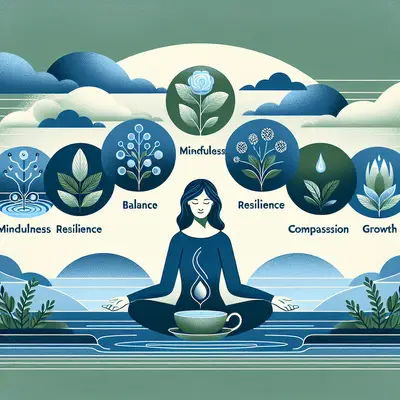
Modern life rewards speed, noise, and visible achievement. Mental wellness, in contrast, is a quiet art—subtle, internal, and deeply personal. For the discerning mind, true well-being is not about quick fixes or wellness trends; it is about cultivating an inner environment so considered and deliberate that calm becomes your default, not a rare event.
Below, you’ll find five exclusive insights—less techniques, more refined shifts in orientation—that elevate mental wellness from “coping” to “curating” the quality of your inner life.
1. Treat Your Attention as a Luxury Asset, Not a Casual Resource
Most people behave as though attention is infinite—something to scatter across notifications, headlines, and endless scrolling. Yet from a mental wellness perspective, attention is your most exquisite currency. Where it goes, your nervous system follows.
Begin to regard your attention as a luxury asset that deserves curation:
- Create intentional thresholds. Before opening email, social media, or news, pause for one conscious breath and silently decide: What is my purpose here? This micro-intention shifts your mind from reactivity to selectivity.
- Design your “prime hours.” Protect the first 60–90 minutes after waking and the last 60 minutes before sleep as premium mental real estate—no trivial inputs, no agitating content. Reserve these windows for reflection, reading, stretching, or a quiet beverage ritual.
- Establish a digital etiquette with yourself. Imagine your mind as a refined lounge, not a crowded train station. Ask: Does this input merit entry? You are not restricting your life; you are elevating its quality.
When attention is treated with this level of discernment, anxiety often softens without a single “tool” being added. The mind finally has room to breathe.
2. Curate an Inner Tone, Not Just Better Thoughts
Conventional advice focuses on “challenging negative thoughts.” Useful, yes—but somewhat blunt. A more sophisticated approach is to cultivate an inner tone: the subtle emotional flavor of how you speak to yourself beneath the surface of your thinking.
Consider the difference between:
- “I need to fix myself” versus “I’m learning how to support myself.”
- “I failed again” versus “I’m collecting data on what doesn’t work—useful information.”
The words may seem small, but the tone is radically different. To refine your inner tone:
- Listen for your background narration. Throughout the day, briefly notice: If my self-talk had a voice, would it be harsh, rushed, clinical, or quietly encouraging? Do not judge; simply recognize.
- Upgrade your vocabulary of self-regard. Replace blunt inner commentary (“I’m a mess,” “I’m behind”) with more accurate, dignified language (“I’m under strain,” “My capacity is limited today, and that’s human”).
- Practice tonal alignment. Let your inner tone match how you would speak to someone you deeply respect who is having a difficult week—not a difficult life.
Mental wellness becomes less about constantly managing thoughts and more about inhabiting a gentler internal climate.
3. Build a “Nervous System Reserve” Instead of Living at the Edge
Many people operate at a hidden deficit—psychologically “overdrafted”—without realizing it. They push until they collapse, then call rest a “luxury.” A more refined approach is to maintain a nervous system reserve: a buffer of calm that ensures you’re not perpetually functioning at your edge.
Think of this as elegant, preventative mental care:
- Replace only-reactive rest with pre-emptive restoration. Do not wait for burnout signals (irritability, brain fog, emotional numbness) to justify rest. Integrate small restoration practices—5 minutes of quiet, tech-free walks, slow breathing—long before you feel desperate for them.
- Let recovery be proportional to demand. Intense emotional or cognitive days deserve meaningful decompression, not merely collapsing in front of a screen. A warm shower with low light, journaling in a single sentence, or a slow, solitary cup of tea can act as rituals of closure.
- Adopt “micro-release moments.” Several times a day, consciously soften your jaw, lower your shoulders, and exhale slowly. This communicates safety to the nervous system—tiny signals that steadily reconstitute your reserve.
Over time, you cease to view calm as an occasional break from stress and begin to see it as the foundation from which you engage life.
4. Create an Intentional Emotional Aesthetic for Your Life
We pay careful attention to aesthetics in clothing, interiors, and travel—yet often ignore the emotional aesthetic of our days. What should your internal atmosphere feel like, at its best? Understated ease? Quiet assurance? Light curiosity?
Mental wellness deepens when you deliberately design for that feeling:
- Name your signature emotional atmosphere. Choose one or two adjectives that describe how you want your inner world to feel most of the time, not occasionally. Examples: “unhurried and steady,” “spacious and clear,” “attentive and warm.”
- Let this inform your environment. If your desired atmosphere is “spacious and clear,” declutter your digital and physical spaces—fewer tabs, fewer open loops. If it is “attentive and warm,” integrate soft lighting, textured fabrics, and a dedicated chair or corner for quiet moments.
- Curate your inputs like a gallery. Music, conversations, accounts you follow, and even the pace of your schedule either align with or erode your chosen emotional aesthetic. Adjust accordingly, subtly but steadily.
This is not about constructing a flawless life; it is about aligning daily choices with an inner signature mood—so your mind doesn’t live in emotional contradiction.
5. Honor Emotional Subtlety as a Sign of Mental Sophistication
A refined approach to mental wellness recognizes that emotions are rarely singular or simple. You can be relieved and sad, grateful and disappointed, hopeful and exhausted—all at once. The ability to hold this complexity without demanding tidy resolutions is a mark of psychological maturity.
To honor emotional subtlety:
- Move beyond “good” vs. “bad” days. Instead, ask: What are the three main feelings present in me today? Name them without ranking them. This widens your emotional vocabulary and loosens the grip of all-or-nothing thinking.
- Allow mixed feelings without self-critique. You can cherish someone and feel frustrated with them. You can love your work and feel momentarily disenchanted by it. There is no betrayal in layered emotions; they are a realistic response to a nuanced life.
- Use gentle witnessing instead of instant fixing. When a feeling arises, try: Something in me feels anxious right now, rather than I am anxious. This small linguistic distance allows you to observe emotion without becoming entirely merged with it.
By treating your emotional life with this level of nuance, you reduce the pressure to “feel right” and gain the freedom to simply feel—and still remain grounded.
Conclusion
Mental wellness at its highest expression is not a performance; it is a private standard. It evolves quietly in the way you handle your attention, in the tone of your self-talk, in the reserves you protect, in the emotional aesthetic you curate, and in the subtlety with which you honor your inner life.
These five shifts are not tasks to complete, but orientations to return to—gently, repeatedly. Over time, they transform mental wellness from something you chase into something you quietly embody: less spectacle, more substance; less friction, more understated ease.
Sources
- National Institute of Mental Health – Caring for Your Mental Health – Overview of foundational practices and perspectives for maintaining mental health
- American Psychological Association – Building Your Resilience – Explores the role of resilience, recovery, and adaptive coping in psychological well-being
- Harvard Health Publishing – The Importance of Rest for Mental Health – Discusses how rest, recovery, and nervous system regulation support long-term mental wellness
- Greater Good Science Center, UC Berkeley – What Is Self-Compassion? – Explains the science and practice of kinder inner dialogue and self-regard
- Mayo Clinic – Stress Management – Provides evidence-based guidance on reducing stress and supporting emotional balance
Key Takeaway
The most important thing to remember from this article is that this information can change how you think about Mental Wellness.