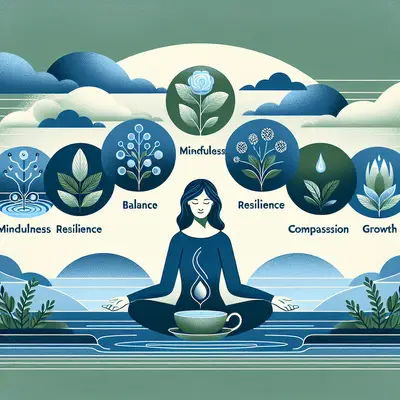
Mental wellness, at its most refined, is less about dramatic breakthroughs and more about cultivating a subtle, enduring elegance in how you relate to your own mind. In a culture that glorifies constant optimization, true mental refinement feels almost subversive: it is spacious, unhurried, and deeply attuned to nuance. This is the realm where mental wellness becomes a craft—where attention, rest, and self-regard are treated as luxuries you deliberately curate, not afterthoughts you fit between obligations.
Below are five exclusive, quietly powerful insights for those who no longer want quick fixes, but a more elevated, artful relationship with their inner world.
Insight 1: Treat Your Inner Dialogue as an Interior Design Project
Most advice focuses on “positive thinking,” which can feel forced and unsophisticated. A more elevated approach is to think of your inner dialogue as the acoustic design of a private residence: subtle, layered, and intentional.
Rather than trying to “think positive,” consider the texture of your thoughts. Are they sharp, rushed, and brittle? Or spacious, precise, and measured? Start by editing your self-talk the way a designer edits a room:
- Remove mental “clutter words” like always, never, and should that create harsh, absolute judgments.
- Replace vague self-criticism (“I’m failing”) with specific, observational language (“This deadline is tight, and I’m under-resourced”).
- Introduce a neutral, almost journalistic tone when you speak to yourself about setbacks—less courtroom, more art gallery description.
Over time, your internal environment becomes less like a crowded, fluorescent office and more like a carefully lit, thoughtfully curated space. Mental wellness, in this sense, is not about denial of difficulty; it is about upgrading the aesthetic of how you narrate your life to yourself.
Insight 2: Align Your Nervous System With Your Calendar
Most people schedule their time and then hope their nervous system will cooperate. A more refined strategy reverses this: you design your commitments to harmonize with your physiology rather than constantly pushing against it.
This begins with noticing your natural rhythms: when your mind feels clearest, when your body subtly protests, when social interaction nourishes you versus depletes you. Instead of merely “time blocking,” consider “nervous system blocking”:
- Place cognitively demanding tasks in your naturally alert windows.
- Reserve transition buffers—micro-intervals of quiet—between emotionally demanding calls or meetings.
- Protect one zone of the day as a nervous system sanctuary: no difficult conversations, no news scroll, no administrative clutter.
When your schedule respects the ebb and flow of your nervous system, stress stops being a constant baseline and returns to its proper role: an occasional visitor, not a full-time resident.
Insight 3: Curate Information Intake With the Standards of a Private Club
Mental wellness is increasingly shaped by what we consume psychologically, not only by what we feel. A sophisticated mind does not allow its attention to be treated as a public utility. It is curated—like a membership list.
Instead of vague “digital detox” rules, adopt the mindset of a meticulous gatekeeper:
- Ask, before you open any app or article: What is the emotional cost of this information, and what is the return?
- Guard your mornings from low-quality mental inputs: inflammatory headlines, outrage-driven commentary, and shallow comparisons.
- Treat your attention as a premium asset—something that must be earned by depth, nuance, or genuine nourishment.
Over time, this curation reshapes your internal climate. The background hum of anxiety softens when you are no longer outsourcing your mental atmosphere to algorithms. Your mind becomes a more dignified place to inhabit—less noisy, more discerning, and more capable of subtle thought.
Insight 4: Redefine Rest as a High-Fidelity Mental Reset
Many people confuse distraction with rest. Streaming a show while scrolling a second screen is not restorative; it is stimulus layered on more stimulus. A premium approach to mental wellness treats rest as a high-fidelity reset—clean, intentional, and minimal.
Consider upgrading your concept of rest along three dimensions:
- Sensory purity: Choose one primary sensory experience at a time—music without conversation, a walk without a podcast, a bath without notifications.
- Cognitive spaciousness: Opt for activities that don’t require constant micro-decisions—gentle movement, looking out a window, unstructured journaling.
- Emotional softness: Select rest that allows feelings to surface without being immediately overridden—quiet time, low-light evenings, slow conversation with a trusted person.
This kind of rest may look uneventful from the outside, but internally it is exquisite. It gives the mind room to re-order, integrate, and breathe. Over days and weeks, your tolerance for stress expands—not because you push harder, but because you are truly restoring at a deeper level.
Insight 5: Practice Discreet Self-Compassion, Not Grand Self-Care
The phrase “self-care” has been stretched to the point of cliché. What genuinely transforms mental wellness, especially for a discerning mind, is discreet self-compassion: subtle, almost private gestures of respect toward your own limits and needs.
Rather than centering elaborate routines, focus on micro-decisions that communicate quiet loyalty to yourself:
- Ending a conversation five minutes earlier than politeness demands because you feel your energy fading.
- Choosing a slightly earlier bedtime even when another episode beckons.
- Allowing yourself to be “human-grade” instead of “performance-grade” on days when life is already heavy.
These are not dramatic acts, yet they recalibrate your internal hierarchy. Your well-being stops being an afterthought and becomes a default assumption: I am not required to abandon myself to be worthy, successful, or loved. That understanding, lived consistently in small ways, is one of the most luxurious states a mind can inhabit.
Conclusion
Mental wellness at a refined level is not about chasing perfection, nor about constructing an aesthetic of calm for others to admire. It is a quieter ambition: to live inside a mind that feels well-designed, well-defended, and deeply respectful of its own complexity.
By tending to your inner dialogue like an interior space, aligning your schedule with your nervous system, curating information as if your attention were a rare asset, elevating rest into a true reset, and practicing discreet self-compassion, you create something rare in a frantic world: psychological elegance.
This is not a quick transformation but an ongoing edit—subtle, deliberate, and entirely worth the care.
Sources
- National Institute of Mental Health – Caring for Your Mental Health - Overview of evidence-based practices for supporting mental well-being
- American Psychological Association – Stress Effects on the Body - Explains how stress interacts with the nervous system and why regulation matters
- Harvard Health Publishing – The Importance of Rest and Sleep - Details the role of quality rest in cognitive and emotional health
- Greater Good Science Center, UC Berkeley – What Is Self-Compassion? - Research-based exploration of self-compassion and its mental health benefits
- Pew Research Center – News Consumption and Mental Health - Data on information intake patterns and their broader implications
Key Takeaway
The most important thing to remember from this article is that this information can change how you think about Mental Wellness.