There is a particular kind of calm that feels less like escape and more like arrival—a composed, unhurried clarity that lingers beneath the noise of daily life. This is the terrain of natural calm: not sedation, not distraction, but a cultivated ease of mind anchored in the body, the senses, and quietly intelligent rituals. For those who value discernment in their wellness choices, natural remedies are not about chasing the latest trend; they are about curating a personal ecosystem of practices and botanicals that feel both effective and exquisitely considered.
Below, you’ll find a refined exploration of natural mental wellness, including five exclusive insights designed for readers who seek more than generic advice—who prefer their calm to be deliberate, elegant, and deeply grounded in both science and subtlety.
Reframing “Natural”: From Quick Fix to Daily Design
“Natural remedy” is often misread as something you simply take—a capsule, a tea, a tincture. A more sophisticated view is to see natural calm as something you design: a combination of environment, rhythm, and carefully chosen supports that act together over time.
A well-curated natural approach considers three layers. First is the physical foundation: sleep quality, gentle movement, blood sugar balance, and hydration. If these are off, no herb or essential oil will fully compensate. Second is the sensory environment: light, sound, scent, and texture all speak directly to the nervous system, often faster than conscious thought. Third is the subtle layer of intention: the rituals and micro-habits that signal to your mind that it is safe to soften.
The aim is not to switch stress “off,” but to give your biology multiple cues of safety and sufficiency. High-performing minds, in particular, benefit from this layered approach. Instead of merely calming a racing mind, you are retraining it—gently, persistently—to recognize that not every alert deserves an alarm.
The Nervous System as Your Most Discerning Instrument
The modern nervous system is overstimulated, under-recovered, and rarely allowed to complete a full cycle from activation to release. Yet it is also exquisitely responsive to nuance. Understanding this responsiveness is the key to using natural remedies in a truly elevated way.
At its simplest, your autonomic nervous system toggles between sympathetic (alert, mobilized) and parasympathetic (rest, repair) states. Chronic stress can hold you in a subtle but constant state of “almost-alert,” which feels productive in the short term but erodes clarity and mood over time. Natural supports—botanical, sensory, and behavioral—don’t override this system; they whisper different instructions to it.
Gentle breath practices, warm beverages, weighted fabrics, and certain botanicals (such as chamomile or passionflower) all communicate safety through different channels. This is why a cup of herbal tea, taken in silence, feels different from the same tea gulped at your desk. The remedy is never just the substance; it is the context, the pace, the posture. Elevating your mental wellness means curating all of these details with intention.
Five Exclusive Insights for the Discerning Mind
1. Treat Calm as a Rhythm, Not a Reward
Many people approach calm as something they “earn” after a demanding day. A more refined approach is to see calm as a rhythm you return to repeatedly, in small, almost invisible intervals.
Instead of one large evening ritual, consider multiple micro-pauses: a 90-second breathing reset between calls, a quiet sip of lemon balm tea before opening your inbox, 5 minutes of outdoor light before your first screen. These small signals accumulate; they prevent your stress response from escalating unchecked.
Natural remedies—adaptogenic herbs, calming teas, or aromatherapy—are most effective when they support a pre-existing rhythm of restoration. Think of them as amplifiers of a pattern you are already committed to, not as compensations for a lifestyle that never pauses.
2. Use Botanicals as Companions, Not Crutches
Well-chosen botanicals can be remarkable allies for mental ease, but their sophistication lies in how they are used, not merely in their names or origins. A discerning approach starts with understanding their different “personalities.”
For instance, ashwagandha and rhodiola are often grouped together as adaptogens, yet they feel very different in practice. Ashwagandha tends toward grounding and can be particularly supportive in the evening for those who feel wired yet exhausted. Rhodiola, by contrast, may feel clarifying and gently energizing, making it more suitable earlier in the day for stress-related fatigue. Similarly, lavender may calm both mind and body, while lemon balm offers a softer, more uplifting ease.
Rather than building a crowded supplement shelf, choose two or three botanicals that match your specific patterns of stress—racing thoughts, tension, irritability, or depleted focus—and rotate them seasonally. This keeps your practice intentional and allows you to actually notice how each plant is affecting you.
3. Curate a “Sensory Signature” for Calm
One subtle yet powerful insight: your nervous system learns to associate specific sensory combinations with emotional states. You can use this to your advantage by designing a “sensory signature” that your body begins to recognize as calm.
Select one or two scents (such as high-quality lavender, neroli, or sandalwood), a particular type of light (a warm lamp or candle), a specific fabric (a favorite robe, throw, or shawl), and perhaps a consistent soundscape (gentle instrumentals, nature sounds, or even considered silence). Use this same combination whenever you engage in restorative practices—meditation, journaling, reading quietly, or an evening wind-down.
Over time, simply encountering that familiar scent or texture can begin to downshift your nervous system within minutes. This is where natural remedies transcend “nice extras” and become precision tools for mental state-shifting. The key is consistency: same elements, same intention, repeated often enough that your body learns the pattern.
4. Reserve One Space in Your Home for Uncomplicated Quiet
In a world where every corner of the home can be colonized by devices and notifications, having even a small, strictly protected area dedicated to mental ease becomes a powerful natural remedy in its own right.
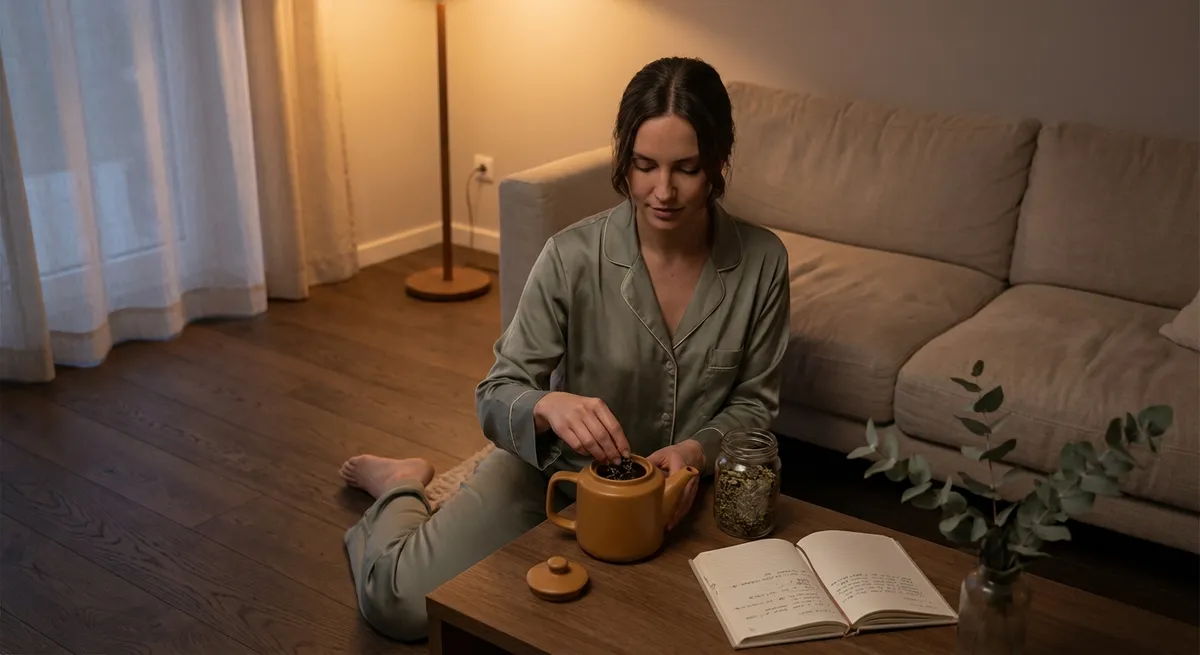
This space need not be elaborate—a particular chair, a corner by a window, a place at the dining table that you only use for unhurried mornings or reflective evenings. The refinement lies in its boundaries. No laptop. No active notifications. No multitasking. Ideally, this space is paired with your sensory signature of calm: a familiar scent, warm light, perhaps a calming tea.
When your body recognizes that “we only sit here to slow down,” the physical act of entering that space becomes part of your remedy. Over time, this turns into a kind of architectural nervous system cue: your environment co-operates with your inner life rather than competing with it.
5. Elevate Hydration into a Nervous-System Ritual
Hydration is often discussed in purely physical terms, but subtle dehydration can contribute to fatigue, irritability, and difficulty concentrating—quietly eroding mental wellness. Instead of viewing water as a checkbox, consider elevating it into a nervous-system ritual.
Infuse still or lightly sparkling water with ingredients that have gentle calming or clarifying properties: slices of cucumber and fresh mint, a twist of lemon with a sprig of rosemary, or a few crushed berries with basil. These additions are not merely aesthetic; they engage your senses, slow your drinking pace, and create a moment of attentiveness rather than automatic consumption.
Sipping slowly, seated, and undistracted turns a basic physiological need into a daily re-centering practice. This is the essence of a premium approach to natural remedies: using what is ordinary—water, light, scent, touch—and rendering it deliberate and soothing through detail and care.
Natural Remedies as Subtle Architecture for the Mind
The most elegant mental wellness practices rarely announce themselves. They do not demand hour-long routines or exotic ingredients. Instead, they function like subtle architecture: small, intentional structures that quietly support how you think, feel, and recover throughout the day.
By treating calm as a rhythm rather than a reward, using botanicals as companions instead of crutches, curating a personal sensory signature, protecting even one small space for uncomplicated quiet, and elevating simple hydration into a ritual, you create a refined ecosystem for mental ease. Natural remedies, in this context, are not isolated solutions but integral elements in a beautifully designed way of living.
Over time, the result is not just fewer anxious moments or better sleep, but a deeper sense of being internally composed—regardless of how demanding your outer world may be.
Sources
- National Center for Complementary and Integrative Health (NCCIH) – Stress and Relaxation Techniques – Overview of evidence-based approaches to stress management, including mind-body practices
- Harvard Health Publishing – Understanding the Stress Response – Explains how the autonomic nervous system and stress hormones affect the body and mind
- Mayo Clinic – Herbal Supplements and Mental Health – Discusses safety, efficacy, and considerations when using herbal remedies
- Cleveland Clinic – Adaptogens: What You Need to Know – Reviews adaptogenic herbs like ashwagandha and rhodiola and how they may influence stress resilience
- Sleep Foundation – The Role of Relaxation in Sleep Quality – Details how calming routines and sensory cues support better rest and nervous-system regulation
Key Takeaway
The most important thing to remember from this article is that this information can change how you think about Natural Remedies.